This learning resource is available in interactive and printable formats. The interactive worksheet can be played online and assigned to students. The Printable PDF version can be downloaded and printed for completion by hand.
This passage explores the Montgomery Bus Boycott of 1955-1956, focusing on the use of economic pressure by the African American community to challenge segregation in public transportation. Students will analyze the causes and consequences of the boycott, consider multiple perspectives—including those of black citizens, white officials, and local businesses—and examine the strategic use of nonviolent protest. The passage integrates primary source evidence and academic vocabulary, supporting the development of historical reasoning skills. Activities include a multiple-choice quiz, explanatory writing prompts, and a graphic organizer, all aligned to C3 Framework and Common Core ELA standards. Timeline events help clarify the sequence of key moments. This resource also features a read aloud audio and a Spanish translation, making it accessible for diverse learners. Keywords include Montgomery Bus Boycott, economic pressure, civil rights, and protest.
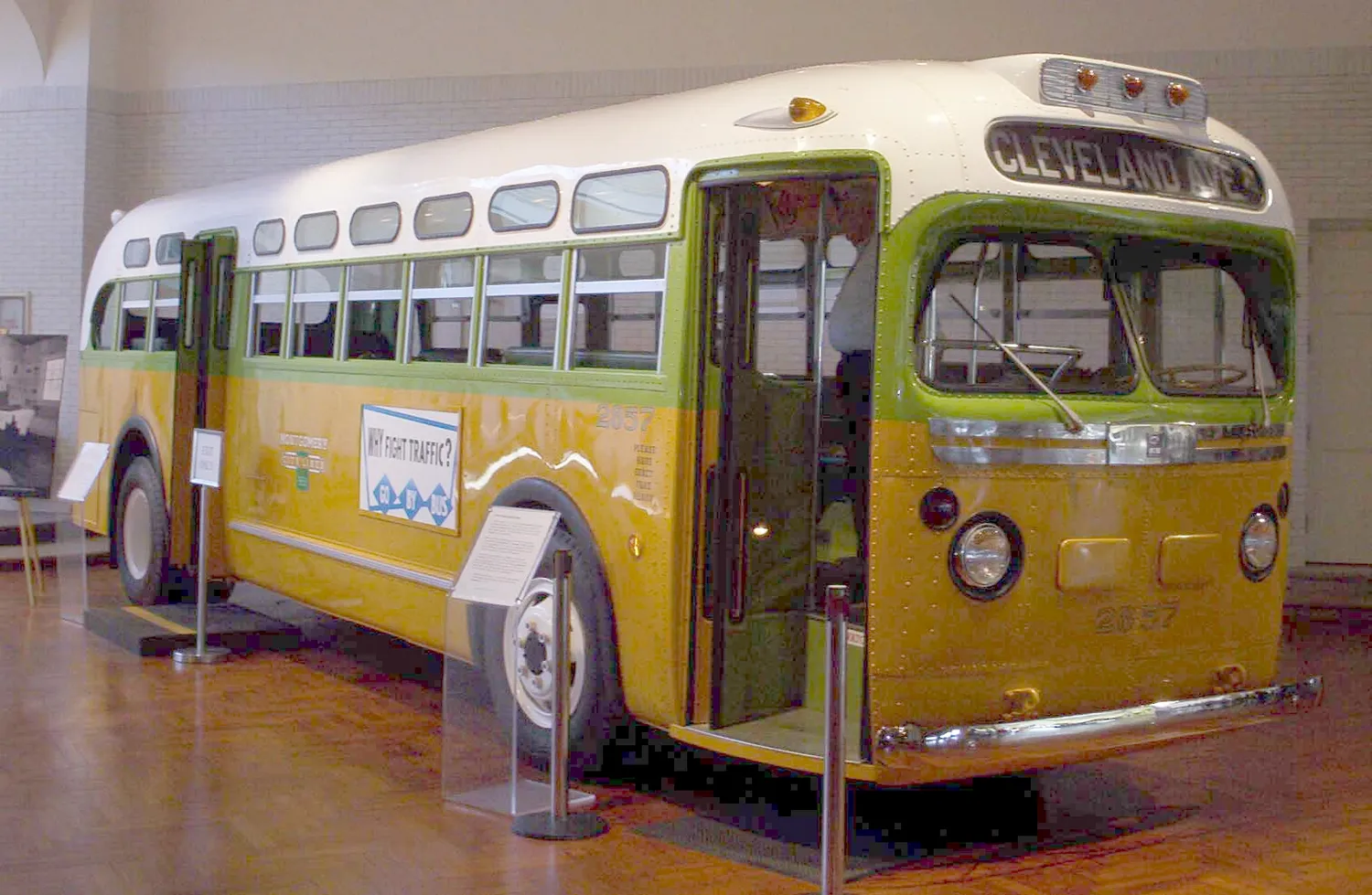
The Montgomery City Lines bus that sparked the Montgomery bus boycott, on display at the Henry Ford Museum in Dearborn, Michigan
The Montgomery Bus Boycott of 1955-1956 was a major turning point in the American civil rights movement. For over a year, African American citizens in Montgomery, Alabama refused to ride city buses, protesting the city’s laws enforcing racial segregation. The boycott began after Rosa Parks, a black seamstress, was arrested for refusing to give up her seat to a white passenger. This act of resistance inspired local leaders and citizens to organize a coordinated campaign against bus segregation, using economic pressure as a key strategy.
The boycott was not simply about bus seats. It was about dignity, justice, and the power of a community to demand change. Black residents made up the majority of bus riders, and their refusal to ride created an immediate financial crisis for the city’s bus company. Organizers, including Dr. Martin Luther King Jr. and the Montgomery Improvement Association, encouraged people to walk, carpool, or find other means of transportation. This collective action forced the city and business leaders to confront the economic consequences of segregation. As Dr. King stated, “We must use the weapon of love. We must have compassion and understanding for those who hate us.” King’s words highlighted the philosophy of nonviolent protest that guided the movement.
Multiple perspectives shaped the unfolding events. African American citizens saw the boycott as a way to challenge unjust laws and gain equality. Many white officials and business owners, however, viewed it as a threat to the city’s social order and economy. Some white residents even responded with intimidation or violence. Meanwhile, bus company officials struggled to maintain profits, as empty buses ran through Montgomery’s streets. The conflict created tension, but also revealed the power of organized, peaceful protest to disrupt systems of injustice.
The economic effects of the boycott were significant. The city lost thousands of dollars each week as buses remained empty. Local businesses, which depended on black customers, also suffered. This financial strain pressured city leaders to reconsider their position. Yet, many officials refused to change, hoping the boycott would collapse over time. Instead, the determination of the black community only grew stronger. Their unity and resolve demonstrated how targeted economic action could achieve social and political change.
Legal challenges also played a crucial role. Civil rights lawyers filed lawsuits arguing that bus segregation violated the U.S. Constitution. In November 1956, the Supreme Court ruled that segregation on public buses was unconstitutional. This landmark decision ended the boycott and marked a victory for civil rights advocates. The outcome inspired similar protests across the South, showing the effectiveness of combining legal action with community organizing and economic strategies.
The Montgomery Bus Boycott also exposed contradictions in American society. While the nation prided itself on democracy and freedom, millions of citizens faced daily discrimination. The boycott forced Americans to confront these contradictions and reconsider the meaning of equality. For the black community, the struggle was not only about transportation but about being recognized as full citizens.
In conclusion, the Montgomery Bus Boycott showed how ordinary people, through unity and determination, could challenge powerful institutions. The use of economic pressure, legal action, and nonviolent protest became a model for later civil rights campaigns. The event’s significance lies not just in changing bus laws, but in proving that collective action can break down systems of injustice.
Interesting Fact: During the boycott, black citizens organized one of the largest carpool systems in history, using over 300 cars to help people get to work and school each day.
Who was arrested to spark the boycott?
Rosa ParksMartin Luther King Jr.Thurgood MarshallE.D. Nixon
When did the Montgomery Bus Boycott begin?
December 5, 1955November 1956April 1963August 1965
What city did the boycott take place in?
MontgomeryBirminghamAtlantaJackson
How did the boycott use economic pressure?
Refusing to ride busesJoining the armyWriting lettersBuilding new buses
What was the result of the Supreme Court decision?
Bus segregation endedBoycott continuedBuses shut downNew bus law passed
Why did white officials resist change?
To keep social orderTo support boycottTo lower costsTo help carpoolers
The boycott lasted more than a year. True or false?
TrueFalse
What does 'segregation' mean?
Separation by racePeaceful protestEconomic pressureLegal action
Perfect For:
👩🏫 Teachers
• Reading comprehension practice
• Auto-graded assessments
• Literacy skill development
👨👩👧👦 Parents
• Reading practice at home
• Comprehension improvement
• Educational reading time
🏠 Homeschoolers
• Reading curriculum support
• Independent reading practice
• Progress monitoring
Reading Features:
📖
Reading Passage
Engaging fiction or nonfiction text
❓
Comprehension Quiz
Auto-graded questions
📊
Instant Feedback
Immediate results and scoring
📄
Printable Version
Download for offline reading
🔊
Read Aloud
Voice-over with word highlighting
Related Content
Informational Text —Healthy Teeth and Gums
RI.4.10RI.4.3RF.4.4RF.4.4.A
Natural Disasters and Urban flooding
This reading comprehension worksheet focuses on the topic of natural disasters, specifically urban flooding. Following t...
RI.4.44-ESS3ESS3.B4-ESS3-1
The Formation of Fossils
L.4.2.DL.4.6RI.4.4
Climate and Water Cycle
W.4.2.ARI.4.4RI.4.1
Ocean Acidification
Download this reading comprehension worksheet about ocean acidification. The worksheet includes an informational text ab...
RI.4.4
Informational Text —The History of Toothpaste
RI.4.4RI.4.4
Informational Text —Migratory Birds
Engage young minds with this worksheet that delves into the wonders of migratory birds. Learn about their extraordinary ...
RI.4.10RI.4.3RF.4.4RF.4.4.A
Informational Text —All About Dentists
Students read an informational text explaining what dentists do and how they are trained. Aligned to RI.4.3-2
RI.4.10RI.4.3RF.4.4RF.4.4.A
Understanding Climate Action Context Clues
Understanding Climate Action" worksheet, aligned with CCS L.4.4.A and NGSS. This resource introduces key concepts such a...
L.4.4.ARI.4.1RI.4.4
Pollination: A Crucial Ecosystem Service
Explore the vital role of pollination beyond plant reproduction, as it sustains ecosystems by ensuring food security, pr...
RI.4.2RI.4.3RI.4.4RI.5.1
The States of Matter: Solid
Discover the differences between solids, liquids and gases by exploring how their particles are arranged and move. This ...
RI.4.2RI.4.3RI.4.4RI.5.1
What is a Simple Machine
Discover the power of simple machines! This informational text explores how basic tools like levers, pulleys and incline...
RI.4.2RI.4.3RI.4.4RI.5.1
The Role of Pollinators in Nature
Learn about the fascinating world of pollinators and discover their crucial role in the reproductive process of flowerin...
RI.4.2RI.4.3RI.4.4RI.5.1
Seed Dispersal: How Plants Travel
Plants may seem stationary, but their seeds have amazing ways to travel! Explore the fascinating world of seed dispersal...
RI.4.2RI.4.3RI.4.4RI.5.1
Sunspots and Solar Flares
This quiz is designed to test your understanding of the fascinating phenomena of sunspots and solar flares, as described...
RI.4.1RI.4.4RI.5.1ESS1.A
Learn about the Inner Planets
The inner planets of our solar system—Mercury, Venus, Earth, and Mars—are fascinating worlds made of rock and metal. Clo...
RI.4.4RI.4.2
The Sun: Our Nearest Star
The Sun is the heart of our solar system and the closest star to Earth. Composed of hot plasma, the Sun generates energy...
RI.4.4RI.4.2
Exploring Space: Rockets and Spacecraft
Space exploration has been one of humanity's greatest achievements, made possible by rockets and spacecraft. Rockets act...
RI.4.4RI.4.2
Understanding the Inner Planets
The inner planets of the solar system—Mercury, Venus, Earth, and Mars—are known for their solid, rocky surfaces. Mercury...
RI.4.4RI.4.2
The Sun: Our Special Star
The Sun is the closest star to Earth and the center of our solar system.