Mormon Migration West
Interactive passage with audio narration, comprehension questions, and printable PDF.
By completing this purchase you agree to our Terms of Use and Privacy Policy. Your subscription renews automatically until you cancel. You can cancel anytime from your account settings. All sales are final and non-refundable. Digital content is available for download in your account immediately upon purchase.
What's included
Mormon Migration West preview and details
About this printable Mormon Migration West reading passage (Grades 6-8)
Sample passage and quiz from Mormon Migration West
Reading passage and comprehension quiz preview
Mormon Migration West
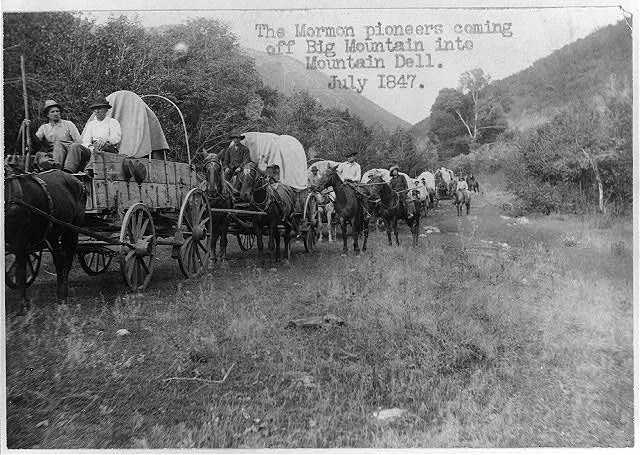
"The Mormon pioneers coming off Big Mountain into Mountain dell. July 1847" / Library of Congress.
The Mormon Migration West was a significant chapter in U.S. history during the era of westward expansion. In the 1840s, members of the Church of Jesus Christ of Latter-day Saints, often called Mormons, faced growing persecution in the eastern United States. This opposition came from misunderstandings about their beliefs, their desire to form close-knit communities, and tensions with neighbors over land and politics. As a result, the Mormons searched for a place where they could achieve religious freedom and practice their faith in peace.
The main problem facing the Mormons was the constant threat to their safety and way of life. In cities like Nauvoo, Illinois, violence and discrimination disrupted their daily existence and forced them to leave their homes. Church leader Brigham Young became the principal organizer of their response. He proposed a solution: to migrate west, outside the boundaries of the United States, toward what was then Mexican territory. This plan would allow the Mormons to form a new settlement where they could determine their own laws and create a sustainable infrastructure for their community.
The migration began in early 1846. Guided by Brigham Young, thousands of Mormons prepared for the long journey. They traveled over 1,000 miles using wagons, handcarts, and on foot. The path was difficult, crossing rivers, plains, and mountains. Along the way, the travelers faced harsh weather, disease, and limited supplies. Despite these obstacles, their organization and mutual support helped them endure. The migration was one of the largest and most organized in American history, showing how determination and collective action can overcome adversity.
In July 1847, after more than a year of travel, the first group of Mormon pioneers entered the Salt Lake Valley in present-day Utah. Brigham Young declared, "This is the right place," marking the beginning of a new phase for the community. The Mormons quickly set about building homes, planting crops, and establishing churches and schools. Their efforts transformed the dry valley into a thriving settlement. Over the next several years, more groups arrived, and the population of the Utah Territory grew rapidly. The Mormons created a society based on cooperation, hard work, and their religious principles.
The Mormon Migration West is an example of how people respond to challenges by seeking solutions that reflect their values. The desire for religious freedom was a powerful motivator, and the migration shaped the development of the American West. It also raised questions about how different groups could coexist and how new territories would be governed. Through adaptation and perseverance, the Mormon pioneers left a lasting legacy in Utah and throughout the region.
Interesting Fact: The Mormon Trail stretched over 1,300 miles and was used by more than 70,000 people during the migration from 1846 to 1869.
Comprehension quiz (8 questions)
1. Who led the Mormon migration?
2. What year did the migration begin?
3. Where did the Mormon pioneers settle?
4. Why did the Mormons migrate west?
5. What was a main challenge of the journey?
6. How did the Mormons change Salt Lake Valley?
7. The Mormon Trail was over 1,300 miles long.
8. What does 'settlement' mean?
Common Core standards for Mormon Migration West
Explain events, procedures, ideas, or concepts in a historical, scientific, or technical text, including what happened and why, based on specific information in the text.
Determine the meaning of general academic and domain-specific words or phrases in a text relevant to a grade 4 topic or subject area.
Write informative/explanatory texts to examine a topic and convey ideas and information clearly.
Perfect for the way you teach
- Build comprehension skills
- Auto-graded quiz
- Differentiated reading
- Read together at home
- Improve fluency
- Quiet reading time
- Reading curriculum support
- Independent practice
- Track Lexile growth