Neil Armstrong Walks on the Moon — Reading Comprehension
Rate this
Premium Resource
Present
Present in classroom. No work saved
Assign
Classroom with student accounts, Track progress
Quick Play
No student accounts, assign with a link
Grades
3
4
5
Standards
D2.HIS.1-4.3-5
RI.4.1
RI.4.3
RI.4.4
W.4.2
PRINT+DIGITAL RESOURCE
This learning resource is available in interactive and printable formats. The interactive worksheet can be played online and assigned to students. The Printable PDF version can be downloaded and printed for completion by hand.
This reading passage introduces students to the historic event of Neil Armstrong walking on the moon during the Apollo 11 mission. Aligned with the C3 Framework and Common Core ELA standards, the passage presents a clear, chronological narrative of the first moon landing, highlighting key figures like Neil Armstrong and Buzz Aldrin, and the teamwork that made this mission possible. Students will learn about NASA, the significance of the moon landing, and the bravery it took to accomplish this goal. The passage features important vocabulary words, a timeline of events, and an 'Interesting Fact' to spark curiosity. Activities include a multiple-choice quiz and writing prompts to help students analyze historical events and connect them to the present. The resource includes a Spanish translation and is perfect for history lessons focused on American achievements in space exploration. Read aloud audio is available to support diverse learners.
CONTENT PREVIEW
Expand content preview
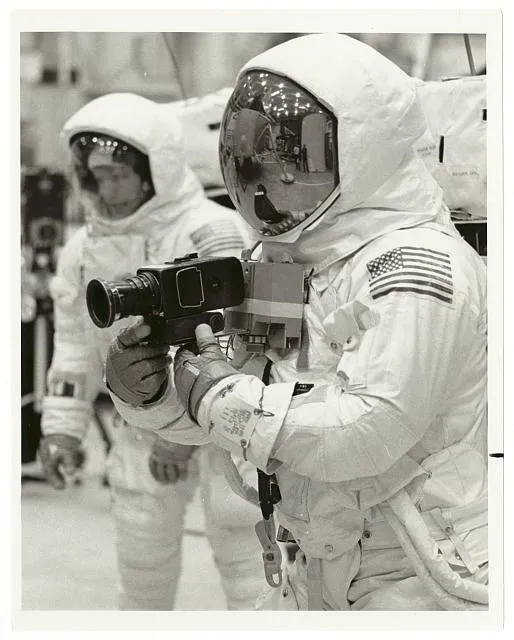
Apollo 11 Spacecraft Commander Neil Armstrong (front) and Lunar Module Pilot Edwin E. Aldrin (rear) practice lunar surface mobility at the Manned Spacecraft Center, Houston Armstrong has a camera attached to the chest area of the space suit. This method of attaching the camera is under study. The astronauts are in pressurized space suits / Source: Library of Congress - United States. National Aeronautics and Space Administration
On July 20, 1969, Neil Armstrong became the first human to walk on the Moon. This was part of the Apollo 11 mission, an important project led by the United States. The goal was to land astronauts on the Moon and return them safely to Earth. People all over the world were excited to see history being made.
The journey began when a rocket called Saturn V launched from Florida on July 16, 1969. Three astronauts, Neil Armstrong, Buzz Aldrin, and Michael Collins, were chosen for this mission. Their spacecraft had two main parts: the command module, where Collins stayed orbiting the Moon, and the lunar module, which Armstrong and Aldrin used to land.
After four days in space, the lunar module called "Eagle" separated from the command module. Armstrong and Aldrin carefully guided Eagle down to the Moon’s surface. There were many risks. The Moon’s surface was rough and dusty. The astronauts had to use all their training and courage to land safely. When Eagle landed, Armstrong sent a message to Earth: “The Eagle has landed.”
Soon after, Neil Armstrong climbed down the ladder and stepped onto the Moon. He said, “That’s one small step for man, one giant leap for mankind.” This moment was watched by about 600 million people on television. It was a moment of pride for the United States and people everywhere.
Armstrong and Aldrin spent about two hours exploring. They collected rocks, took photos, and planted an American flag. They also set up experiments to learn more about the Moon. Meanwhile, Michael Collins stayed in orbit, making sure the team could return home.
After their work, Armstrong and Aldrin returned to the lunar module. They joined Collins and traveled back to Earth. On July 24, 1969, Apollo 11 splashed down in the Pacific Ocean. The mission was a great success. It showed what people can do with teamwork, determination, and science.
The Apollo 11 mission inspired future space exploration. It proved that people could reach new worlds and work together for a common dream.
Interesting Fact: The footprints Armstrong and Aldrin left on the Moon may last for millions of years because there is no wind or rain to erase them.
Who was the first to walk on the Moon?
Neil ArmstrongBuzz AldrinMichael CollinsJohn Glenn
What was the name of the mission?
Apollo 11Gemini 4Mercury 7Voyager 1
Where did Apollo 11 land after returning?
Pacific OceanAtlantic OceanIndian OceanGulf of Mexico
Why was the Apollo 11 mission important?
First people on the MoonFirst trip to MarsBuilt a space stationFound new planets
What did Armstrong say when he stepped on the Moon?
One giant leap for mankindMission completeHello, Moon!Houston, we have a problem
How did teamwork help the mission?
Made landing safeBuilt a new rocketSent more astronautsDiscovered aliens
Neil Armstrong was an astronaut. True or false?
TrueFalse
What does 'courage' mean in the passage?
BraverySpeedAngerTiredness
Perfect For:
👩🏫 Teachers
• Reading comprehension practice
• Auto-graded assessments
• Literacy skill development
👨👩👧👦 Parents
• Reading practice at home
• Comprehension improvement
• Educational reading time
🏠 Homeschoolers
• Reading curriculum support
• Independent reading practice
• Progress monitoring
Reading Features:
📖
Reading Passage
Engaging fiction or nonfiction text
❓
Comprehension Quiz
Auto-graded questions
📊
Instant Feedback
Immediate results and scoring
📄
Printable Version
Download for offline reading
🔊
Read Aloud
Voice-over with word highlighting
Reviews & Ratings
No reviews yet. Be the first to share your experience!
Related Content
Trade and Trading Routes Between Tribes
This engaging history reading passage explores the important role of trade and trading routes between Native American tr...
D2.HIS.1-4.3-5RI.4.1RI.4.3RI.4.4
The 13 Original Colonies: An Overview
This engaging U.S. history reading passage introduces students to the 13 original colonies. It presents the story of how...
D2.HIS.1-4.3-5RI.4.3RI.4.4RI.4.10
The French and Indian War
This educational history reading passage explores the French and Indian War, a major conflict in North America before th...
D2.HIS.1-4.3-5RI.4.1RI.4.3RI.4.4
Unfair Taxes and the Stamp Act
This engaging U.S. history reading passage explores the story of the Stamp Act and unfair taxes in colonial America. Ali...
D2.HIS.1-4.3-5RI.4.1RI.4.3
Paul Revere's Midnight Ride
This U.S. History reading passage explores the famous Midnight Ride of Paul Revere, a key event in the American Revoluti...
D2.HIS.1-4.3-5RI.4.3RI.4.4RI.4.10
The Declaration of Independence and Thomas Jefferson
This engaging passage teaches students about the Declaration of Independence and Thomas Jefferson, one of America's Foun...
D2.HIS.1-4.3-5RI.4.1RI.4.2RI.4.3
Soldiers at Valley Forge in Winter
Explore the inspiring story of the Continental Army at Valley Forge during the harsh winter of 1777-1778. This history r...
D2.HIS.1-4.3-5RI.4.3RI.4.4RI.5.3
The Treaty of Paris 1783
This passage introduces students to the Treaty of Paris 1783, the important agreement that officially ended the American...
D2.HIS.1-4.3-5RI.4.3RI.4.4RI.4.10
The Star-Spangled Banner and War
This reading passage explores the inspiring story of 'The Star-Spangled Banner' and its origins during the War of 1812. ...
D2.HIS.1-4.3-5RI.4.1RI.4.3RI.4.4
Thomas Jefferson and the Louisiana Purchase
This engaging U.S. history reading passage teaches students about Thomas Jefferson and the Louisiana Purchase, one of th...
D2.HIS.1-4.3-5RI.4.3RI.5.3
James Madison and the War of 1812
This engaging U.S. history reading passage focuses on James Madison and the War of 1812. Students learn about key events...
D2.HIS.1-4.3-5RI.4.1RI.4.3RI.4.4
The First Political Parties Form
This engaging passage explores the formation of America's first political parties, highlighting the Federalists and Demo...
D2.HIS.1-4.3-5RI.4.3RI.4.4
James Monroe and the Monroe Doctrine
This engaging U.S. history reading passage introduces students to President James Monroe and the Monroe Doctrine, a key ...
D2.HIS.1-4.3-5RI.4.1RI.4.2RI.4.3
Americans Move West: The Oregon Trail
This engaging history passage explores the Oregon Trail and the westward movement of Americans in the 1800s. Students wi...
D2.HIS.1-4.3-5RI.4.3RI.4.4RI.5.3
Cowboys and Cattle Drives
This engaging U.S. History reading passage introduces students to the world of cowboys and cattle drives, a key part of ...
D2.HIS.1-4.3-5RI.4.3RI.4.4RI.5.3
Life in a Frontier Town
This passage explores the daily life and challenges faced by people living in a frontier town in the early United States...
D2.HIS.1-4.3-5RI.4.3RI.4.4W.4.2
Homestead Act: Free Land for Settlers
This engaging history reading passage explores the Homestead Act and its impact on American settlers moving west. Studen...
D2.HIS.1-4.3-5RI.4.3RI.4.4
Dangers on the Oregon Trail
This reading passage explores the many dangers faced by pioneers on the Oregon Trail, one of the most significant journe...
D2.HIS.1-4.3-5RI.4.1RI.4.3RI.4.4
Native Americans Lose Their Lands: The Trail of Tears
This reading passage explores the story of the Trail of Tears, focusing on the experiences of Native Americans as they l...
D2.HIS.1-4.3-5RI.4.3RI.4.4RI.4.7
Sherman's March to the Sea
This U.S. history reading passage explores Sherman's March to the Sea, a turning point during the Civil War. Students wi...