New Deal and Great Depression
Interactive passage with audio narration, comprehension questions, and printable PDF.
By completing this purchase you agree to our Terms of Use and Privacy Policy. Your subscription renews automatically until you cancel. You can cancel anytime from your account settings. All sales are final and non-refundable. Digital content is available for download in your account immediately upon purchase.
What's included
New Deal and Great Depression preview and details
About this printable New Deal and Great Depression reading passage (Grades 6-8)
Sample passage and quiz from New Deal and Great Depression
Reading passage and comprehension quiz preview
New Deal and Great Depression
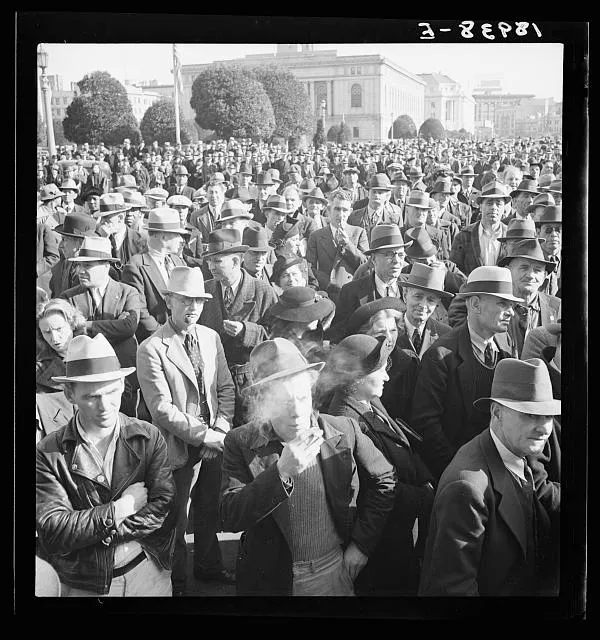
"Listening to speeches at mass meeting of Works Progress Administration (WPA) workers protesting congressional cut of relief appropriations. San Francisco, California" by Lange, Dorothea / Library of Congress.
The Great Depression was the most severe economic crisis in the history of the United States. Beginning in 1929, the nation's stock market crashed, causing banks to fail and businesses to close. Millions of Americans lost their jobs, savings, and homes. These events led to widespread poverty and hardship across the country. The government and people needed urgent solutions to address this national emergency.
President Franklin D. Roosevelt responded to the crisis with a series of programs called the New Deal. The New Deal was a set of federal policies and agencies designed to provide relief for the unemployed, promote economic recovery, and reform the banking system. The federal government took a more active role than ever before, using its power to try and stabilize the economy and support struggling Americans.
One of the primary problems during the Great Depression was unemployment. By 1933, nearly one out of every four workers was without a job. The government created agencies such as the Civilian Conservation Corps (CCC) and Works Progress Administration (WPA) to provide temporary jobs building parks, roads, and public buildings. These programs helped people earn income and improved the nation's infrastructure at the same time.
Another major issue was the collapse of the banking system. Many banks ran out of money when panicked depositors withdrew their savings all at once. In response, Roosevelt declared a national "bank holiday" to close all banks for inspection. The government then established the Federal Deposit Insurance Corporation (FDIC) to protect people's savings and restore trust in banks. These policies encouraged people to deposit their money again, which helped banks reopen.
The impact of the New Deal was wide-ranging. Some Americans felt hopeful as the government provided jobs and assistance. Others criticized the programs, believing they gave too much power to the federal government or did not go far enough to help those in need. Despite the debates, many historians agree that the New Deal changed the relationship between citizens and the government, making the federal government more responsible for economic stability and social welfare.
Although the New Deal did not end the Great Depression entirely, it lessened suffering and created lasting reforms. Social Security, a New Deal program, still provides income to retired workers today. The lessons of the New Deal shaped future government responses to economic crises, showing the importance of balancing relief, recovery, and reform in times of trouble.
Interesting Fact: During the Great Depression, some families traveled hundreds of miles in search of work, and the unemployment rate reached nearly 25% in 1933.
Comprehension quiz (8 questions)
1. When did the Great Depression begin?
2. Who was President during the New Deal?
3. What percent was unemployment in 1933?
4. Why was the FDIC created?
5. What did the CCC and WPA provide?
6. How did the New Deal change government?
7. The New Deal ended the Great Depression. True or false?
8. What does 'relief' mean in the passage?
Common Core standards for New Deal and Great Depression
Explain events, procedures, ideas, or concepts in a historical, scientific, or technical text, including what happened and why, based on specific information in the text.
Determine the meaning of general academic and domain-specific words or phrases in a text relevant to a grade 4 topic or subject area.
Write informative/explanatory texts to examine a topic and convey ideas and information clearly.
Perfect for the way you teach
- Build comprehension skills
- Auto-graded quiz
- Differentiated reading
- Read together at home
- Improve fluency
- Quiet reading time
- Reading curriculum support
- Independent practice
- Track Lexile growth