New England Town Meetings: Colonial Democracy
Interactive passage with audio narration, comprehension questions, and printable PDF.
By completing this purchase you agree to our Terms of Use and Privacy Policy. Your subscription renews automatically until you cancel. You can cancel anytime from your account settings. All sales are final and non-refundable. Digital content is available for download in your account immediately upon purchase.
What's included
New England Town Meetings: Colonial Democracy preview and details
About this printable New England Town Meetings: Colonial Democracy reading passage (Grades 6-8)
Sample passage and quiz from New England Town Meetings: Colonial Democracy
Reading passage and comprehension quiz preview
New England Town Meetings
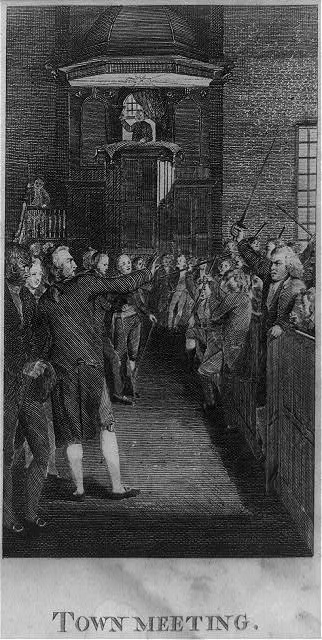
Source: Library of Congress - Tisdale, Elkanah, 1768-1835
New England town meetings were a central part of life in colonial America. In the seventeenth and eighteenth centuries, these meetings gave ordinary citizens a direct voice in local government decisions. Unlike many societies where only a few people had political power, New England towns practiced a form of direct democracy. This meant that eligible men could vote on local laws, taxes, and community problems by gathering together, discussing issues, and making decisions as a group.
Town meetings usually took place in a central meetinghouse, a simple wooden building that also served as a church and community center. Participation was mostly limited to white males who owned property, reflecting the restrictions on suffrage at the time. However, even with these limits, more people had a say in government than in many parts of Europe. At these meetings, neighbors debated, listened, and sometimes disagreed before voting. This tradition of deliberation taught colonists the value of public discussion and compromise.
One problem New Englanders faced was how to govern themselves without a powerful king or royal official telling them what to do. Town meetings offered a solution: local people could make decisions that affected their own lives. This system of self-government encouraged responsibility and gave men practical experience in running a community. Over time, these skills helped prepare colonists for the larger challenges of independence and nation-building.
As tensions with Britain grew, town meetings became even more important. Citizens used them to organize protests, debate British laws, and plan actions like the boycott of British goods. Town meetings allowed colonists to express their grievances, build unity, and make collective decisions. This provided a model for future American political life, where open debate and civic participation are valued.
Despite their importance, town meetings were not perfect. Women, enslaved people, Indigenous peoples, and non-property owners were excluded from voting. This exclusion highlights the limits of colonial democracy. Still, town meetings represented a significant step toward broader participation, compared to the more restrictive governments of Europe and other colonies.
Over the years, ideas developed in New England town meetings influenced the creation of state constitutions and the U.S. Constitution itself. Concepts like majority rule, open discussion, and the right to petition the government became core parts of American democracy. Today, some New England towns still hold annual meetings where citizens can vote directly on local matters.
Interesting Fact: In 1774, town meetings in Massachusetts were banned by the British government, but colonists continued to meet in secret, showing their determination to govern themselves.
Comprehension quiz (8 questions)
1. Where did town meetings take place?
2. Who could usually vote in town meetings?
3. What did colonists vote on?
4. How did town meetings help democracy?
5. Why did town meetings become more important during British rule?
6. What was a major limitation of town meetings?
7. Town meetings are still held in some towns. True or false?
8. What does 'deliberation' mean?
Common Core standards for New England Town Meetings: Colonial Democracy
Explain events, procedures, ideas, or concepts in a historical, scientific, or technical text, including what happened and why, based on specific information in the text.
Determine the meaning of general academic and domain-specific words or phrases in a text relevant to a grade 4 topic or subject area.
Write informative/explanatory texts to examine a topic and convey ideas and information clearly.
Perfect for the way you teach
- Build comprehension skills
- Auto-graded quiz
- Differentiated reading
- Read together at home
- Improve fluency
- Quiet reading time
- Reading curriculum support
- Independent practice
- Track Lexile growth