Oceans and Climate Patterns
Interactive passage with audio narration, comprehension questions, and printable PDF.
By completing this purchase you agree to our Terms of Use and Privacy Policy. Your subscription renews automatically until you cancel. You can cancel anytime from your account settings. All sales are final and non-refundable. Digital content is available for download in your account immediately upon purchase.
What's included
Oceans and Climate Patterns preview and details
About this printable Oceans and Climate Patterns science reading passage, NGSS-aligned (Grades 5-8)
Sample passage and quiz from Oceans and Climate Patterns
Reading passage and comprehension quiz preview
How Oceans Shape Climate Patterns
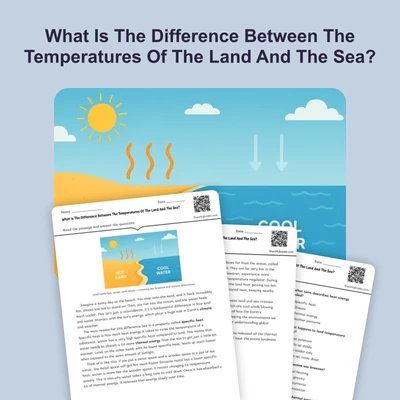
Oceans control Earth's climate by storing and moving enormous amounts of thermal energy. Water can absorb and hold far more heat than land or air. This property is called heat capacity. Because of this high heat capacity, oceans soak up solar energy during the day and release it slowly at night. Coastal cities experience milder temperatures year-round compared to inland areas. Inland regions heat up quickly in summer and cool down rapidly in winter.
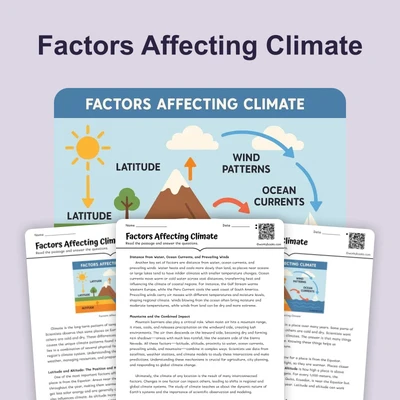
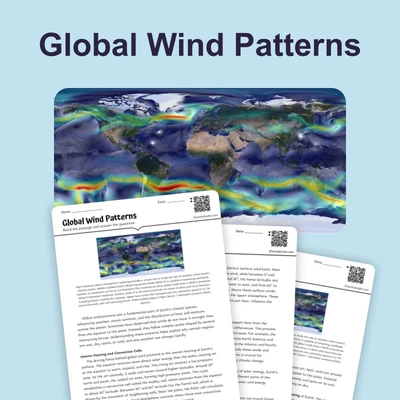
Ocean currents act like giant conveyor belts that transport warm and cold water around the planet. Warm water flows from the equator toward the poles. Cold water returns from polar regions back toward the equator. This movement redistributes heat across the globe. The Gulf Stream is one powerful example. This warm current flows from the Gulf of Mexico across the Atlantic Ocean toward Europe. Evidence shows that the Gulf Stream keeps Western Europe much warmer than other regions at the same latitude. Without this current, countries like Ireland and England would have climates similar to cold Labrador, Canada.
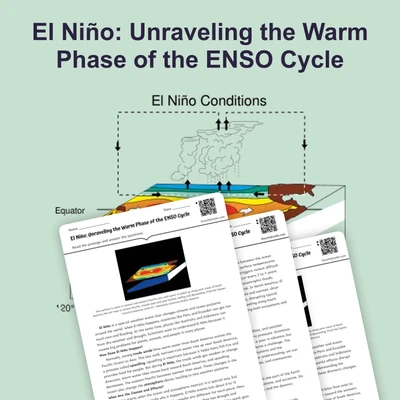
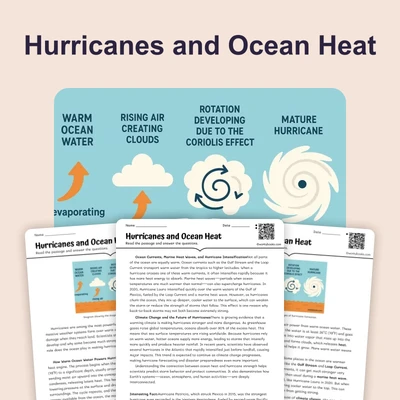
The ocean and atmosphere work together as connected partners. Oceans absorb about 90 percent of the extra heat trapped by greenhouse gases. They also absorb roughly 25 percent of carbon dioxide released by human activities. This absorption slows the rate of atmospheric warming. However, scientists observe that warmer ocean temperatures can change current patterns. These changes may affect regional climates and weather systems. Warmer water also holds less dissolved oxygen, which can harm marine life.
Understanding ocean-climate connections helps scientists predict future climate patterns. Oceans influence rainfall, storm intensity, and temperature extremes. Climate models must include ocean data to produce accurate forecasts. The ocean's role as Earth's climate regulator makes it essential to study ocean-atmosphere interactions. Changes in ocean temperature and circulation can shift weather patterns thousands of miles away. Protecting ocean health means protecting climate stability for all life on Earth.
Interesting Fact: The top ten feet of the ocean store more heat than Earth's entire atmosphere. This massive heat reservoir makes oceans the most important factor in regulating global climate.
Comprehension quiz (10 questions)
1. What property allows water to absorb and hold more heat than land or air?
2. According to the passage, where do warm ocean currents flow?
3. What does the term 'atmosphere' mean in this passage?
4. Based on the passage, what does 'latitude' refer to?
5. Why do coastal cities have milder temperatures than inland areas?
6. How does the Gulf Stream affect Western Europe's climate?
7. What percentage of extra heat from greenhouse gases do oceans absorb?
8. According to the passage, what can happen when ocean temperatures increase?
9. The top ten feet of the ocean store more heat than Earth's entire atmosphere.
10. Ocean currents only affect climate near coastlines and do not influence weather thousands of miles away.
Perfect for the way you teach
- Build comprehension skills
- Auto-graded quiz
- Differentiated reading
- Read together at home
- Improve fluency
- Quiet reading time
- Reading curriculum support
- Independent practice
- Track Lexile growth