Plymouth Colony and Pilgrims
Interactive passage with audio narration, comprehension questions, and printable PDF.
By completing this purchase you agree to our Terms of Use and Privacy Policy. Your subscription renews automatically until you cancel. You can cancel anytime from your account settings. All sales are final and non-refundable. Digital content is available for download in your account immediately upon purchase.
What's included
Plymouth Colony and Pilgrims preview and details
About this printable Plymouth Colony and Pilgrims reading passage (Grades 6-8)
Sample passage and quiz from Plymouth Colony and Pilgrims
Reading passage and comprehension quiz preview
Plymouth Colony and the Pilgrims
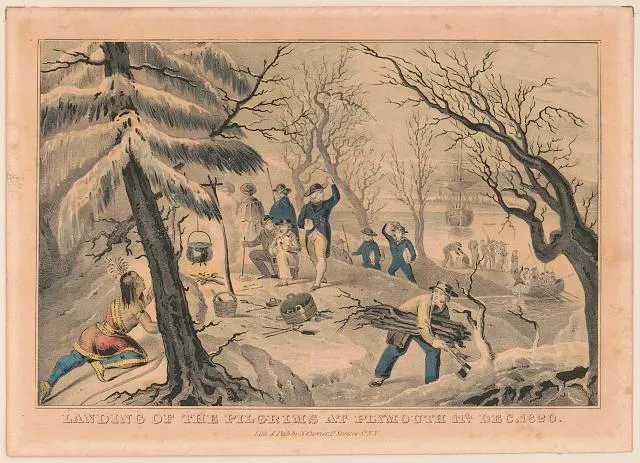
Source: Library of Congress - N. Currier (Firm)
In 1620, a group of Separatists known as the Pilgrims established Plymouth Colony in what is now Massachusetts. These settlers left England because they faced religious persecution, which means they were treated unfairly for their beliefs. Their main goal was to create a community where they could practice their religion freely. The journey across the Atlantic Ocean on the Mayflower was perilous, filled with storms and discomfort, but their determination to find religious freedom was strong.
Arriving in November, the Pilgrims confronted severe challenges. Winter was harsh, and many colonists lacked essential resources such as food, shelter, and warm clothing. Disease and malnutrition caused the death of almost half the settlers during the first winter. These hardships forced the Pilgrims to adapt quickly to their new environment. They realized that survival would depend on learning new skills and forming relationships with local peoples.
The Wampanoag, an Indigenous nation led by Chief Massasoit, played a critical role in the Pilgrims' survival. At first, there was uncertainty and tension between the two groups. However, through negotiation and shared needs, they established an alliance. This partnership was mutually beneficial: the Wampanoag provided knowledge about local crops and hunting, while the Pilgrims offered trade goods and military support. Squanto, a member of the Patuxet tribe who spoke English, became a key intermediary and taught the Pilgrims how to plant corn and find edible plants.
The first successful harvest in 1621 led to a three-day feast shared by the Pilgrims and Wampanoag. This event is widely recognized as the first Thanksgiving. It symbolized cooperation and gratitude, though relations between settlers and Native Americans would later become more complex and often conflictual. At the time, however, the celebration reflected a period of relative peace and shared prosperity.
Plymouth Colony's legacy is significant in American history. It represents both the struggle for religious freedom and the importance of cross-cultural cooperation. The Pilgrims' experiences influenced later colonial policies and American values. However, it is important to remember that the story of Plymouth also includes the perspectives and experiences of Indigenous peoples, who faced profound changes to their way of life as a result of colonization.
Interesting Fact: The Mayflower Compact, signed aboard the Mayflower, was one of the first forms of self-government in the English colonies, setting a framework for majority rule.
Comprehension quiz (8 questions)
1. When was Plymouth Colony founded?
2. What was the Pilgrims' main goal?
3. Who helped the Pilgrims survive?
4. Why was the alliance with Wampanoag important?
5. What does the first Thanksgiving represent?
6. How did Squanto help the Pilgrims?
7. The Mayflower Compact was a form of self-government.
8. What is an 'alliance'?
Common Core standards for Plymouth Colony and Pilgrims
Explain events, procedures, ideas, or concepts in a historical, scientific, or technical text, including what happened and why, based on specific information in the text.
Determine the meaning of general academic and domain-specific words or phrases in a text relevant to a grade 4 topic or subject area.
Write informative/explanatory texts to examine a topic and convey ideas and information clearly.
Perfect for the way you teach
- Build comprehension skills
- Auto-graded quiz
- Differentiated reading
- Read together at home
- Improve fluency
- Quiet reading time
- Reading curriculum support
- Independent practice
- Track Lexile growth