Pullman Strike 1894: Federal Government Intervenes
Interactive passage with audio narration, comprehension questions, and printable PDF.
By completing this purchase you agree to our Terms of Use and Privacy Policy. Your subscription renews automatically until you cancel. You can cancel anytime from your account settings. All sales are final and non-refundable. Digital content is available for download in your account immediately upon purchase.
What's included
Pullman Strike 1894: Federal Government Intervenes preview and details
About this printable Pullman Strike 1894: Federal Government Intervenes reading passage (Grades 6-8)
Sample passage and quiz from Pullman Strike 1894: Federal Government Intervenes
Reading passage and comprehension quiz preview
Pullman Strike 1894
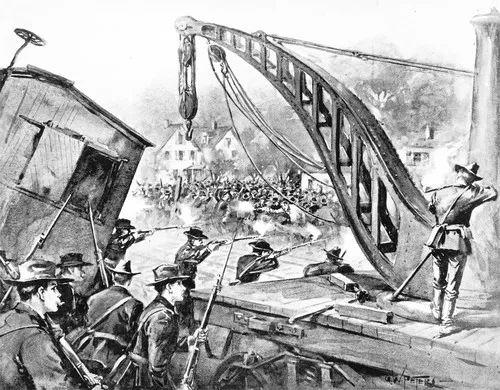
"Pullman strike guard harpers" by Drawn by G. W. Peters from a sketch by G. A. Coffin.
Source: Wikimedia Commons (Public domain).
The Pullman Strike of 1894 was a major labor conflict that took place in the United States during the Progressive Era. The strike began when workers at the Pullman Palace Car Company, located near Chicago, protested against severe wage cuts. These wage reductions came at a time when rent and prices in the company-owned town remained unchanged, creating economic hardship for Pullman employees and their families.
As the situation worsened, the workers formed a strike to demand fairer wages and better working conditions. The American Railway Union (ARU), led by Eugene V. Debs, supported the Pullman workers by organizing a boycott of trains that used Pullman cars. This boycott quickly spread across the country, affecting railroads nationwide and disrupting both passenger and freight traffic.
The Pullman Company refused to negotiate with the workers or the ARU. As the strike escalated, railroad owners and business leaders pressured the federal government to take action. President Grover Cleveland’s administration responded by issuing a federal injunction against the strike, which is a legal order to stop an activity. When workers ignored the injunction, federal troops were sent to Chicago to force an end to the strike. This federal intervention led to violent clashes, resulting in property damage and several deaths.
Ultimately, the strike was broken, and many labor leaders, including Debs, were arrested. Though the Pullman workers did not achieve their immediate goals, the strike highlighted the challenges faced by industrial workers and the power of large corporations. It also set important precedents for how the U.S. government could become involved in labor disputes, often siding with business interests over labor rights.
The Pullman Strike revealed deep divisions in American society over the rights of workers, the responsibilities of employers, and the role of government. The conflict encouraged future labor reforms and inspired debates about collective bargaining, union recognition, and the use of government power in private industry.
Interesting Fact: Labor Day became a national holiday in the United States in 1894, partly as a response to the Pullman Strike and to improve relations between workers and the government.
Comprehension quiz (8 questions)
1. When did the Pullman Strike happen?
2. Where was the Pullman Company located?
3. Who led the American Railway Union?
4. Why did the workers strike?
5. What was the effect of the boycott?
6. How did the government respond?
7. Federal intervention ended the strike. True or false?
8. What is a boycott?
Common Core standards for Pullman Strike 1894: Federal Government Intervenes
Explain events, procedures, ideas, or concepts in a historical, scientific, or technical text, including what happened and why, based on specific information in the text.
Determine the meaning of general academic and domain-specific words or phrases in a text relevant to a grade 4 topic or subject area.
Write informative/explanatory texts to examine a topic and convey ideas and information clearly.
Perfect for the way you teach
- Build comprehension skills
- Auto-graded quiz
- Differentiated reading
- Read together at home
- Improve fluency
- Quiet reading time
- Reading curriculum support
- Independent practice
- Track Lexile growth