Puritan Life Massachusetts — Reading Comprehension
Rate this
Present
Present in classroom. No work saved
Assign
Classroom with student accounts, Track progress
Quick Play
No student accounts, assign with a link
Grades
6
7
8
Standards
D2.HIS.2.3-5
D2.HIS.3.3-5
RI.4.3
RI.4.4
W.4.2
PRINT+DIGITAL RESOURCE
This learning resource is available in interactive and printable formats. The interactive worksheet can be played online and assigned to students. The Printable PDF version can be downloaded and printed for completion by hand.
This passage explores the complexities of Puritan life in the Massachusetts Bay Colony, examining the causes, motivations, and consequences of their settlement. Students will learn how Puritan beliefs shaped government, daily routines, and relationships with dissenters. The text adopts an analytical lens, using compare-and-contrast structure and integrating a primary source quote for historical reasoning. Key vocabulary terms are woven throughout to build academic language skills. The passage ends with an interesting historical fact, and includes a glossary, multiple-choice quiz, writing activities, graphic organizer, and a timeline of key events. The passage aligns with D2.His.2.3-5, D2.His.3.3-5, RI.4.3, RI.4.4, and W.4.2 standards. Students can access read aloud audio and a Spanish translation, making it suitable for diverse classrooms. This resource is ideal for teachers seeking rigorous, standards-aligned US history reading passages on colonial America.
CONTENT PREVIEW
Expand content preview
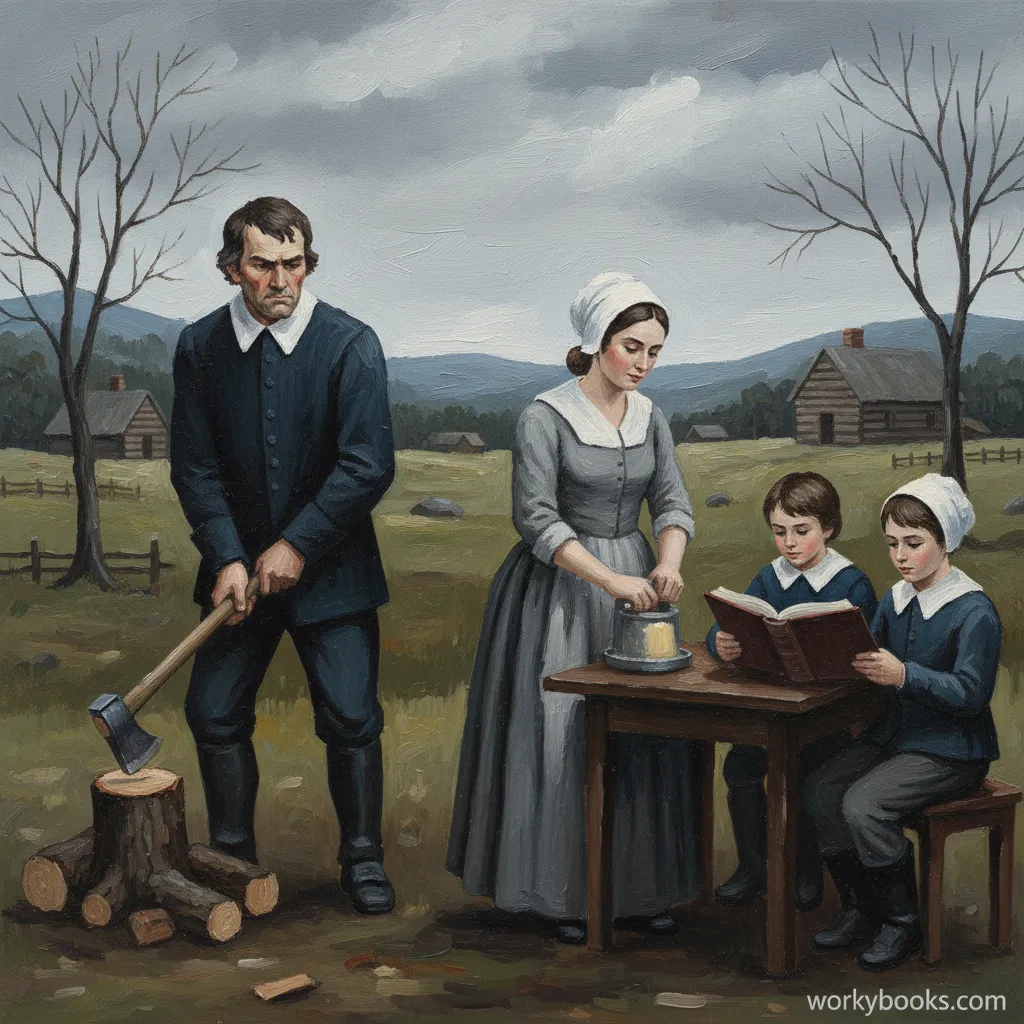
Puritan family life: labor and learning in colonial Massachusetts Bay Colony
The Puritans who settled in Massachusetts during the 1600s believed that strict religious rules were essential for a successful community. Their daily lives were shaped by a devotion to piety, which meant showing strong religious faith and moral behavior. The Puritans created laws that required everyone to attend church services, and missing church could result in fines or public punishment. No one was exempt from these expectations, not even leaders or wealthy citizens.
Life in Puritan Massachusetts was organized around the local church, called the congregation. The meeting house was the center of both religious and social life. On Sundays, families gathered for long church services, and the entire community participated in discussions and decisions that affected everyone. The Puritans believed that their community was bound by a covenant, or sacred agreement with God, making it necessary to uphold shared values.
Strict discipline was a key part of Puritan society. Laws prohibited activities like dancing, gambling, and celebrating holidays such as Christmas, which the Puritans viewed as distractions from worship. Children were taught obedience and respect for authority from an early age. Breaking rules often led to public shame or even physical punishment, reflecting the community’s belief in maintaining order and purity.
Education held special significance for the Puritans. They believed that everyone should read the Bible, so laws were passed to establish schools in every town. Boys and girls learned to read, though boys were more likely to continue to higher education. The strict structure of Puritan schools reflected their larger focus on discipline and self-control. Teachers enforced rules, and lessons included religious instruction along with reading and writing.
Family life in Puritan Massachusetts was shaped by well-defined roles and expectations. Fathers led the household and made important decisions, while mothers managed the home and taught children about religious duties. Children were expected to contribute to the family’s work and obey their elders. These roles reinforced the Puritan belief in a well-ordered society.
Despite the emphasis on unity, not everyone agreed with Puritan rules. Dissenters, or people who challenged the church’s authority, sometimes faced severe consequences, such as being banished from the community. Conflicts also arose over how strictly to interpret religious laws, showing that Puritan life was not without disagreements and challenges.
In summary, Puritan life in Massachusetts was shaped by shared values, strict rules, and a deep commitment to faith. While these beliefs helped create strong communities, they also led to conflicts and harsh punishments for those who did not conform. Understanding Puritan society helps us see how religious ideas influenced early American laws, education, and social structures.
Interesting Fact: The first public school in America, the Boston Latin School, was founded by Puritans in 1635 to ensure that children could read the Bible.
What was required of all Puritans?
Attend church servicesCelebrate ChristmasLearn to danceTravel to England
Where was the center of Puritan life?
The marketThe meeting houseThe harborThe governor's mansion
Who founded the Boston Latin School?
PuritansPilgrimsQuakersNative Americans
Why did Puritans ban dancing?
Too noisyDistracted from worshipUnsafeNot enough space
What happened to dissenters?
They were celebratedGiven moneyBanished from communityMade leaders
How did Puritan education reflect their beliefs?
No schoolsFocused on Bible and disciplineOnly math taughtTaught only art
Puritans allowed everyone to break the rules.
TrueFalse
What does 'piety' mean?
Strong religious faithDancing skillsPolitical powerCooking ability
Perfect For:
👩🏫 Teachers
• Reading comprehension practice
• Auto-graded assessments
• Literacy skill development
👨👩👧👦 Parents
• Reading practice at home
• Comprehension improvement
• Educational reading time
🏠 Homeschoolers
• Reading curriculum support
• Independent reading practice
• Progress monitoring
Reading Features:
📖
Reading Passage
Engaging fiction or nonfiction text
❓
Comprehension Quiz
Auto-graded questions
📊
Instant Feedback
Immediate results and scoring
📄
Printable Version
Download for offline reading
🔊
Read Aloud
Voice-over with word highlighting
Reviews & Ratings
No reviews yet. Be the first to share your experience!
Related Content
Native American Tribes Across America
This engaging history reading passage introduces students to Native American tribes across America, focusing on their da...
D2.HIS.1.3-5D2.HIS.2.3-5RI.4.1RI.4.2
Teepees: Homes on the Great Plains
This engaging history reading passage introduces students to teepees, the unique homes of Native American tribes on the ...
D2.HIS.2.3-5D2.HIS.14.3-5RI.4.1RI.4.2RI.4.4
Traditional Native American Clothing
This engaging history passage explores traditional Native American clothing and how it reflected the environment, values...
D2.HIS.2.3-5D2.HIS.3.3-5RI.4.3RI.4.4
The Iroquois Confederacy: A System of Peace
This engaging U.S. History reading passage introduces students to the Iroquois Confederacy, a powerful alliance of Nativ...
D2.HIS.2.3-5D2.HIS.3.3-5RI.4.3RI.4.4
The Cherokee Nation: History and Culture
This reading passage explores the rich history and culture of the Cherokee Nation, one of the largest Native American tr...
D2.HIS.2.3-5D2.HIS.14.3-5RI.4.3RI.4.4RI.4.10
The Sioux: Warriors and Tribal Leaders
This history reading passage explores the Sioux Nation, focusing on their roles as warriors and tribal leaders. Students...
D2.HIS.1.3-5D2.HIS.2.3-5RI.4.1RI.4.3
Native American Respect for Nature
This engaging history reading passage explores Native American respect for nature, emphasizing the close relationship be...
D2.HIS.2.3-5D2.HIS.3.3-5RI.4.3RI.4.4
Jamestown: The First Permanent English Colony
This engaging history passage explores the founding of Jamestown, the first permanent English colony in America. Aligned...
D2.HIS.1.3-5D2.HIS.2.3-5RI.4.3RI.4.4
Pocahontas and the Powhatan People
This engaging reading passage explores the life of Pocahontas and the Powhatan people and their important role in early ...
D2.HIS.1.3-5D2.HIS.2.3-5RI.4.1RI.4.3
Colonial Children: School and Chores
This reading passage explores the daily lives of colonial children, focusing on their experiences at school and their ma...
D2.HIS.2.3-5D2.HIS.3.3-5RI.4.1RI.4.2RI.4.4
Colonial Clothing and Homemade Goods
This engaging U.S. history passage explores the daily life of early American colonists with a focus on colonial clothing...
D2.HIS.2.3-5RI.4.3RI.4.4
Colonial Jobs: Blacksmiths, Bakers, and Craftsmen
This engaging history reading passage explores the vital roles of blacksmiths, bakers, and craftsmen in colonial America...
D2.HIS.2.3-5D2.HIS.3.3-5RI.4.3RI.4.4
Colonial Towns and Village Life
This engaging history reading passage explores the daily life, work, and unity found in colonial towns and villages. Ali...
D2.HIS.1.3-5D2.HIS.2.3-5RI.4.3RI.4.4
Colonial Trade with England and Africa
This history reading passage explores colonial trade between the American colonies, England, and Africa, focusing on the...
D2.HIS.2.3-5D2.HIS.14.3-5RI.4.3RI.4.4
Benjamin Franklin: Printer, Inventor, and Leader
This history reading passage explores the life and achievements of Benjamin Franklin, one of America's most important ea...
D2.HIS.2.3-5D2.HIS.3.3-5RI.4.1RI.4.3
George Washington Leads the Army
This engaging history reading passage explores how George Washington bravely led the Continental Army during the America...
D2.HIS.1.3-5D2.HIS.2.3-5RI.4.3RI.4.4
Women and Children During the Revolutionary War
This reading passage explores the important roles women and children played during the Revolutionary War. Students will ...
D2.HIS.2.3-5RI.4.3RI.5.3
African Americans Fight for Freedom
This educational passage explores the brave and inspiring story of how African Americans fought for freedom in the Unite...
D2.HIS.2.3-5D2.HIS.3.3-5RI.4.3RI.4.4
The Battle of Yorktown Ends War
This engaging U.S. history reading passage explores the Battle of Yorktown, a key event that ended the American Revoluti...
D2.HIS.1.3-5D2.HIS.2.3-5RI.4.1RI.4.3
Loyalists vs. Patriots: Divided Families
This engaging U.S. history reading passage explores the division between Loyalists and Patriots during the American Revo...