Reflection, Absorption, and Albedo — Reading Comprehension
Rate this
Premium Resource
Present
Present in classroom. No work saved
Assign
Classroom with student accounts, Track progress
Quick Play
No student accounts, assign with a link
Grades
5
6
7
8
Standards
MS-ESS2-6
PRINT+DIGITAL RESOURCE
This learning resource is available in interactive and printable formats. The interactive worksheet can be played online and assigned to students. The Printable PDF version can be downloaded and printed for completion by hand.
This middle school science passage, aligned with NGSS standard MS-ESS2-6, explores the interactions of incoming solar energy with Earth's surface through the processes of reflection and absorption. Students will learn the meaning of albedo, discover why snow, ice, clouds, oceans, and forests reflect or absorb sunlight differently, and examine how these differences influence Earth's energy balance and climate. The passage uses clear examples and introduces students to the critical concept of the ice-albedo feedback, which plays a role in climate change. With vocabulary support, differentiated readings, Spanish translations, and audio integration, this resource is designed to be accessible and engaging for grades 6-8. Included activities reinforce comprehension and analytical skills, making it an ideal addition to any Earth science curriculum.
CONTENT PREVIEW
Expand content preview
The map shows the difference between the amount of sunlight Greenland reflected in the summer of 2011 versus the average percent it reflected between 2000 to 2006. Virtually the entire ice sheet shows some change, with some areas reflecting close to 20 percent less light than a decade ago. Scanning electron microscope photos courtesy the Electron and Confocal Microscopy Laboratory, USDA Agricultural Research Service. / Wikimedia Commons (Public domain).
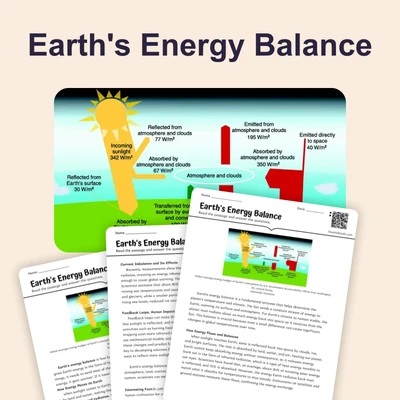
When sunlight reaches Earth, it does not behave the same everywhere. Some of the Sun’s energy bounces off surfaces, while the rest is taken in and used to warm the planet. These two processes, called reflection and absorption, are crucial for understanding Earth’s energy balance. The amount of sunlight that a surface reflects is measured by its albedo. Albedo is a fraction between 0 and 1, where higher values mean more reflection.
How Surfaces Reflect and Absorb Sunlight
Different surfaces on Earth have different albedos. For example, fresh snow and thick clouds have a high albedo, reflecting more than 80% of incoming sunlight. These bright surfaces act like giant mirrors, sending solar energy back into space. In contrast, dark surfaces like oceans and dense forests have a low albedo, reflecting less than 20%. Most of the sunlight hitting these surfaces is absorbed, turning into heat. This is why dark asphalt on a summer day gets hotter than white concrete. On average, about 30% of the Sun’s energy is reflected by Earth’s surface and atmosphere, while 70% is absorbed.
Albedo’s Role in Earth’s Climate
Albedo is not just a property of surfaces—it has a major impact on Earth’s climate system. For example, the polar regions are covered in ice and snow, giving them a high albedo. When ice melts due to warming, it exposes darker ocean water underneath. This lowers the albedo, so less sunlight is reflected and more is absorbed. The increased absorption causes more warming, which melts even more ice. This process is known as the ice-albedo feedback and is an important factor in climate change.
Interactions and Implications
Clouds also have a strong effect on albedo. Thick, low clouds reflect a lot of sunlight, helping to cool the planet. However, clouds can also trap heat, acting as insulation. Scientists use satellites to measure albedo around the world and track changes over time. Understanding albedo helps us predict weather, design energy-efficient buildings, and address environmental challenges. For example, cities can paint roofs white to reflect more sunlight and reduce cooling costs. Even small changes in albedo can have large effects on global temperatures.
In summary, the way sunlight is reflected or absorbed by Earth’s surfaces and atmosphere is a complex system with wide-ranging impacts. By studying albedo and related processes, scientists can better understand and respond to changes in our planet’s climate.
Interesting Fact: Scientists estimate that if all Arctic sea ice melted, Earth’s average temperature could rise by more than 0.5°C due to the loss of high-albedo surfaces.
What is the definition of albedo?
The fraction of sunlight reflected by a surfaceThe amount of heat absorbed by a surfaceThe process of energy transfer by airThe speed of light in the atmosphere
Which surface has the highest albedo?
Fresh snowOcean waterDense forestAsphalt road
What percentage of incoming solar energy is absorbed by Earth on average?
10%30%50%70%
What happens during the ice-albedo feedback?
Melting ice lowers albedo, more sunlight is absorbed, and more ice meltsMelting ice increases albedo, less sunlight is absorbedSnow increases reflection, leading to coolingOceans freeze, increasing Earth's albedo
What is one way cities can use albedo to reduce cooling costs?
Paint roofs whiteBuild more roadsPlant dark-colored treesIncrease car traffic
What does the term 'energy balance' mean as used in the passage?
The balance between sunlight Earth gets and what it reflects or releasesThe amount of energy in the oceanThe difference between day and nightThe balance of wind and rain
Which is a true statement based on the passage?
Clouds can both reflect sunlight and trap heatAll surfaces on Earth have the same albedoForests reflect more sunlight than snowThe albedo of the ocean is higher than snow
Which statement best describes how satellites are used in studying albedo?
Satellites measure albedo from space to track changes on EarthSatellites increase Earth's albedoSatellites make clouds brighterSatellites melt Arctic ice
True or False: If all Arctic sea ice melted, Earth's average temperature would likely decrease.
TrueFalse
True or False: Albedo is only important in cold climates.
TrueFalse
Perfect For:
👩🏫 Teachers
• Reading comprehension practice
• Auto-graded assessments
• Literacy skill development
👨👩👧👦 Parents
• Reading practice at home
• Comprehension improvement
• Educational reading time
🏠 Homeschoolers
• Reading curriculum support
• Independent reading practice
• Progress monitoring
Reading Features:
📖
Reading Passage
Engaging fiction or nonfiction text
❓
Comprehension Quiz
Auto-graded questions
📊
Instant Feedback
Immediate results and scoring
📄
Printable Version
Download for offline reading
🔊
Read Aloud
Voice-over with word highlighting
Reviews & Ratings
No reviews yet. Be the first to share your experience!
Related Content
How Rainforests Help the Planet
This NGSS-aligned reading passage for middle school students explains how rainforests help regulate Earth’s climate and ...
MS-ESS2-6MS-LS2-5
Understanding the Koppen Climate Classification System
This NGSS-aligned science reading passage explains the Köppen Climate Classification System, a scientific method used to...
MS-ESS2-6MS-LS2-5
What Is a Temperate Climate?
This NGSS-aligned science reading passage introduces middle school students to temperate climates, which have moderate t...
MS-ESS2-6
What Is the Temperate Zone?
This NGSS-aligned reading passage explains the location and characteristics of the temperate zone. Students learn that t...
MS-ESS2-6
Humid Continental Climate Characteristics
This NGSS-aligned reading passage introduces middle school students to the humid continental climate zone. It explains t...
MS-ESS2-6
Humid Continental Climate Countries
This NGSS-aligned reading passage introduces students to countries that have a humid continental climate, including part...
MS-ESS2-6
How Do Highland Climates Differ from Polar Climates?
This NGSS-aligned reading passage helps middle school students compare and contrast highland and polar climates. It expl...
MS-ESS2-6
Which Factor Controls the Water Cycle?
This NGSS-aligned science reading passage explores the question: Which factor controls the water cycle? Students will le...
MS-ESS2-6
What Is Condensation in the Water Cycle?
This NGSS-aligned reading passage introduces students to the role of condensation in the water cycle. Written for middle...
MS-ESS2-6
What Are Natural Causes That Lead to Increased CO₂ Levels in the Carbon Cycle?
This NGSS-aligned middle school science passage explains natural causes that increase carbon dioxide levels in the carbo...
MS-ESS2-6
Earth's Spheres
This middle school science passage introduces students to Earth's four major spheres: the geosphere, hydrosphere, atmosp...
MS-ESS2-4MS-ESS2-6
Weather vs. Climate
This comprehensive passage for grades 6-8 explores the difference between weather and climate, aligning with NGSS standa...
MS-ESS2-6
Factors Affecting Climate
This informative science passage for grades 6-8 explains the main factors that determine climate in different regions of...
MS-ESS2-6
Climate Zones
This passage provides an in-depth look at Earth’s climate zones using the Köppen classification system, covering tropica...
MS-ESS2-6
The Greenhouse Effect
This comprehensive middle school science passage explores the greenhouse effect, a process essential to maintaining Eart...
MS-ESS2-6MS-ESS3-5
Global Wind Patterns
This comprehensive passage introduces middle school students to global wind patterns and atmospheric circulation, aligni...
MS-ESS2-6
Wind
This comprehensive science passage introduces middle school students to the mechanisms of wind formation, focusing on ai...
MS-ESS2-5MS-ESS2-6
El Niño
This middle school science passage provides an in-depth exploration of El Niño, the warm phase of the El Niño-Southern O...
MS-ESS2-6MS-ESS3-5
Hurricanes and Ocean Heat
This middle school science passage explores the relationship between hurricanes and ocean heat, aligning with NGSS stand...
MS-ESS2-6MS-ESS3-2
ENSO and Global Climate
This comprehensive passage explores the El Niño-Southern Oscillation (ENSO), a crucial driver of global climate variabil...