Republicans and Reconstruction Policy — Reading Comprehension
Rate this
Present
Present in classroom. No work saved
Assign
Classroom with student accounts, Track progress
Quick Play
No student accounts, assign with a link
Grades
6
7
8
Standards
D2.HIS.2.3-5
D2.HIS.3.3-5
RI.4.3
RI.4.4
W.4.2
PRINT+DIGITAL RESOURCE
This learning resource is available in interactive and printable formats. The interactive worksheet can be played online and assigned to students. The Printable PDF version can be downloaded and printed for completion by hand.
This comprehensive U.S. history reading passage explores the Radical Republicans and Reconstruction Policy following the Civil War. Students will examine the causes, motivations, and challenges faced during Reconstruction, focusing on the contrasting approaches of President Andrew Johnson and the Radical Republicans in Congress. The passage integrates multiple perspectives, primary source evidence, and disciplinary vocabulary to foster deep historical understanding. With a problem/solution structure and rigorous activities—including a timeline, glossary, multiple-choice quiz, writing prompts, and a graphic organizer—students develop analytical skills aligned to C3 Framework and Common Core (RI.4.3, RI.4.4, W.4.2). The resource includes read aloud audio and a Spanish translation for accessibility. Ideal for building students’ skills in historical reasoning, textual analysis, and understanding the complexities of Reconstruction.
CONTENT PREVIEW
Expand content preview
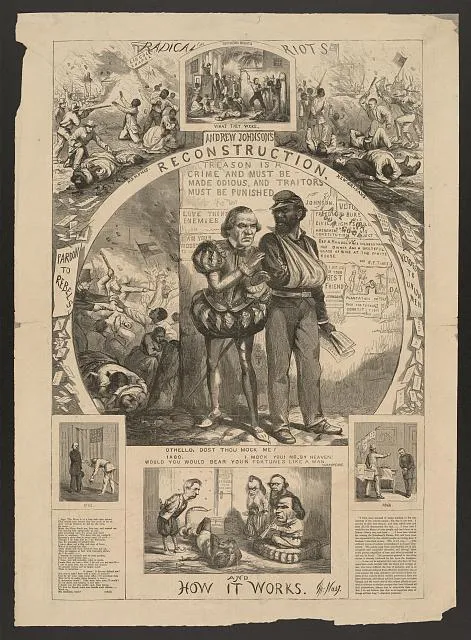
Andrew Johnson's reconstruction and how it works. Source: Library of Congress - Nast, Thomas, 1840-1902
The end of the Civil War in 1865 left the United States facing difficult questions about how to rebuild the South and ensure justice for formerly enslaved people. The Republican Party, which led the Union during the war, became divided over the best approach to Reconstruction. Some members, known as Radical Republicans, believed in taking strong actions to change Southern society, while others, including Presidents Abraham Lincoln and Andrew Johnson, supported more moderate policies that focused on reuniting the nation quickly.
The major challenge was how to protect the rights of newly freed African Americans. The Radical Republicans in Congress argued that simply ending slavery was not enough. They wanted to pass legislation such as the Civil Rights Act of 1866 and the Fourteenth Amendment, which granted citizenship and equal protection under the law. These leaders believed that without federal intervention, Southern states would find ways to deny basic rights to Black citizens.
In contrast, President Johnson favored a lenient approach. He issued proclamations that allowed Southern states to rejoin the Union easily if they accepted the end of slavery and pledged loyalty. However, many Southern governments responded by creating Black Codes, which restricted the freedom of African Americans and tried to keep them in low-wage labor.
This conflict between Congress and the President led to a major political struggle. Congress eventually took control of Reconstruction, passing the Reconstruction Acts of 1867. These laws divided the South into military districts and required states to write new constitutions that protected Black voting rights. Federal troops were sent to enforce these requirements, showing the use of national power to achieve social change.
Despite these efforts, resistance in the South was strong. Groups like the Ku Klux Klan used violence and intimidation to prevent African Americans from exercising their rights. Over time, support for Radical Reconstruction weakened in the North, leading to the withdrawal of federal troops by 1877. Many of the changes intended by the Radical Republicans were reversed, and Southern states created new ways to limit Black participation in society.
The Reconstruction period showed both the possibilities and limits of government action. While important legal protections were added to the Constitution, enforcing those rights proved difficult. The struggle between different branches of government and the ongoing resistance in the South revealed the complexity of reshaping a society after civil war.
Interesting Fact: The first African American members of Congress were elected during Reconstruction, including Hiram Revels and Blanche K. Bruce from Mississippi.
When did the Civil War end?
1865186118771870
Who were the Radical Republicans?
Leaders favoring strong changeSouthern DemocratsPresidents Lincoln and JohnsonArmy generals
What were Black Codes?
Laws limiting Black freedomVoting rules for womenNorthern factory rulesTrade agreements
Why did Congress take control of Reconstruction?
To protect African American rightsTo lower taxesTo stop the warTo help Southern leaders
How did Southern states resist Reconstruction?
Created Black CodesWelcomed new lawsBuilt new schoolsSupported Radical Republicans
Why did Radical Reconstruction end?
Northern support fadedCivil War restartedReconstruction Act failedSouth voted against it
Reconstruction started after the Civil War. True or false?
TrueFalse
What does 'legislation' mean?
A law or set of lawsA war strategyA holidayA kind of government
Perfect For:
👩🏫 Teachers
• Reading comprehension practice
• Auto-graded assessments
• Literacy skill development
👨👩👧👦 Parents
• Reading practice at home
• Comprehension improvement
• Educational reading time
🏠 Homeschoolers
• Reading curriculum support
• Independent reading practice
• Progress monitoring
Reading Features:
📖
Reading Passage
Engaging fiction or nonfiction text
❓
Comprehension Quiz
Auto-graded questions
📊
Instant Feedback
Immediate results and scoring
📄
Printable Version
Download for offline reading
🔊
Read Aloud
Voice-over with word highlighting
Reviews & Ratings
No reviews yet. Be the first to share your experience!
Related Content
Native American Tribes Across America
This engaging history reading passage introduces students to Native American tribes across America, focusing on their da...
D2.HIS.1.3-5D2.HIS.2.3-5RI.4.1RI.4.2
Teepees: Homes on the Great Plains
This engaging history reading passage introduces students to teepees, the unique homes of Native American tribes on the ...
D2.HIS.2.3-5D2.HIS.14.3-5RI.4.1RI.4.2RI.4.4
Traditional Native American Clothing
This engaging history passage explores traditional Native American clothing and how it reflected the environment, values...
D2.HIS.2.3-5D2.HIS.3.3-5RI.4.3RI.4.4
The Iroquois Confederacy: A System of Peace
This engaging U.S. History reading passage introduces students to the Iroquois Confederacy, a powerful alliance of Nativ...
D2.HIS.2.3-5D2.HIS.3.3-5RI.4.3RI.4.4
The Cherokee Nation: History and Culture
This reading passage explores the rich history and culture of the Cherokee Nation, one of the largest Native American tr...
D2.HIS.2.3-5D2.HIS.14.3-5RI.4.3RI.4.4RI.4.10
The Sioux: Warriors and Tribal Leaders
This history reading passage explores the Sioux Nation, focusing on their roles as warriors and tribal leaders. Students...
D2.HIS.1.3-5D2.HIS.2.3-5RI.4.1RI.4.3
Native American Respect for Nature
This engaging history reading passage explores Native American respect for nature, emphasizing the close relationship be...
D2.HIS.2.3-5D2.HIS.3.3-5RI.4.3RI.4.4
Jamestown: The First Permanent English Colony
This engaging history passage explores the founding of Jamestown, the first permanent English colony in America. Aligned...
D2.HIS.1.3-5D2.HIS.2.3-5RI.4.3RI.4.4
Pocahontas and the Powhatan People
This engaging reading passage explores the life of Pocahontas and the Powhatan people and their important role in early ...
D2.HIS.1.3-5D2.HIS.2.3-5RI.4.1RI.4.3
Colonial Children: School and Chores
This reading passage explores the daily lives of colonial children, focusing on their experiences at school and their ma...
D2.HIS.2.3-5D2.HIS.3.3-5RI.4.1RI.4.2RI.4.4
Colonial Clothing and Homemade Goods
This engaging U.S. history passage explores the daily life of early American colonists with a focus on colonial clothing...
D2.HIS.2.3-5RI.4.3RI.4.4
Colonial Jobs: Blacksmiths, Bakers, and Craftsmen
This engaging history reading passage explores the vital roles of blacksmiths, bakers, and craftsmen in colonial America...
D2.HIS.2.3-5D2.HIS.3.3-5RI.4.3RI.4.4
Colonial Towns and Village Life
This engaging history reading passage explores the daily life, work, and unity found in colonial towns and villages. Ali...
D2.HIS.1.3-5D2.HIS.2.3-5RI.4.3RI.4.4
Colonial Trade with England and Africa
This history reading passage explores colonial trade between the American colonies, England, and Africa, focusing on the...
D2.HIS.2.3-5D2.HIS.14.3-5RI.4.3RI.4.4
Benjamin Franklin: Printer, Inventor, and Leader
This history reading passage explores the life and achievements of Benjamin Franklin, one of America's most important ea...
D2.HIS.2.3-5D2.HIS.3.3-5RI.4.1RI.4.3
George Washington Leads the Army
This engaging history reading passage explores how George Washington bravely led the Continental Army during the America...
D2.HIS.1.3-5D2.HIS.2.3-5RI.4.3RI.4.4
Women and Children During the Revolutionary War
This reading passage explores the important roles women and children played during the Revolutionary War. Students will ...
D2.HIS.2.3-5RI.4.3RI.5.3
African Americans Fight for Freedom
This educational passage explores the brave and inspiring story of how African Americans fought for freedom in the Unite...
D2.HIS.2.3-5D2.HIS.3.3-5RI.4.3RI.4.4
The Battle of Yorktown Ends War
This engaging U.S. history reading passage explores the Battle of Yorktown, a key event that ended the American Revoluti...
D2.HIS.1.3-5D2.HIS.2.3-5RI.4.1RI.4.3
Loyalists vs. Patriots: Divided Families
This engaging U.S. history reading passage explores the division between Loyalists and Patriots during the American Revo...