Rosa Parks 1955
Interactive passage with audio narration, comprehension questions, and printable PDF.
By completing this purchase you agree to our Terms of Use and Privacy Policy. Your subscription renews automatically until you cancel. You can cancel anytime from your account settings. All sales are final and non-refundable. Digital content is available for download in your account immediately upon purchase.
What's included
Rosa Parks 1955 preview and details
About this printable Rosa Parks 1955 reading passage (Grades 6-8)
Sample passage and quiz from Rosa Parks 1955
Reading passage and comprehension quiz preview
Rosa Parks 1955: Catalyst of the Civil Rights Movement
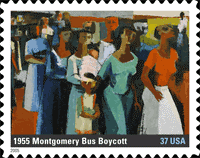
Source: Wikimedia Commons
On December 1, 1955, Rosa Parks made a decision that would become a turning point in American history. In Montgomery, Alabama, local laws known as segregation ordinances required African Americans to sit at the back of city buses and give up their seats to white passengers if the front became full. When a white man boarded and the bus driver ordered Parks to stand, she quietly refused. Parks’ act of resistance was not just an isolated event; it was a response to years of discrimination and injustice faced by African Americans in the South.
Parks’ arrest for violating the segregation laws was swift. Police took her to jail, and her fingerprinted mugshot quickly became a symbol of the struggle against unfair treatment. The news of her arrest spread rapidly, prompting leaders of the African American community, including Dr. Martin Luther King Jr., to organize the Montgomery Bus Boycott. This boycott was a form of collective resistance, where thousands of African Americans refused to ride city buses for over a year. They walked, carpooled, or found other ways to get to work and school, despite facing threats and violence.
The boycott was not only a protest but also a powerful demonstration of unity and determination. It required strategic planning, courage, and sacrifice. The participants faced harsh consequences—many lost jobs or endured harassment—but their solidarity was unwavering. Montgomery’s bus system lost a significant portion of its revenue, revealing the economic power of the Black community. Through sustained effort, the boycott drew national attention to the problem of segregation and the urgent need for change.
Eventually, after 381 days, the U.S. Supreme Court ruled that Montgomery’s bus segregation was unconstitutional. This legal victory was a crucial step forward in the Civil Rights Movement, inspiring similar actions across the country. Parks’ quiet act had become a catalyst for lasting change. She emerged as a symbol of dignity and strength, while the movement itself showed how ordinary citizens could demand justice through peaceful means.
However, the struggle for equality was far from over. The Civil Rights Movement continued for years, confronting other forms of discrimination in education, voting, and public life. Rosa Parks’ story reminds us that change often begins with ordinary people who choose to act against injustice. Her decision, and the boycott that followed, demonstrate how individual actions can ignite powerful movements.
Interesting Fact: After the boycott, Rosa Parks and her family faced ongoing threats and economic hardship, forcing them to move to Detroit, Michigan, where she continued to work for civil rights.
Comprehension quiz (8 questions)
1. When did Rosa Parks refuse her seat?
2. Where did the event take place?
3. Who helped lead the bus boycott?
4. Why did people boycott the buses?
5. What was the effect of the boycott?
6. How did the boycott show solidarity?
7. Rosa Parks was arrested for resistance. True or false?
8. What does 'catalyst' mean?
Common Core standards for Rosa Parks 1955
Explain events, procedures, ideas, or concepts in a historical, scientific, or technical text, including what happened and why, based on specific information in the text.
Determine the meaning of general academic and domain-specific words or phrases in a text relevant to a grade 4 topic or subject area.
Write informative/explanatory texts to examine a topic and convey ideas and information clearly.
Perfect for the way you teach
- Build comprehension skills
- Auto-graded quiz
- Differentiated reading
- Read together at home
- Improve fluency
- Quiet reading time
- Reading curriculum support
- Independent practice
- Track Lexile growth