Sacagawea Helps Lewis and Clark
Interactive passage with audio narration, comprehension questions, and printable PDF.
By completing this purchase you agree to our Terms of Use and Privacy Policy. Your subscription renews automatically until you cancel. You can cancel anytime from your account settings. All sales are final and non-refundable. Digital content is available for download in your account immediately upon purchase.
What's included
Sacagawea Helps Lewis and Clark preview and details
About this printable Sacagawea Helps Lewis and Clark reading passage (Grades 3-5)
Sample passage and quiz from Sacagawea Helps Lewis and Clark
Reading passage and comprehension quiz preview
Sacagawea Lewis Clark
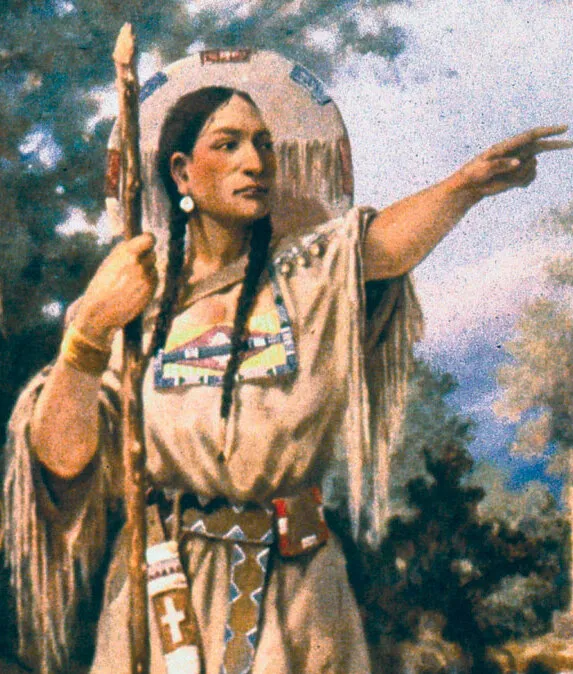
"Sacagawea Detail Lewis & Clark at Three Forks (cropped)" by Edgar Samuel Paxson / Wikimedia Commons (Public domain).
Sacagawea was a young Shoshone woman who played a key role in American history. In 1804, explorers Meriwether Lewis and William Clark led an expedition to explore the lands west of the Mississippi River. These lands were mostly unknown to Americans at the time. Their journey became known as the Lewis and Clark Expedition.
Lewis and Clark needed help to travel safely through these new lands. They did not know the land or the languages spoken by Native American tribes. In 1805, they met Sacagawea. She was only about sixteen years old and had a baby son named Jean Baptiste with her. Even though she was young, Sacagawea joined the expedition as an interpreter and guide.
Sacagawea spoke both Shoshone and Hidatsa. She helped Lewis and Clark talk with Native Americans they met. Her skills helped the group trade for horses, which were needed to cross the Rocky Mountains. She also found wild foods, like roots and berries, that kept the group healthy. Her knowledge of plants and animals was very important on the journey.
As the expedition moved west, Sacagawea faced many challenges. She traveled by foot, boat, and horseback, all while carrying her baby. She stayed calm and helpful even when things got hard. Her presence showed Native American tribes that the group came in peace, because she was a woman with a child. This built trust and made it safer for everyone.
In November 1805, the group reached the Pacific Ocean. The journey was more than 4,000 miles long. Sacagawea had helped them every step of the way. The success of the expedition was possible because of her bravery, knowledge, and teamwork.
Interesting Fact: Sacagawea is one of the few women honored with a statue in the U.S. Capitol for her important role in history.
Comprehension quiz (8 questions)
1. Who was Sacagawea?
2. What did Sacagawea carry during the trip?
3. Where did the expedition end?
4. Why was Sacagawea important to the expedition?
5. How did Sacagawea help with food?
6. What effect did Sacagawea have on Native tribes?
7. Sacagawea was a guide. True or false?
8. What does "expedition" mean?
Common Core standards for Sacagawea Helps Lewis and Clark
Explain events, procedures, ideas, or concepts in a historical, scientific, or technical text, including what happened and why, based on specific information in the text.
Determine the meaning of general academic and domain-specific words or phrases in a text relevant to a grade 4 topic or subject area.
Paraphrase portions of a text read aloud or information presented in diverse media and formats, including visually, quantitatively, and orally.
Write informative/explanatory texts to examine a topic and convey ideas and information clearly.
Perfect for the way you teach
- Build comprehension skills
- Auto-graded quiz
- Differentiated reading
- Read together at home
- Improve fluency
- Quiet reading time
- Reading curriculum support
- Independent practice
- Track Lexile growth