Schools in the Southern Colonies
Interactive passage with audio narration, comprehension questions, and printable PDF.
By completing this purchase you agree to our Terms of Use and Privacy Policy. Your subscription renews automatically until you cancel. You can cancel anytime from your account settings. All sales are final and non-refundable. Digital content is available for download in your account immediately upon purchase.
What's included
Part of this bundle

Schools in the Southern Colonies preview and details
About this printable Schools in the Southern Colonies reading passage (Grades 3-5)
Sample passage and quiz from Schools in the Southern Colonies
Reading passage and comprehension quiz preview
Southern Colonies Education
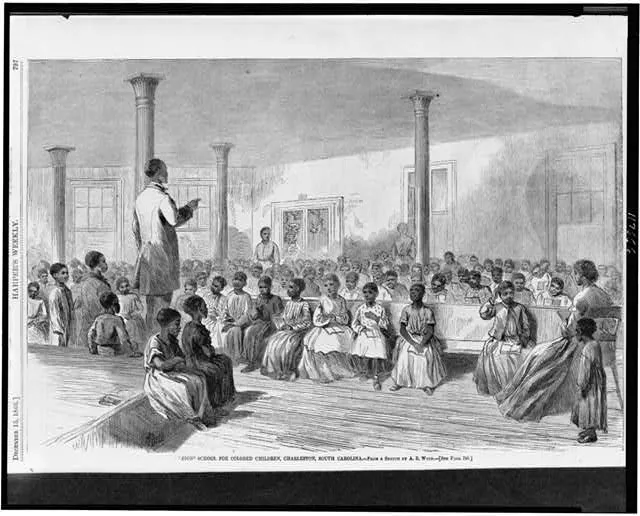
""Zion" school for colored children, Charleston, South Carolina" by Waud, Alfred R. (Alfred Rudolph), 1828-1891 / Library of Congress.
In the Southern Colonies of colonial America, education was not the same for everyone. Children from wealthy families often learned at home with the help of private tutors. These tutors taught reading, writing, math, and sometimes foreign languages. Boys from rich families could also learn about business or farming from their fathers. Girls learned skills for running a home.
Most poor children did not go to school at all. Their families needed them to help on the farm or in the home. There were very few schools in the Southern Colonies, unlike New England where towns built many schools. This was because the Southern Colonies had large farms called plantations that were far apart from each other. It was hard to gather many children in one place for a school.
For enslaved people, education was even more limited. It was often against the law to teach enslaved children to read or write. Slave owners worried that education might lead to rebellion or escape. As a result, most enslaved people never learned to read or write in the Southern Colonies.
This system created inequality in education. Wealthy children had the chance to learn and prepare for future jobs. Poor children and enslaved people had few opportunities. This meant that most people in the South could not read or write well. Only a small group of people had the power and knowledge that came from education.
Some religious groups tried to teach poor children, but they did not reach everyone. Over time, people started to see that education was important for all. However, big changes did not come until many years later.
In summary, education in the Southern Colonies depended on your family's wealth and status. Private tutors helped the rich, while most poor and enslaved children were left out. This created gaps in learning that lasted for many years.
Interesting Fact: Thomas Jefferson, a leader from Virginia, wanted free public schools for all children, but his idea did not happen until much later.
Comprehension quiz (8 questions)
1. Who taught wealthy children at home?
2. Why were there few schools in the South?
3. Who had the least chance for education?
4. What did girls in wealthy families learn?
5. What effect did few schools have?
6. Why did slave owners fear education for enslaved people?
7. Education was equal for all in the South.
8. What is "inequality" as used in the passage?
Common Core standards for Schools in the Southern Colonies
Explain events, procedures, ideas, or concepts in a historical, scientific, or technical text, including what happened and why, based on specific information in the text.
Determine the meaning of general academic and domain-specific words or phrases in a text relevant to a grade 4 topic or subject area.
Write informative/explanatory texts to examine a topic and convey ideas and information clearly.
Perfect for the way you teach
- Build comprehension skills
- Auto-graded quiz
- Differentiated reading
- Read together at home
- Improve fluency
- Quiet reading time
- Reading curriculum support
- Independent practice
- Track Lexile growth