This learning resource is available in interactive and printable formats. The interactive worksheet can be played online and assigned to students. The Printable PDF version can be downloaded and printed for completion by hand.
This passage explores the causes, events, and impact of the Seneca Falls Convention of 1848, a milestone in the U.S. women's rights movement. Students will analyze the motivations of key figures such as Elizabeth Cady Stanton and Frederick Douglass, examine contrasting perspectives on gender equality, and evaluate the convention's legacy. The text integrates primary sources, academic vocabulary, and a nuanced analysis to help students understand the complexities of social reform in 19th-century America. Activities include a timeline, reading comprehension quiz, writing prompts, and a graphic organizer, all designed to meet D2.His.2.3-5, D2.His.3.3-5, RI.4.3, RI.4.4, and W.4.2 standards. Read aloud audio and a full Spanish translation support diverse learners. This resource develops historical reasoning and ELA skills while deepening knowledge of a pivotal moment in the fight for equality.
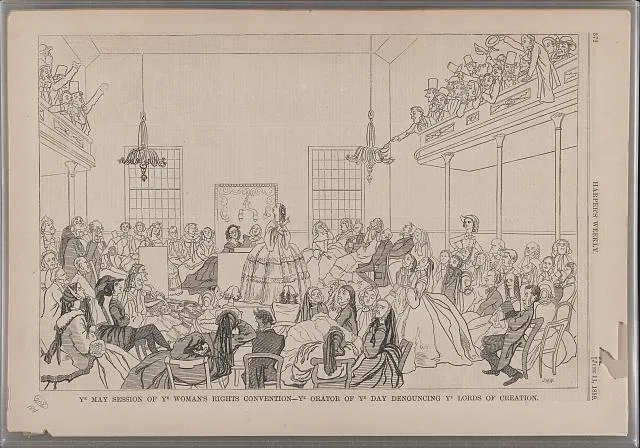
Ye May session of ye woman's rights convention - ye orator of ye day denouncing ye lords of creation Source: Library of Congress
The Seneca Falls Convention of 1848 marked a turning point in the fight for equality in the United States. Held in Seneca Falls, New York, this gathering brought together women and men who challenged the nation's laws and customs that denied women basic rights. At that time, women could not vote, own property after marriage, or hold most jobs. The organizers believed these restrictions were unfair and decided to take action to address the problem.
Elizabeth Cady Stanton and Lucretia Mott, both experienced activists, led the effort to organize the convention. They were motivated by years of frustration with discrimination against women. Stanton, in particular, had experienced exclusion at earlier reform meetings, which inspired her to call for a women's rights gathering. But even among reformers, there were disagreements. Some supporters feared the idea of women's suffrage—the right to vote—was too radical and would hurt their cause.
The convention attracted nearly 300 people, including men like Frederick Douglass, a former enslaved person and well-known abolitionist. Douglass supported women's rights, arguing that "right is of no sex, truth is of no color." This quote from Douglass highlighted the belief that justice should not depend on gender or race. His presence at Seneca Falls showed that the fight for equality could unite different reform movements, even if not everyone agreed on every issue.
At Seneca Falls, the attendees debated and approved the "Declaration of Sentiments," a document modeled after the Declaration of Independence. The declaration stated, "We hold these truths to be self-evident: that all men and women are created equal." This bold statement called for changes to laws and customs that kept women in a lower status. The declaration listed specific grievances, such as the lack of property rights, educational opportunities, and the inability to participate fully in government.
However, not all participants agreed on the solutions. The demand for women's suffrage was the most controversial part of the declaration. Some attendees thought it would alienate potential supporters. Others, including Stanton and Douglass, argued that true equality required women to have the vote. After heated discussion, the convention narrowly approved the suffrage resolution. This decision set a precedent for the women's rights movement, although it would take many decades to achieve full voting rights.
The Seneca Falls Convention did not immediately change laws or grant women new rights. In fact, many newspapers mocked the idea of women's equality, reflecting the deep resistance in American society. Still, the convention inspired similar meetings and created a network of activists who continued to push for change. The event showed that social reform is often complex and requires cooperation, compromise, and persistence.
From today's perspective, the Seneca Falls Convention is significant because it showed how determined individuals could challenge injustice and begin to reshape society. It also reminds us that progress is rarely simple. Different groups—men and women, Black and white Americans, moderate and radical reformers—each brought their own perspectives and faced their own barriers. The debates and disagreements at Seneca Falls were part of a larger struggle for democracy and citizenship in the United States.
Legacy is another important concept to consider. The convention's legacy was not immediate victory, but the beginning of a movement that eventually won major changes in American law and society. By analyzing the causes, conflicts, and consequences at Seneca Falls, we can better understand how social change happens—and why it is often difficult and slow.
Interesting Fact: Only one of the original signers of the Declaration of Sentiments, Charlotte Woodward, lived to see women gain the right to vote in 1920.
Where was the Seneca Falls Convention held?
Seneca Falls, New YorkBoston, MassachusettsPhiladelphia, PennsylvaniaAlbany, New York
Who helped organize the convention?
Elizabeth Cady StantonSusan B. AnthonyHarriet TubmanSojourner Truth
What year did the convention take place?
1848192017761865
Why was suffrage controversial at the convention?
It seemed too radicalFew women wanted to voteMen could not voteIt was already law
What did the Declaration of Sentiments demand?
Changes to unfair lawsAn end to slaveryWar with BritainNew taxes
What was Frederick Douglass's role?
Supported women's rightsWas against the conventionOrganized the eventWrote the Declaration
The Seneca Falls Convention led to quick legal changes. True or false?
TrueFalse
What does 'legacy' mean in the passage?
Lasting impact of an eventA type of lawA person's opinionA formal meeting
Perfect For:
👩🏫 Teachers
• Reading comprehension practice
• Auto-graded assessments
• Literacy skill development
👨👩👧👦 Parents
• Reading practice at home
• Comprehension improvement
• Educational reading time
🏠 Homeschoolers
• Reading curriculum support
• Independent reading practice
• Progress monitoring
Reading Features:
📖
Reading Passage
Engaging fiction or nonfiction text
❓
Comprehension Quiz
Auto-graded questions
📊
Instant Feedback
Immediate results and scoring
📄
Printable Version
Download for offline reading
🔊
Read Aloud
Voice-over with word highlighting
Related Content
Informational Text —Healthy Teeth and Gums
RI.4.10RI.4.3RF.4.4RF.4.4.A
Natural Disasters and Urban flooding
This reading comprehension worksheet focuses on the topic of natural disasters, specifically urban flooding. Following t...
RI.4.44-ESS3ESS3.B4-ESS3-1
The Formation of Fossils
L.4.2.DL.4.6RI.4.4
Climate and Water Cycle
W.4.2.ARI.4.4RI.4.1
Ocean Acidification
Download this reading comprehension worksheet about ocean acidification. The worksheet includes an informational text ab...
RI.4.4
Informational Text —The History of Toothpaste
RI.4.4RI.4.4
Informational Text —Migratory Birds
Engage young minds with this worksheet that delves into the wonders of migratory birds. Learn about their extraordinary ...
RI.4.10RI.4.3RF.4.4RF.4.4.A
Informational Text —All About Dentists
Students read an informational text explaining what dentists do and how they are trained. Aligned to RI.4.3-2
RI.4.10RI.4.3RF.4.4RF.4.4.A
Understanding Climate Action Context Clues
Understanding Climate Action" worksheet, aligned with CCS L.4.4.A and NGSS. This resource introduces key concepts such a...
L.4.4.ARI.4.1RI.4.4
Pollination: A Crucial Ecosystem Service
Explore the vital role of pollination beyond plant reproduction, as it sustains ecosystems by ensuring food security, pr...
RI.4.2RI.4.3RI.4.4RI.5.1
The States of Matter: Solid
Discover the differences between solids, liquids and gases by exploring how their particles are arranged and move. This ...
RI.4.2RI.4.3RI.4.4RI.5.1
What is a Simple Machine
Discover the power of simple machines! This informational text explores how basic tools like levers, pulleys and incline...
RI.4.2RI.4.3RI.4.4RI.5.1
The Role of Pollinators in Nature
Learn about the fascinating world of pollinators and discover their crucial role in the reproductive process of flowerin...
RI.4.2RI.4.3RI.4.4RI.5.1
Seed Dispersal: How Plants Travel
Plants may seem stationary, but their seeds have amazing ways to travel! Explore the fascinating world of seed dispersal...
RI.4.2RI.4.3RI.4.4RI.5.1
Sunspots and Solar Flares
This quiz is designed to test your understanding of the fascinating phenomena of sunspots and solar flares, as described...
RI.4.1RI.4.4RI.5.1ESS1.A
Learn about the Inner Planets
The inner planets of our solar system—Mercury, Venus, Earth, and Mars—are fascinating worlds made of rock and metal. Clo...
RI.4.4RI.4.2
The Sun: Our Nearest Star
The Sun is the heart of our solar system and the closest star to Earth. Composed of hot plasma, the Sun generates energy...
RI.4.4RI.4.2
Exploring Space: Rockets and Spacecraft
Space exploration has been one of humanity's greatest achievements, made possible by rockets and spacecraft. Rockets act...
RI.4.4RI.4.2
Understanding the Inner Planets
The inner planets of the solar system—Mercury, Venus, Earth, and Mars—are known for their solid, rocky surfaces. Mercury...
RI.4.4RI.4.2
The Sun: Our Special Star
The Sun is the closest star to Earth and the center of our solar system.