Sequoyah: Cherokee Written Language — Reading Comprehension
Rate this
Premium Resource
Present
Present in classroom. No work saved
Assign
Classroom with student accounts, Track progress
Quick Play
No student accounts, assign with a link
Grades
6
7
8
Standards
D2.HIS.2.3-5
D2.HIS.3.3-5
RI.4.3
RI.4.4
W.4.2
PRINT+DIGITAL RESOURCE
This learning resource is available in interactive and printable formats. The interactive worksheet can be played online and assigned to students. The Printable PDF version can be downloaded and printed for completion by hand.
This passage explores the life and achievements of Sequoyah, the Cherokee silversmith and inventor who created the Cherokee syllabary. Students will analyze the causes and consequences of Sequoyah's work, explore multiple perspectives on the adoption of written language among the Cherokee, and examine the broader historical context of Native American cultural preservation and adaptation. The passage models historical reasoning and integrates a primary source quote, disciplinary vocabulary, and a nuanced point of view. Activities include a reading comprehension quiz, writing prompts focused on causation and historical evidence, a T-Chart graphic organizer comparing perspectives, and a timeline of key events. All resources are aligned to D2.His.2.3-5, D2.His.3.3-5, RI.4.3, RI.4.4, and W.4.2 standards. This is a history reading passage with read aloud audio and Spanish translation, designed to challenge students to think critically about the past and its ongoing significance.
CONTENT PREVIEW
Expand content preview
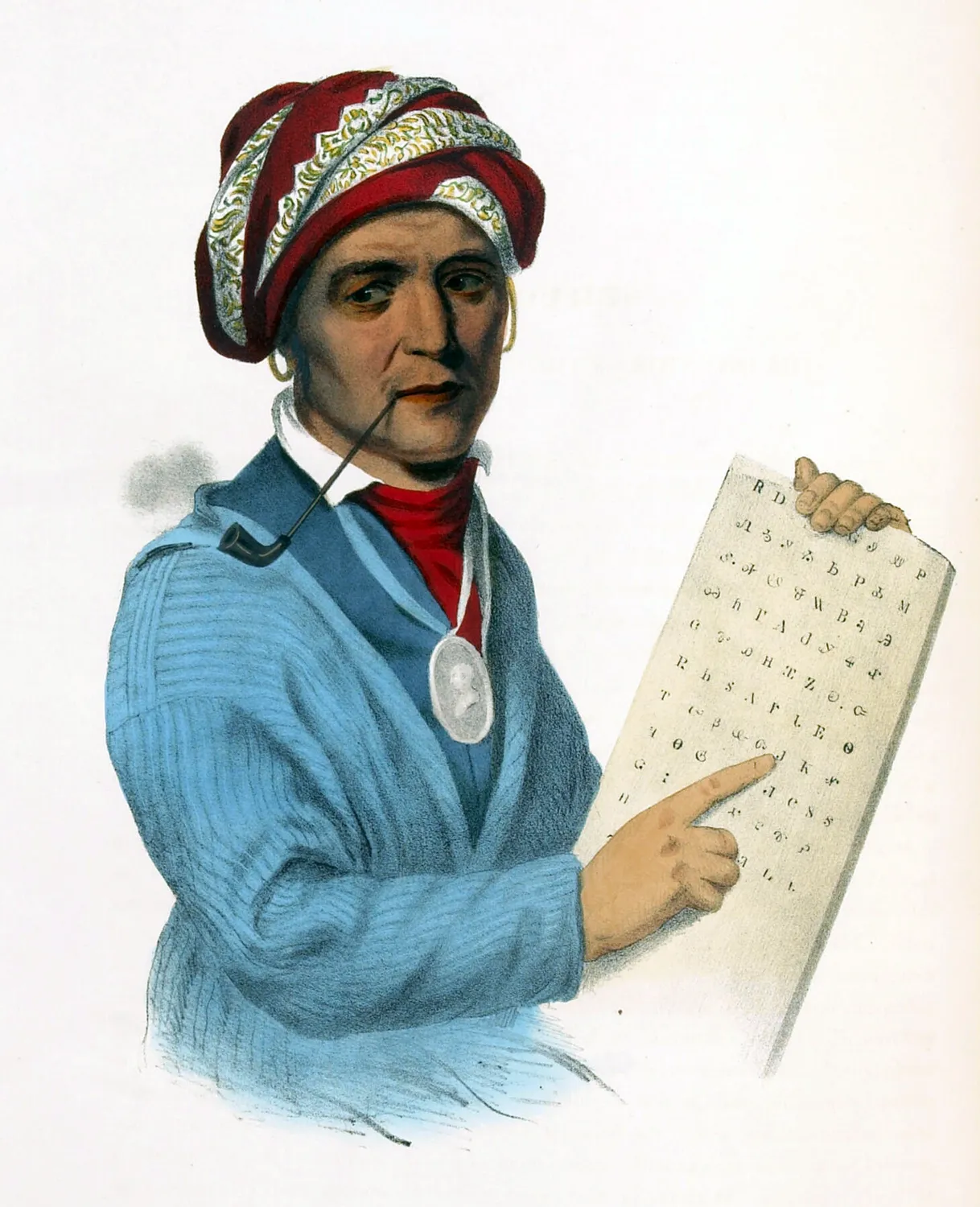
"Sequoyah" by Lithographer: Lehman and Duval (George Lehman (d.1870); Peter S. Duval) Painter: Henry Inman (1801-20-28 - 1846-01-17); copy after a painting by Charles Bird King (1785 - 1862) which was lost in a fire in the Smithsonian in 1865. / Wikimedia Commons (Public domain).
The Cherokee Nation became one of the first Native American nations to develop a written language when Sequoyah, a talented silversmith and trader, invented the Cherokee syllabary in the early 1800s. A syllabary is a set of written symbols, each representing a syllable, which is a unit of sound in spoken language. Sequoyah’s achievement was remarkable because he had no prior experience with reading or writing any language. He understood that written language could bring power, opportunity, and preservation to the Cherokee people during a time of tremendous change and conflict in the United States.
At the time, U.S. westward expansion threatened the land and sovereignty of many Native nations, including the Cherokee. Sequoyah noticed that European Americans used written documents to create laws, record history, and communicate across great distances. The Cherokee, who relied on oral traditions, faced challenges in defending their rights and maintaining their culture. Sequoyah identified this as a serious problem, believing that literacy—the ability to read and write—would help the Cherokee compete and survive.
Sequoyah dedicated years to developing his system despite skepticism and resistance from some members of his community, who feared it would bring unwanted change or undermine tradition. Through trial and error, he created 85 symbols—each one representing a sound in the Cherokee language. This innovation made it possible for Cherokee speakers to learn to read and write in their own language in just a few weeks. The adoption of the syllabary spread rapidly. Within a short period, thousands of Cherokee became literate, an extraordinary achievement compared to many U.S. communities at the time.
The written syllabary allowed the Cherokee to publish newspapers, write books, and keep official records. One of the first Native American newspapers in the United States, the Cherokee Phoenix, began publishing in 1828 in both Cherokee and English. This development strengthened Cherokee identity, supported self-government, and allowed for the preservation of their stories and laws. However, despite these successes, the Cherokee still faced forced removal from their lands through policies such as the Indian Removal Act. The resilience of the Cherokee people was tested, but their written language helped maintain cultural bonds and share information during these difficult times.
Sequoyah’s work is an example of how individuals can respond to historical challenges with creativity and persistence. His accomplishment not only helped the Cherokee Nation but also inspired other Indigenous groups to create or adapt written systems for their languages. The story of Sequoyah and the Cherokee syllabary reminds us that innovation can be a powerful tool for survival and cultural continuity.
Interesting Fact: Sequoyah never learned to speak, read, or write English, yet his invention made the Cherokee one of the most literate groups in North America by the 1830s.
Who invented the Cherokee syllabary?
SequoyahSitting BullTecumsehChief Joseph
What is a syllabary?
A set of symbols for syllablesA law bookA type of foodA musical instrument
When was the Cherokee Phoenix first published?
1828186018001789
Why did Sequoyah invent the syllabary?
To help Cherokee preserve cultureTo create a new alphabet for EnglishTo make jewelryTo move west
How did the syllabary help the Cherokee?
Allowed them to publish newspapersHelped them build housesGave them new landTaught them English
What challenge did the Cherokee face?
Loss of landToo much foodBoredomPeace with settlers
Sequoyah learned to read English.
TrueFalse
What does 'literacy' mean?
Ability to read and writeAbility to cookAbility to travelAbility to sing
Perfect For:
👩🏫 Teachers
• Reading comprehension practice
• Auto-graded assessments
• Literacy skill development
👨👩👧👦 Parents
• Reading practice at home
• Comprehension improvement
• Educational reading time
🏠 Homeschoolers
• Reading curriculum support
• Independent reading practice
• Progress monitoring
Reading Features:
📖
Reading Passage
Engaging fiction or nonfiction text
❓
Comprehension Quiz
Auto-graded questions
📊
Instant Feedback
Immediate results and scoring
📄
Printable Version
Download for offline reading
🔊
Read Aloud
Voice-over with word highlighting
Reviews & Ratings
No reviews yet. Be the first to share your experience!
Related Content
Native American Tribes Across America
This engaging history reading passage introduces students to Native American tribes across America, focusing on their da...
D2.HIS.1.3-5D2.HIS.2.3-5RI.4.1RI.4.2
Teepees: Homes on the Great Plains
This engaging history reading passage introduces students to teepees, the unique homes of Native American tribes on the ...
D2.HIS.2.3-5D2.HIS.14.3-5RI.4.1RI.4.2RI.4.4
Traditional Native American Clothing
This engaging history passage explores traditional Native American clothing and how it reflected the environment, values...
D2.HIS.2.3-5D2.HIS.3.3-5RI.4.3RI.4.4
The Iroquois Confederacy: A System of Peace
This engaging U.S. History reading passage introduces students to the Iroquois Confederacy, a powerful alliance of Nativ...
D2.HIS.2.3-5D2.HIS.3.3-5RI.4.3RI.4.4
The Cherokee Nation: History and Culture
This reading passage explores the rich history and culture of the Cherokee Nation, one of the largest Native American tr...
D2.HIS.2.3-5D2.HIS.14.3-5RI.4.3RI.4.4RI.4.10
The Sioux: Warriors and Tribal Leaders
This history reading passage explores the Sioux Nation, focusing on their roles as warriors and tribal leaders. Students...
D2.HIS.1.3-5D2.HIS.2.3-5RI.4.1RI.4.3
Native American Respect for Nature
This engaging history reading passage explores Native American respect for nature, emphasizing the close relationship be...
D2.HIS.2.3-5D2.HIS.3.3-5RI.4.3RI.4.4
Jamestown: The First Permanent English Colony
This engaging history passage explores the founding of Jamestown, the first permanent English colony in America. Aligned...
D2.HIS.1.3-5D2.HIS.2.3-5RI.4.3RI.4.4
Pocahontas and the Powhatan People
This engaging reading passage explores the life of Pocahontas and the Powhatan people and their important role in early ...
D2.HIS.1.3-5D2.HIS.2.3-5RI.4.1RI.4.3
Colonial Children: School and Chores
This reading passage explores the daily lives of colonial children, focusing on their experiences at school and their ma...
D2.HIS.2.3-5D2.HIS.3.3-5RI.4.1RI.4.2RI.4.4
Colonial Clothing and Homemade Goods
This engaging U.S. history passage explores the daily life of early American colonists with a focus on colonial clothing...
D2.HIS.2.3-5RI.4.3RI.4.4
Colonial Jobs: Blacksmiths, Bakers, and Craftsmen
This engaging history reading passage explores the vital roles of blacksmiths, bakers, and craftsmen in colonial America...
D2.HIS.2.3-5D2.HIS.3.3-5RI.4.3RI.4.4
Colonial Towns and Village Life
This engaging history reading passage explores the daily life, work, and unity found in colonial towns and villages. Ali...
D2.HIS.1.3-5D2.HIS.2.3-5RI.4.3RI.4.4
Colonial Trade with England and Africa
This history reading passage explores colonial trade between the American colonies, England, and Africa, focusing on the...
D2.HIS.2.3-5D2.HIS.14.3-5RI.4.3RI.4.4
Benjamin Franklin: Printer, Inventor, and Leader
This history reading passage explores the life and achievements of Benjamin Franklin, one of America's most important ea...
D2.HIS.2.3-5D2.HIS.3.3-5RI.4.1RI.4.3
George Washington Leads the Army
This engaging history reading passage explores how George Washington bravely led the Continental Army during the America...
D2.HIS.1.3-5D2.HIS.2.3-5RI.4.3RI.4.4
Women and Children During the Revolutionary War
This reading passage explores the important roles women and children played during the Revolutionary War. Students will ...
D2.HIS.2.3-5RI.4.3RI.5.3
African Americans Fight for Freedom
This educational passage explores the brave and inspiring story of how African Americans fought for freedom in the Unite...
D2.HIS.2.3-5D2.HIS.3.3-5RI.4.3RI.4.4
The Battle of Yorktown Ends War
This engaging U.S. history reading passage explores the Battle of Yorktown, a key event that ended the American Revoluti...
D2.HIS.1.3-5D2.HIS.2.3-5RI.4.1RI.4.3
Loyalists vs. Patriots: Divided Families
This engaging U.S. history reading passage explores the division between Loyalists and Patriots during the American Revo...