This learning resource is available in interactive and printable formats. The interactive worksheet can be played online and assigned to students. The Printable PDF version can be downloaded and printed for completion by hand.
This engaging history reading passage explores the development and impact of Hull House and its co-founder Jane Addams within the broader context of the Progressive Era and the settlement house movement. Designed for middle school students, it employs a compare and contrast structure to analyze the causes, motivations, and consequences of social reform efforts in urban America. The passage examines multiple perspectives, including those of immigrants, reformers, and local residents, and integrates a primary source quote for deeper historical understanding. Students will encounter key vocabulary words, a timeline of significant events, glossary, and critical thinking activities. This resource aligns with D2.His.2.3-5, D2.His.3.3-5, RI.4.3, RI.4.4, and W.4.2, and includes read aloud audio and a full Spanish translation to support diverse learners.
CONTENT PREVIEW
Expand content preview
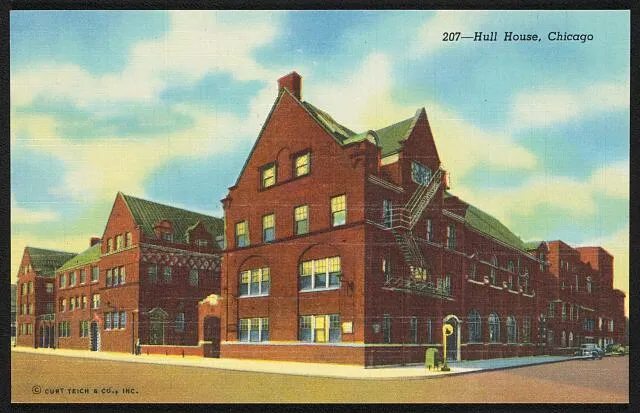
"Hull House, Chicago" / Library of Congress.
During the Progressive Era in the late nineteenth and early twentieth centuries, the United States experienced rapid urban growth and a surge of immigration. Many newcomers settled in crowded city neighborhoods, often facing poverty, language barriers, and discrimination. One response to these problems was the creation of settlement houses, which were community centers established in poor urban areas. These houses aimed to provide educational, social, and health-related services to help immigrants adjust to American life.
The idea for settlement houses began in England and soon spread to the United States. The most famous American example was Hull House, founded by Jane Addams and Ellen Gates Starr in Chicago in 1889. Hull House offered classes in English, job training, childcare, and recreational activities. The goal was to support families as they navigated their new environment. Settlement houses often included libraries, art rooms, and medical clinics, aiming to improve living conditions in the neighborhood.
Unlike traditional charities, settlement houses encouraged reformers—many of whom were middle-class women—to live and work alongside the people they served. This approach fostered understanding and cooperation between different groups. Reformers believed that by sharing daily life, they could better identify community needs and develop practical solutions. They also advocated for broader social reforms, such as child labor laws and improved housing standards.
Despite their positive impact, settlement houses faced significant challenges. They often struggled with limited funding and resistance from those who opposed change. Sometimes, efforts to help immigrants were shaped by the reformers’ own values, which did not always match the traditions of the people they aimed to serve. These tensions sometimes led to misunderstandings or conflicts within the community.
Nonetheless, settlement houses played a crucial role in American society. They helped thousands of immigrants gain skills and find a sense of belonging. Many leaders in education, public health, and social work began their careers in settlement houses, inspired by their mission of service. The legacy of these institutions can still be seen today in community centers and social service agencies across the country.
Interesting Fact: The Hull House complex eventually grew to include 13 buildings and a summer camp, serving as a model for hundreds of other settlement houses nationwide.
Who founded Hull House?
Jane Addams & Ellen Gates StarrSusan B. Anthony & Alice PaulElizabeth Cady Stanton & Lucretia MottMary McLeod Bethune & Ida B. Wells
When was Hull House founded?
1889191918651776
What was a main goal of settlement houses?
Help immigrants adaptBuild factoriesCreate new statesStart new cities
How did settlement houses differ from charities?
Reformers lived with the communityThey only gave moneyThey were banksThey were government offices
What problem did settlement houses try to solve?
Poverty and poor living conditionsCity government corruptionFactory pollutionVoting rights only
Why did some efforts cause tension?
Reformers' values differed from immigrants'They closed schoolsThey banned jobsThey stopped all traditions
Hull House was a type of settlement house. True or false?
TrueFalse
What is a 'reformer'?
Person who works for changeSomeone who sells goodsA mayor of a cityA person who immigrates
Perfect For:
👩🏫 Teachers
• Reading comprehension practice
• Auto-graded assessments
• Literacy skill development
👨👩👧👦 Parents
• Reading practice at home
• Comprehension improvement
• Educational reading time
🏠 Homeschoolers
• Reading curriculum support
• Independent reading practice
• Progress monitoring
Reading Features:
📖
Reading Passage
Engaging fiction or nonfiction text
❓
Comprehension Quiz
Auto-graded questions
📊
Instant Feedback
Immediate results and scoring
📄
Printable Version
Download for offline reading
🔊
Read Aloud
Voice-over with word highlighting
Reviews & Ratings
No reviews yet. Be the first to share your experience!
Related Content
Native American Tribes Across America
This engaging history reading passage introduces students to Native American tribes across America, focusing on their da...
D2.HIS.1.3-5D2.HIS.2.3-5RI.4.1RI.4.2
Teepees: Homes on the Great Plains
This engaging history reading passage introduces students to teepees, the unique homes of Native American tribes on the ...
D2.HIS.2.3-5D2.HIS.14.3-5RI.4.1RI.4.2RI.4.4
Traditional Native American Clothing
This engaging history passage explores traditional Native American clothing and how it reflected the environment, values...
D2.HIS.2.3-5D2.HIS.3.3-5RI.4.3RI.4.4
The Iroquois Confederacy: A System of Peace
This engaging U.S. History reading passage introduces students to the Iroquois Confederacy, a powerful alliance of Nativ...
D2.HIS.2.3-5D2.HIS.3.3-5RI.4.3RI.4.4
The Cherokee Nation: History and Culture
This reading passage explores the rich history and culture of the Cherokee Nation, one of the largest Native American tr...
D2.HIS.2.3-5D2.HIS.14.3-5RI.4.3RI.4.4RI.4.10
The Sioux: Warriors and Tribal Leaders
This history reading passage explores the Sioux Nation, focusing on their roles as warriors and tribal leaders. Students...
D2.HIS.1.3-5D2.HIS.2.3-5RI.4.1RI.4.3
Native American Respect for Nature
This engaging history reading passage explores Native American respect for nature, emphasizing the close relationship be...
D2.HIS.2.3-5D2.HIS.3.3-5RI.4.3RI.4.4
Jamestown: The First Permanent English Colony
This engaging history passage explores the founding of Jamestown, the first permanent English colony in America. Aligned...
D2.HIS.1.3-5D2.HIS.2.3-5RI.4.3RI.4.4
Pocahontas and the Powhatan People
This engaging reading passage explores the life of Pocahontas and the Powhatan people and their important role in early ...
D2.HIS.1.3-5D2.HIS.2.3-5RI.4.1RI.4.3
Colonial Children: School and Chores
This reading passage explores the daily lives of colonial children, focusing on their experiences at school and their ma...
D2.HIS.2.3-5D2.HIS.3.3-5RI.4.1RI.4.2RI.4.4
Colonial Clothing and Homemade Goods
This engaging U.S. history passage explores the daily life of early American colonists with a focus on colonial clothing...
D2.HIS.2.3-5RI.4.3RI.4.4
Colonial Jobs: Blacksmiths, Bakers, and Craftsmen
This engaging history reading passage explores the vital roles of blacksmiths, bakers, and craftsmen in colonial America...
D2.HIS.2.3-5D2.HIS.3.3-5RI.4.3RI.4.4
Colonial Towns and Village Life
This engaging history reading passage explores the daily life, work, and unity found in colonial towns and villages. Ali...
D2.HIS.1.3-5D2.HIS.2.3-5RI.4.3RI.4.4
Colonial Trade with England and Africa
This history reading passage explores colonial trade between the American colonies, England, and Africa, focusing on the...
D2.HIS.2.3-5D2.HIS.14.3-5RI.4.3RI.4.4
Benjamin Franklin: Printer, Inventor, and Leader
This history reading passage explores the life and achievements of Benjamin Franklin, one of America's most important ea...
D2.HIS.2.3-5D2.HIS.3.3-5RI.4.1RI.4.3
George Washington Leads the Army
This engaging history reading passage explores how George Washington bravely led the Continental Army during the America...
D2.HIS.1.3-5D2.HIS.2.3-5RI.4.3RI.4.4
Women and Children During the Revolutionary War
This reading passage explores the important roles women and children played during the Revolutionary War. Students will ...
D2.HIS.2.3-5RI.4.3RI.5.3
African Americans Fight for Freedom
This educational passage explores the brave and inspiring story of how African Americans fought for freedom in the Unite...
D2.HIS.2.3-5D2.HIS.3.3-5RI.4.3RI.4.4
The Battle of Yorktown Ends War
This engaging U.S. history reading passage explores the Battle of Yorktown, a key event that ended the American Revoluti...
D2.HIS.1.3-5D2.HIS.2.3-5RI.4.1RI.4.3
Loyalists vs. Patriots: Divided Families
This engaging U.S. history reading passage explores the division between Loyalists and Patriots during the American Revo...