Sherman's March to Sea 1864 — Reading Comprehension
Rate this
Present
Present in classroom. No work saved
Assign
Classroom with student accounts, Track progress
Quick Play
No student accounts, assign with a link
Grades
6
7
8
Standards
D2.HIS.2.3-5
D2.HIS.3.3-5
RI.4.3
RI.4.4
W.4.2
PRINT+DIGITAL RESOURCE
This learning resource is available in interactive and printable formats. The interactive worksheet can be played online and assigned to students. The Printable PDF version can be downloaded and printed for completion by hand.
This detailed history reading passage examines Sherman's March to the Sea in 1864, an event that marked a turning point in the American Civil War. Students will analyze the causes, strategies, and consequences of General William Tecumseh Sherman's military campaign from Atlanta to Savannah, Georgia. The passage uses compare/contrast text structure and integrates multiple perspectives, including those of Union soldiers, Confederate civilians, and enslaved people. Key vocabulary such as 'total war,' 'scorched earth,' and 'infrastructure' is highlighted and defined. The passage models historical reasoning, incorporates a primary source quote, and ends with an interesting fact. Also included are a rigorous quiz, writing prompts, a timeline, and a graphic organizer, all aligned to C3 Framework and Common Core standards (D2.His.2.3-5, D2.His.3.3-5, RI.4.3, RI.4.4, W.4.2). Read aloud audio and full Spanish translation support accessibility and ELA skill-building.
CONTENT PREVIEW
Expand content preview
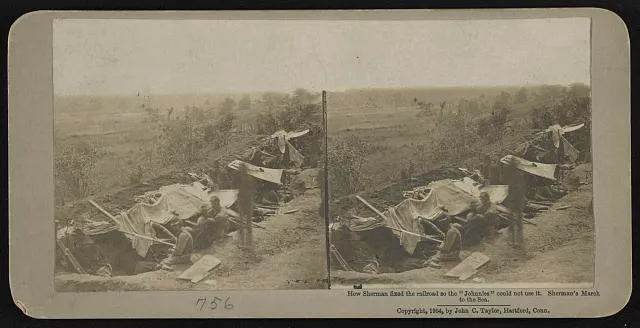
How Sherman fixed the railroad so the "Johnnies" could not use it. Sherman's march to the sea. Source: Library of Congress - O'Sullivan, Timothy H., 1840-1882
In 1864, during the American Civil War, Union General William T. Sherman led a military campaign known as the March to the Sea. Sherman began his march in the city of Atlanta, Georgia, and moved his army toward the coastal city of Savannah. His goal was to weaken the Confederacy's ability to fight by destroying not only enemy armies but also the South’s resources and infrastructure. This strategy, called total war, targeted railroads, farms, factories, and supplies that supported the Southern war effort.
Sherman's army of about 60,000 soldiers faced little direct resistance as they moved across Georgia. Rather than fighting large battles, they focused on breaking the South’s morale and ability to supply its troops. Soldiers tore up railroad tracks, burned barns and crops, and took food and livestock. The destruction made it difficult for the Confederates to move troops and supplies, creating shortages for both soldiers and civilians. Many civilians suffered losses as homes and towns were damaged or destroyed.
The march covered around 250 miles, taking about a month to complete. Sherman's forces split into two columns to cover more ground and confuse Confederate defenders. This strategy made it hard for Southern leaders to predict where the Union army would strike next. By the time Sherman reached Savannah in December 1864, his army had cut a wide path of destruction through Georgia. Savannah surrendered without a fight, and Sherman sent a famous telegram to President Abraham Lincoln, offering the city as a "Christmas gift."
Sherman's March was controversial, even at the time. Supporters argued that the campaign helped end the war more quickly by breaking the South’s will to fight. Critics claimed the use of total war harmed innocent people and was too harsh. The march showed how war can affect not only armies but entire populations. It raised questions about the ethics of targeting civilian property and the long-term consequences of such actions.
The impact of Sherman's March was significant. The destruction of railroads, crops, and factories crippled the Confederate economy and military. Many Southern families were left with nothing. The psychological effect was just as important, convincing many Southerners that victory was impossible. Sherman's tactics have been studied by military leaders ever since, showing how strategy and logistics can determine the outcome of a conflict.
Interesting Fact: Sherman's soldiers became known as "bummers" for foraging supplies from local farms, and some even left behind humorous notes for Southern homeowners.
Who led the March to the Sea?
General William T. ShermanAbraham LincolnRobert E. LeeUlysses S. Grant
Where did Sherman's march begin?
AtlantaRichmondSavannahGettysburg
Which city did Sherman offer as a "Christmas gift"?
SavannahCharlestonAtlantaVicksburg
What was 'total war' in this context?
Attacking all resources, not just armiesOnly fighting enemy soldiersAvoiding battlesHelping civilians
How did Sherman weaken the Confederacy?
Destroyed railroads and suppliesBuilt new factoriesSigned peace treatiesAdded more soldiers
What effect did the march have on civilians?
Many lost homes and foodGained more suppliesMoved to the NorthBecame soldiers
Sherman's March covered about 250 miles. True or false?
TrueFalse
What does 'morale' mean in the passage?
Confidence and spiritA type of weaponA supply trainA city in Georgia
Perfect For:
👩🏫 Teachers
• Reading comprehension practice
• Auto-graded assessments
• Literacy skill development
👨👩👧👦 Parents
• Reading practice at home
• Comprehension improvement
• Educational reading time
🏠 Homeschoolers
• Reading curriculum support
• Independent reading practice
• Progress monitoring
Reading Features:
📖
Reading Passage
Engaging fiction or nonfiction text
❓
Comprehension Quiz
Auto-graded questions
📊
Instant Feedback
Immediate results and scoring
📄
Printable Version
Download for offline reading
🔊
Read Aloud
Voice-over with word highlighting
Reviews & Ratings
No reviews yet. Be the first to share your experience!
Related Content
Native American Tribes Across America
This engaging history reading passage introduces students to Native American tribes across America, focusing on their da...
D2.HIS.1.3-5D2.HIS.2.3-5RI.4.1RI.4.2
Teepees: Homes on the Great Plains
This engaging history reading passage introduces students to teepees, the unique homes of Native American tribes on the ...
D2.HIS.2.3-5D2.HIS.14.3-5RI.4.1RI.4.2RI.4.4
Traditional Native American Clothing
This engaging history passage explores traditional Native American clothing and how it reflected the environment, values...
D2.HIS.2.3-5D2.HIS.3.3-5RI.4.3RI.4.4
The Iroquois Confederacy: A System of Peace
This engaging U.S. History reading passage introduces students to the Iroquois Confederacy, a powerful alliance of Nativ...
D2.HIS.2.3-5D2.HIS.3.3-5RI.4.3RI.4.4
The Cherokee Nation: History and Culture
This reading passage explores the rich history and culture of the Cherokee Nation, one of the largest Native American tr...
D2.HIS.2.3-5D2.HIS.14.3-5RI.4.3RI.4.4RI.4.10
The Sioux: Warriors and Tribal Leaders
This history reading passage explores the Sioux Nation, focusing on their roles as warriors and tribal leaders. Students...
D2.HIS.1.3-5D2.HIS.2.3-5RI.4.1RI.4.3
Native American Respect for Nature
This engaging history reading passage explores Native American respect for nature, emphasizing the close relationship be...
D2.HIS.2.3-5D2.HIS.3.3-5RI.4.3RI.4.4
Jamestown: The First Permanent English Colony
This engaging history passage explores the founding of Jamestown, the first permanent English colony in America. Aligned...
D2.HIS.1.3-5D2.HIS.2.3-5RI.4.3RI.4.4
Pocahontas and the Powhatan People
This engaging reading passage explores the life of Pocahontas and the Powhatan people and their important role in early ...
D2.HIS.1.3-5D2.HIS.2.3-5RI.4.1RI.4.3
Colonial Children: School and Chores
This reading passage explores the daily lives of colonial children, focusing on their experiences at school and their ma...
D2.HIS.2.3-5D2.HIS.3.3-5RI.4.1RI.4.2RI.4.4
Colonial Clothing and Homemade Goods
This engaging U.S. history passage explores the daily life of early American colonists with a focus on colonial clothing...
D2.HIS.2.3-5RI.4.3RI.4.4
Colonial Jobs: Blacksmiths, Bakers, and Craftsmen
This engaging history reading passage explores the vital roles of blacksmiths, bakers, and craftsmen in colonial America...
D2.HIS.2.3-5D2.HIS.3.3-5RI.4.3RI.4.4
Colonial Towns and Village Life
This engaging history reading passage explores the daily life, work, and unity found in colonial towns and villages. Ali...
D2.HIS.1.3-5D2.HIS.2.3-5RI.4.3RI.4.4
Colonial Trade with England and Africa
This history reading passage explores colonial trade between the American colonies, England, and Africa, focusing on the...
D2.HIS.2.3-5D2.HIS.14.3-5RI.4.3RI.4.4
Benjamin Franklin: Printer, Inventor, and Leader
This history reading passage explores the life and achievements of Benjamin Franklin, one of America's most important ea...
D2.HIS.2.3-5D2.HIS.3.3-5RI.4.1RI.4.3
George Washington Leads the Army
This engaging history reading passage explores how George Washington bravely led the Continental Army during the America...
D2.HIS.1.3-5D2.HIS.2.3-5RI.4.3RI.4.4
Women and Children During the Revolutionary War
This reading passage explores the important roles women and children played during the Revolutionary War. Students will ...
D2.HIS.2.3-5RI.4.3RI.5.3
African Americans Fight for Freedom
This educational passage explores the brave and inspiring story of how African Americans fought for freedom in the Unite...
D2.HIS.2.3-5D2.HIS.3.3-5RI.4.3RI.4.4
The Battle of Yorktown Ends War
This engaging U.S. history reading passage explores the Battle of Yorktown, a key event that ended the American Revoluti...
D2.HIS.1.3-5D2.HIS.2.3-5RI.4.1RI.4.3
Loyalists vs. Patriots: Divided Families
This engaging U.S. history reading passage explores the division between Loyalists and Patriots during the American Revo...