Siege of Vicksburg
Interactive passage with audio narration, comprehension questions, and printable PDF.
By completing this purchase you agree to our Terms of Use and Privacy Policy. Your subscription renews automatically until you cancel. You can cancel anytime from your account settings. All sales are final and non-refundable. Digital content is available for download in your account immediately upon purchase.
What's included
Siege of Vicksburg preview and details
About this printable Siege of Vicksburg reading passage (Grades 6-8)
Sample passage and quiz from Siege of Vicksburg
Reading passage and comprehension quiz preview
Siege of Vicksburg
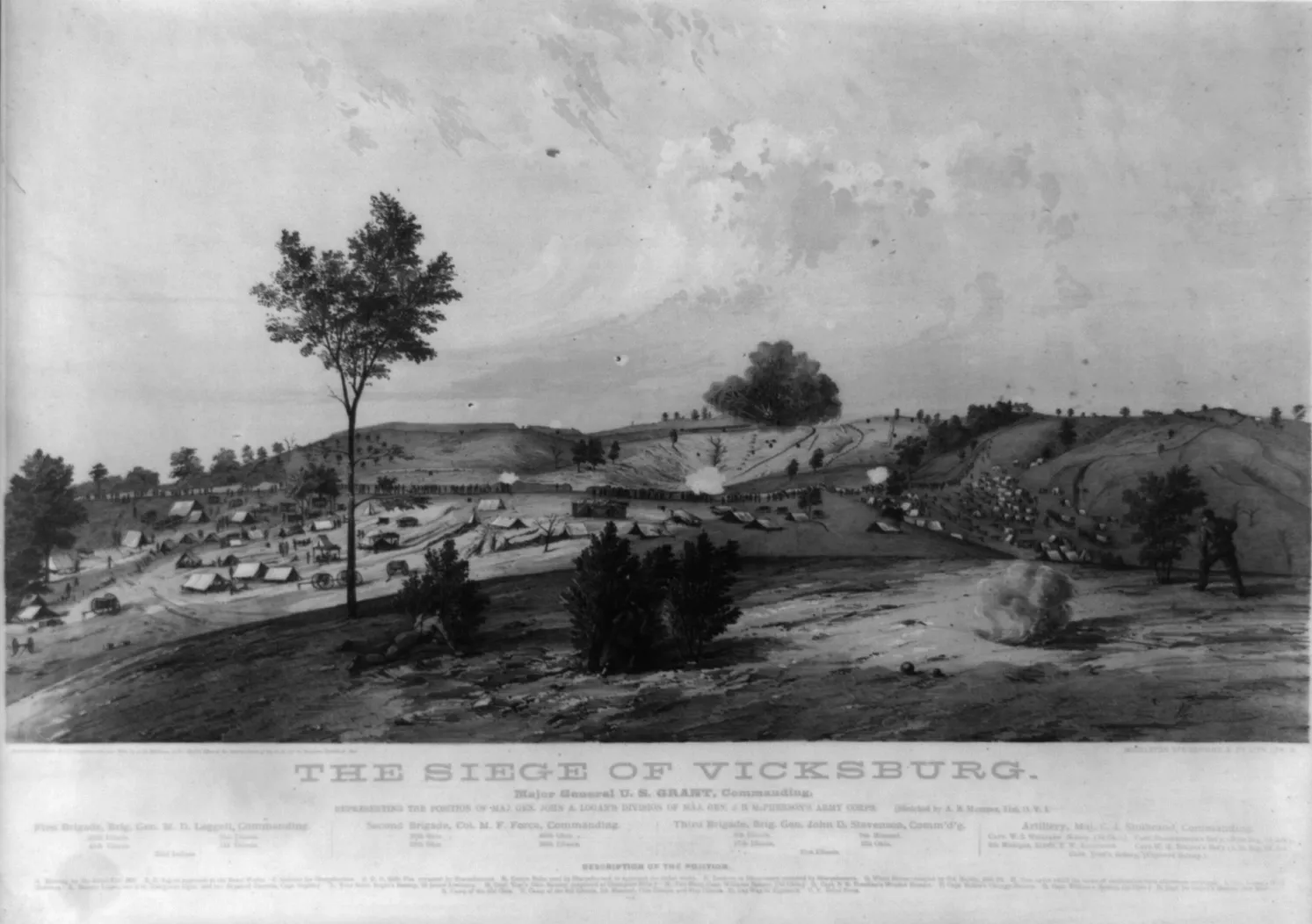
"Siege of Vicksburg" by Middleton / Wikimedia Commons (Public domain).
The Siege of Vicksburg in 1863 was a major turning point in the American Civil War. Located on a high bluff above the Mississippi River, Vicksburg, Mississippi, was a strategic fortress for the Confederacy. Whoever controlled Vicksburg could control the movement of troops and supplies along the river. President Abraham Lincoln recognized its importance, calling Vicksburg the "key" to victory in the West.
For months, Union General Ulysses S. Grant developed a complex strategy to capture the city. His troops faced great challenges, including difficult terrain and strong Confederate defenses. Instead of launching a direct attack, Grant chose to surround Vicksburg and cut off its supplies. This military tactic, known as a siege, put the city under constant pressure. Union soldiers dug trenches and built fortifications, gradually moving closer to the Confederate lines.
Inside Vicksburg, Confederate soldiers and civilians endured extreme hardship. Food became scarce, and many people had to live in caves to avoid artillery bombardment. Disease and hunger spread rapidly. Despite these hardships, Confederate General John C. Pemberton was determined to hold the city. However, as weeks passed, it became clear that the defenders could not last much longer without outside help.
On July 4, 1863, after 47 days of siege, Pemberton agreed to surrender the city to Grant. The Union victory at Vicksburg gave the North full control of the Mississippi River. This achievement split the Confederacy in two, making it nearly impossible for the eastern and western Confederate states to communicate or send reinforcements.
The impact of the Siege of Vicksburg was enormous. It happened almost at the same time as the Union victory at Gettysburg. Together, these victories marked a shift in momentum to the Union side. The fall of Vicksburg also demonstrated the effectiveness of siege warfare and careful planning in military operations.
Historians have debated the consequences for both the North and South. For the Confederacy, losing Vicksburg was a devastating blow to morale and resources. For the Union, the victory boosted confidence and helped President Lincoln's leadership. The event also showed how geography and logistics could shape the outcome of a war.
Interesting Fact: The people of Vicksburg did not celebrate Independence Day, July 4th, for nearly 80 years after the surrender, showing the lasting effects of the city's experience during the Civil War.
Comprehension quiz (8 questions)
1. Who led Union forces at Vicksburg?
2. What river was Vicksburg near?
3. When did Vicksburg surrender?
4. Why was Vicksburg important?
5. How did the Union win Vicksburg?
6. What was a result of Union victory?
7. The Union gained Mississippi control. True or false?
8. What does 'siege' mean?
Perfect for the way you teach
- Build comprehension skills
- Auto-graded quiz
- Differentiated reading
- Read together at home
- Improve fluency
- Quiet reading time
- Reading curriculum support
- Independent practice
- Track Lexile growth