Slavery Expansion in South After Revolution — Reading Comprehension
Rate this
Premium Resource
Present
Present in classroom. No work saved
Assign
Classroom with student accounts, Track progress
Quick Play
No student accounts, assign with a link
Grades
6
7
8
Standards
D2.HIS.2.3-5
D2.HIS.3.3-5
RI.4.3
RI.4.4
W.4.2
PRINT+DIGITAL RESOURCE
This learning resource is available in interactive and printable formats. The interactive worksheet can be played online and assigned to students. The Printable PDF version can be downloaded and printed for completion by hand.
This rigorous U.S. history reading passage explores the expansion of slavery in the Southern states after the American Revolution and its profound impact on the nation's development. Students will analyze how regional differences in agriculture and economy led the South to rely heavily on enslaved labor, while the North moved in a different direction. The passage uses a compare/contrast structure and introduces critical vocabulary such as regional, agriculture, and economy. It aligns with HSS 5.6.6, 8.7.2, and CCSS.RI.6-8.1, RI.6-8.6, supporting the development of historical reasoning and evidence-based analysis. This resource includes a glossary, a Spanish translation, differentiated versions for accessibility, multiple-choice and writing activities, graphic organizers, and a timeline. Read aloud audio is available, making it an excellent tool for diverse classrooms.
CONTENT PREVIEW
Expand content preview
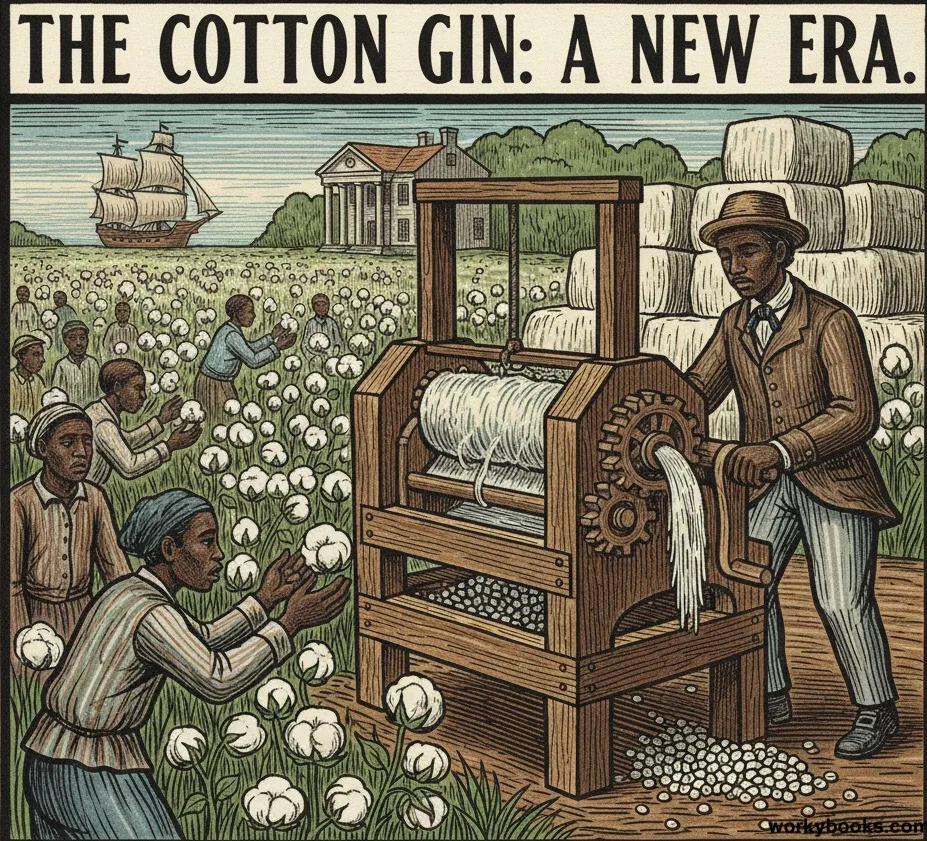
Cotton gin increased production, demanding more enslaved labor.
After the American Revolution ended in 1783, the new United States faced important decisions about its development. The war had brought freedom to the colonies, but not to everyone. In the Southern states, the economy depended on agriculture, especially large plantations growing crops such as tobacco, rice, and later, cotton. These agricultural systems relied on the forced labor of enslaved people. Although the Revolution encouraged ideas of liberty, most Southern leaders continued to support slavery as the main source of labor.
This created a clear regional difference between the North and the South. In the North, many states began to pass laws to gradually end slavery. The Northern economy was becoming more industrial, with new factories and businesses requiring paid workers rather than enslaved labor. In contrast, Southern leaders argued that their warm climate and fertile soil made large-scale farming possible, but only profitable with a system of slavery. The Southern region’s commitment to agriculture and slavery became a defining feature of its society and daily life.
After 1793, the invention of the cotton gin by Eli Whitney transformed Southern agriculture. The cotton gin made it much easier to separate cotton fiber from seeds, allowing plantations to produce cotton faster and in greater quantities. As a result, the demand for enslaved labor increased. Many plantation owners invested in expanding their land and purchasing more enslaved people. Cotton quickly became the South’s most valuable export, further tying the region’s prosperity to slavery.
These changes also deepened the divide between North and South. Some Americans criticized slavery as unjust, while others defended it as necessary for economic success. The issue of slavery led to heated political debates and growing tensions. Southern leaders feared that ending slavery would destroy their way of life. Meanwhile, abolitionist movements in the North gained strength, calling for an end to slavery everywhere in the nation.
In summary, the period after the Revolution was marked by growing conflict over the role of slavery in American society. The South’s agricultural economy and dependence on enslaved labor set it apart from the North. These regional differences would eventually lead to more serious conflicts in the years ahead.
Interesting Fact: In 1790, about 700,000 enslaved people lived in the United States, but by 1860, that number had grown to nearly four million, mostly in the South.
When did the American Revolution end?
1783179318601776
What was the main crop after 1793?
CottonCornWheatRice
Who invented the cotton gin?
Eli WhitneyGeorge WashingtonAbraham LincolnThomas Jefferson
Why did the South depend on slavery?
Needed labor for large farmsNo other jobsFor educationTo build factories
How did the North change after the Revolution?
Became more industrialUsed more plantationsKept slaveryGrew more cotton
What effect did the cotton gin have?
Increased need for enslaved laborEnded slaveryLess cotton producedMore factories in South
Most enslaved people lived in the North. True or false?
TrueFalse
What does 'regional' mean?
Relating to an areaGrowing cropsMaking lawsSelling products
Perfect For:
👩🏫 Teachers
• Reading comprehension practice
• Auto-graded assessments
• Literacy skill development
👨👩👧👦 Parents
• Reading practice at home
• Comprehension improvement
• Educational reading time
🏠 Homeschoolers
• Reading curriculum support
• Independent reading practice
• Progress monitoring
Reading Features:
📖
Reading Passage
Engaging fiction or nonfiction text
❓
Comprehension Quiz
Auto-graded questions
📊
Instant Feedback
Immediate results and scoring
📄
Printable Version
Download for offline reading
🔊
Read Aloud
Voice-over with word highlighting
Reviews & Ratings
No reviews yet. Be the first to share your experience!
Related Content
Native American Tribes Across America
This engaging history reading passage introduces students to Native American tribes across America, focusing on their da...
D2.HIS.1.3-5D2.HIS.2.3-5RI.4.1RI.4.2
Teepees: Homes on the Great Plains
This engaging history reading passage introduces students to teepees, the unique homes of Native American tribes on the ...
D2.HIS.2.3-5D2.HIS.14.3-5RI.4.1RI.4.2RI.4.4
Traditional Native American Clothing
This engaging history passage explores traditional Native American clothing and how it reflected the environment, values...
D2.HIS.2.3-5D2.HIS.3.3-5RI.4.3RI.4.4
The Iroquois Confederacy: A System of Peace
This engaging U.S. History reading passage introduces students to the Iroquois Confederacy, a powerful alliance of Nativ...
D2.HIS.2.3-5D2.HIS.3.3-5RI.4.3RI.4.4
The Cherokee Nation: History and Culture
This reading passage explores the rich history and culture of the Cherokee Nation, one of the largest Native American tr...
D2.HIS.2.3-5D2.HIS.14.3-5RI.4.3RI.4.4RI.4.10
The Sioux: Warriors and Tribal Leaders
This history reading passage explores the Sioux Nation, focusing on their roles as warriors and tribal leaders. Students...
D2.HIS.1.3-5D2.HIS.2.3-5RI.4.1RI.4.3
Native American Respect for Nature
This engaging history reading passage explores Native American respect for nature, emphasizing the close relationship be...
D2.HIS.2.3-5D2.HIS.3.3-5RI.4.3RI.4.4
Jamestown: The First Permanent English Colony
This engaging history passage explores the founding of Jamestown, the first permanent English colony in America. Aligned...
D2.HIS.1.3-5D2.HIS.2.3-5RI.4.3RI.4.4
Pocahontas and the Powhatan People
This engaging reading passage explores the life of Pocahontas and the Powhatan people and their important role in early ...
D2.HIS.1.3-5D2.HIS.2.3-5RI.4.1RI.4.3
Colonial Children: School and Chores
This reading passage explores the daily lives of colonial children, focusing on their experiences at school and their ma...
D2.HIS.2.3-5D2.HIS.3.3-5RI.4.1RI.4.2RI.4.4
Colonial Clothing and Homemade Goods
This engaging U.S. history passage explores the daily life of early American colonists with a focus on colonial clothing...
D2.HIS.2.3-5RI.4.3RI.4.4
Colonial Jobs: Blacksmiths, Bakers, and Craftsmen
This engaging history reading passage explores the vital roles of blacksmiths, bakers, and craftsmen in colonial America...
D2.HIS.2.3-5D2.HIS.3.3-5RI.4.3RI.4.4
Colonial Towns and Village Life
This engaging history reading passage explores the daily life, work, and unity found in colonial towns and villages. Ali...
D2.HIS.1.3-5D2.HIS.2.3-5RI.4.3RI.4.4
Colonial Trade with England and Africa
This history reading passage explores colonial trade between the American colonies, England, and Africa, focusing on the...
D2.HIS.2.3-5D2.HIS.14.3-5RI.4.3RI.4.4
Benjamin Franklin: Printer, Inventor, and Leader
This history reading passage explores the life and achievements of Benjamin Franklin, one of America's most important ea...
D2.HIS.2.3-5D2.HIS.3.3-5RI.4.1RI.4.3
George Washington Leads the Army
This engaging history reading passage explores how George Washington bravely led the Continental Army during the America...
D2.HIS.1.3-5D2.HIS.2.3-5RI.4.3RI.4.4
Women and Children During the Revolutionary War
This reading passage explores the important roles women and children played during the Revolutionary War. Students will ...
D2.HIS.2.3-5RI.4.3RI.5.3
African Americans Fight for Freedom
This educational passage explores the brave and inspiring story of how African Americans fought for freedom in the Unite...
D2.HIS.2.3-5D2.HIS.3.3-5RI.4.3RI.4.4
The Battle of Yorktown Ends War
This engaging U.S. history reading passage explores the Battle of Yorktown, a key event that ended the American Revoluti...
D2.HIS.1.3-5D2.HIS.2.3-5RI.4.1RI.4.3
Loyalists vs. Patriots: Divided Families
This engaging U.S. history reading passage explores the division between Loyalists and Patriots during the American Revo...