Social Security Act 1935: Safety Net Created — Reading Comprehension
Rate this
Premium Resource
Present
Present in classroom. No work saved
Assign
Classroom with student accounts, Track progress
Quick Play
No student accounts, assign with a link
Grades
6
7
8
Standards
D2.HIS.2.3-5
D2.HIS.3.3-5
RI.4.3
RI.4.4
W.4.2
PRINT+DIGITAL RESOURCE
This learning resource is available in interactive and printable formats. The interactive worksheet can be played online and assigned to students. The Printable PDF version can be downloaded and printed for completion by hand.
This reading passage explores the Social Security Act of 1935, a groundbreaking law during the New Deal era that transformed American society. Students will analyze the causes of the Act, including the economic hardships of the Great Depression, and consider multiple perspectives—workers, politicians, and critics of government intervention. The passage uses a problem/solution structure and includes a primary source quote from President Franklin D. Roosevelt. Vocabulary words such as 'legislation,' 'unemployment,' and 'entitlement' are highlighted for deeper understanding. Activities include a multiple-choice quiz, writing prompts, a timeline, and a graphic organizer, all aligned with D2.His.2.3-5, D2.His.3.3-5, RI.4.3, RI.4.4, and W.4.2 standards. Students can access a Spanish translation and benefit from read aloud audio. This resource is perfect for analyzing the significance and impact of the Social Security Act and understanding how government policies respond to national crises.
CONTENT PREVIEW
Expand content preview
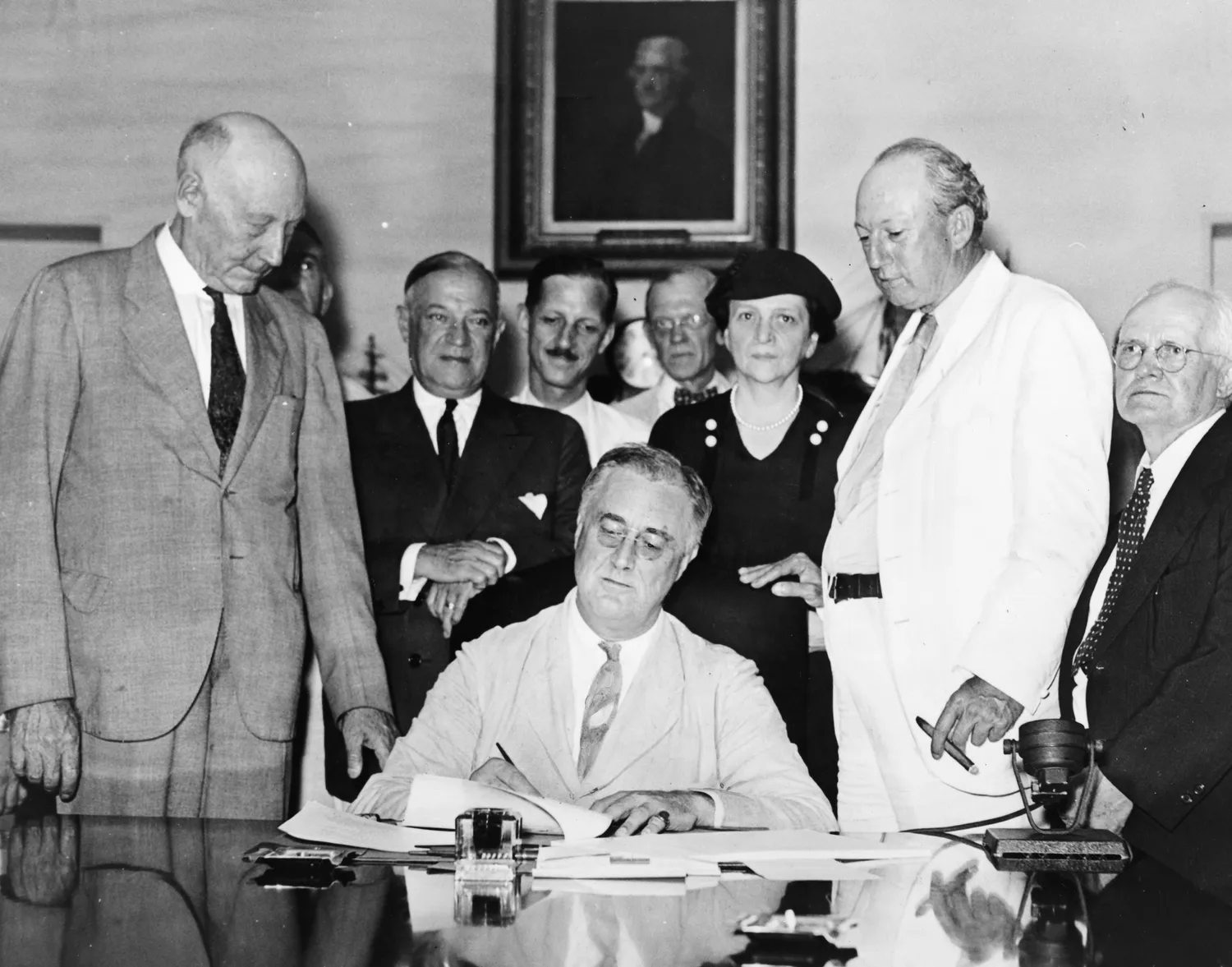
"Signing Of The Social Security Act" by Social Security Online / Wikimedia Commons (Public domain).
The Social Security Act of 1935 was a groundbreaking law passed by the United States Congress during the Great Depression. The nation was suffering from severe economic instability, with millions of people unemployed and families facing poverty. President Franklin D. Roosevelt and his administration recognized that the government needed to find a solution to protect Americans who could not support themselves because of age, job loss, or family circumstances.
One of the main problems during the Great Depression was the lack of a reliable safety net for elderly citizens. Many older Americans had worked their entire lives, but when they could no longer work, they had no source of income. This left them dependent on family or charity, and many lived in poverty. The Social Security Act created a system of retirement payments, known as pensions, for those over a certain age. This was funded by a new type of payroll tax collected from workers and employers. The law aimed to ensure that older Americans could live with dignity and security.
In addition to retirement income, the Social Security Act addressed other urgent needs. It established unemployment insurance, which provided temporary payments to workers who lost their jobs through no fault of their own. This program was designed to help people get by while they searched for new employment, reducing the risk of families falling into poverty during tough economic times. The Act also created programs to assist dependent children and people with disabilities, recognizing that some citizens faced extra challenges in supporting themselves.
The passage of the Social Security Act was not without controversy. Some critics argued that it would make people too reliant on the government, while others felt it did not do enough to help the poorest Americans. Despite these debates, the law marked a turning point in American social policy. It set a precedent for the federal government to play a more active role in protecting citizens from economic hardship. Over the years, the Social Security Act has been expanded and adapted to meet changing needs, but its core principles remain the foundation of the United States' social safety net.
The Social Security Act continues to affect millions of Americans today. Most workers in the United States pay into Social Security through taxes, earning future benefits for themselves and their families. The system is often discussed in politics and society, especially as the population ages and more people rely on retirement income and other benefits. Understanding the reasons behind the Act and the challenges it aimed to solve helps us appreciate how government policies can shape everyday life.
Interesting Fact: The first monthly Social Security check was issued in 1940 to a woman named Ida May Fuller, who received a total of $22.54 in her first payment.
When was the Social Security Act signed?
1935192919411950
Who was president when the Act passed?
Franklin D. RooseveltHerbert HooverHarry TrumanJohn F. Kennedy
What crisis led to the Act?
Great DepressionWorld War ICivil WarDust Bowl
What is a safety net?
A program to help peopleA type of bankA hospitalA retirement home
Why was unemployment insurance important?
It helped jobless peopleIt paid for schoolsIt built new roadsIt funded the military
How did Social Security help older Americans?
Provided retirement paymentsGave them free foodOffered free homesSent them to school
The Act helped only children. True or false?
TrueFalse
What is a payroll tax?
Tax from paychecksTax on groceriesTax on housesTax on cars
Perfect For:
👩🏫 Teachers
• Reading comprehension practice
• Auto-graded assessments
• Literacy skill development
👨👩👧👦 Parents
• Reading practice at home
• Comprehension improvement
• Educational reading time
🏠 Homeschoolers
• Reading curriculum support
• Independent reading practice
• Progress monitoring
Reading Features:
📖
Reading Passage
Engaging fiction or nonfiction text
❓
Comprehension Quiz
Auto-graded questions
📊
Instant Feedback
Immediate results and scoring
📄
Printable Version
Download for offline reading
🔊
Read Aloud
Voice-over with word highlighting
Reviews & Ratings
No reviews yet. Be the first to share your experience!
Related Content
Native American Tribes Across America
This engaging history reading passage introduces students to Native American tribes across America, focusing on their da...
D2.HIS.1.3-5D2.HIS.2.3-5RI.4.1RI.4.2
Teepees: Homes on the Great Plains
This engaging history reading passage introduces students to teepees, the unique homes of Native American tribes on the ...
D2.HIS.2.3-5D2.HIS.14.3-5RI.4.1RI.4.2RI.4.4
Traditional Native American Clothing
This engaging history passage explores traditional Native American clothing and how it reflected the environment, values...
D2.HIS.2.3-5D2.HIS.3.3-5RI.4.3RI.4.4
The Iroquois Confederacy: A System of Peace
This engaging U.S. History reading passage introduces students to the Iroquois Confederacy, a powerful alliance of Nativ...
D2.HIS.2.3-5D2.HIS.3.3-5RI.4.3RI.4.4
The Cherokee Nation: History and Culture
This reading passage explores the rich history and culture of the Cherokee Nation, one of the largest Native American tr...
D2.HIS.2.3-5D2.HIS.14.3-5RI.4.3RI.4.4RI.4.10
The Sioux: Warriors and Tribal Leaders
This history reading passage explores the Sioux Nation, focusing on their roles as warriors and tribal leaders. Students...
D2.HIS.1.3-5D2.HIS.2.3-5RI.4.1RI.4.3
Native American Respect for Nature
This engaging history reading passage explores Native American respect for nature, emphasizing the close relationship be...
D2.HIS.2.3-5D2.HIS.3.3-5RI.4.3RI.4.4
Jamestown: The First Permanent English Colony
This engaging history passage explores the founding of Jamestown, the first permanent English colony in America. Aligned...
D2.HIS.1.3-5D2.HIS.2.3-5RI.4.3RI.4.4
Pocahontas and the Powhatan People
This engaging reading passage explores the life of Pocahontas and the Powhatan people and their important role in early ...
D2.HIS.1.3-5D2.HIS.2.3-5RI.4.1RI.4.3
Colonial Children: School and Chores
This reading passage explores the daily lives of colonial children, focusing on their experiences at school and their ma...
D2.HIS.2.3-5D2.HIS.3.3-5RI.4.1RI.4.2RI.4.4
Colonial Clothing and Homemade Goods
This engaging U.S. history passage explores the daily life of early American colonists with a focus on colonial clothing...
D2.HIS.2.3-5RI.4.3RI.4.4
Colonial Jobs: Blacksmiths, Bakers, and Craftsmen
This engaging history reading passage explores the vital roles of blacksmiths, bakers, and craftsmen in colonial America...
D2.HIS.2.3-5D2.HIS.3.3-5RI.4.3RI.4.4
Colonial Towns and Village Life
This engaging history reading passage explores the daily life, work, and unity found in colonial towns and villages. Ali...
D2.HIS.1.3-5D2.HIS.2.3-5RI.4.3RI.4.4
Colonial Trade with England and Africa
This history reading passage explores colonial trade between the American colonies, England, and Africa, focusing on the...
D2.HIS.2.3-5D2.HIS.14.3-5RI.4.3RI.4.4
Benjamin Franklin: Printer, Inventor, and Leader
This history reading passage explores the life and achievements of Benjamin Franklin, one of America's most important ea...
D2.HIS.2.3-5D2.HIS.3.3-5RI.4.1RI.4.3
George Washington Leads the Army
This engaging history reading passage explores how George Washington bravely led the Continental Army during the America...
D2.HIS.1.3-5D2.HIS.2.3-5RI.4.3RI.4.4
Women and Children During the Revolutionary War
This reading passage explores the important roles women and children played during the Revolutionary War. Students will ...
D2.HIS.2.3-5RI.4.3RI.5.3
African Americans Fight for Freedom
This educational passage explores the brave and inspiring story of how African Americans fought for freedom in the Unite...
D2.HIS.2.3-5D2.HIS.3.3-5RI.4.3RI.4.4
The Battle of Yorktown Ends War
This engaging U.S. history reading passage explores the Battle of Yorktown, a key event that ended the American Revoluti...
D2.HIS.1.3-5D2.HIS.2.3-5RI.4.1RI.4.3
Loyalists vs. Patriots: Divided Families
This engaging U.S. history reading passage explores the division between Loyalists and Patriots during the American Revo...