Space Race: Cold War Competition Explained
Interactive passage with audio narration, comprehension questions, and printable PDF.
By completing this purchase you agree to our Terms of Use and Privacy Policy. Your subscription renews automatically until you cancel. You can cancel anytime from your account settings. All sales are final and non-refundable. Digital content is available for download in your account immediately upon purchase.
What's included
Space Race: Cold War Competition Explained preview and details
About this printable Space Race: Cold War Competition Explained reading passage (Grades 6-8)
Sample passage and quiz from Space Race: Cold War Competition Explained
Reading passage and comprehension quiz preview
Space Race
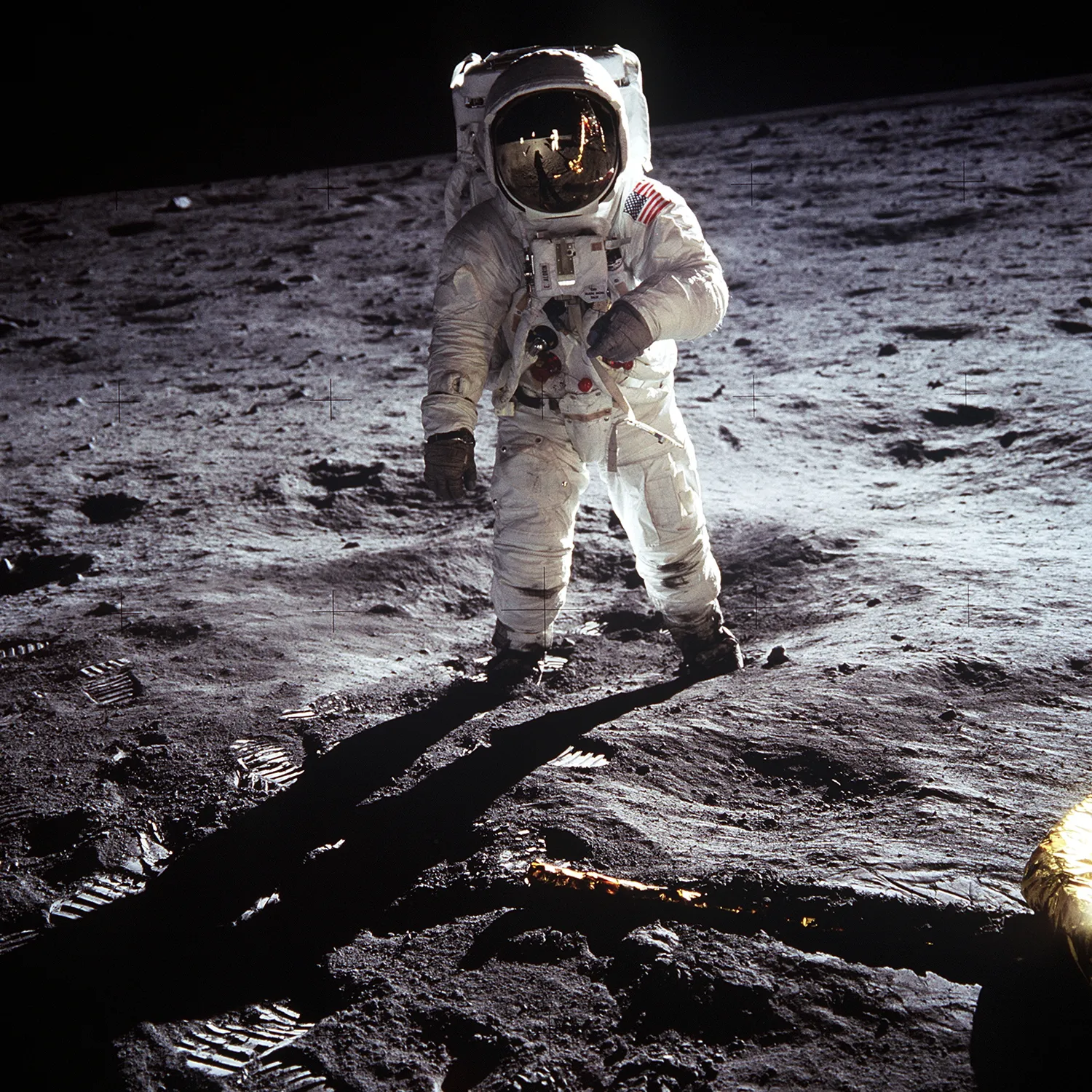
"Aldrin Apollo 11" by Neil A. Armstrong /
Source: Wikimedia Commons (Public domain).
The Space Race was a fierce competition between the United States and the Soviet Union during the Cold War. Both nations aimed to demonstrate their power and technological leadership through achievements in space exploration. The rivalry began after World War II and intensified in the late 1950s, when both countries wanted to prove that their political and scientific systems were superior.
In 1957, the Soviet Union launched Sputnik, the world’s first artificial satellite. This event shocked the United States, as it showed that the Soviets could potentially send missiles across continents. In response, the U.S. government increased investments in science and technology education, leading to the creation of NASA in 1958. The launch of Sputnik marked the start of a technological race that would transform global politics and scientific progress.
The United States and Soviet Union used space exploration to gain prestige and global influence. Success in space became a symbol of national strength and advanced technology. Each side rushed to achieve new milestones, such as sending the first human into space or landing on the moon. These goals required rapid advances in rocketry, communications, and computer science.
In 1961, Soviet astronaut Yuri Gagarin became the first person to orbit Earth. This achievement gave the Soviets a significant advantage, but the United States responded with President John F. Kennedy’s promise to land an American on the moon by the end of the decade. This ambitious goal provided a clear focus for American scientists and engineers.
The competition led to major scientific breakthroughs. The U.S. achieved its goal in 1969, when Apollo 11 astronauts Neil Armstrong and Buzz Aldrin became the first humans to walk on the moon. This event was broadcast worldwide and is often seen as the peak of the Space Race. The moon landing demonstrated the power of teamwork, innovation, and determination.
Despite their rivalry, both countries faced challenges such as technical failures and the risk of disaster. They also made efforts to use space for peaceful purposes, such as scientific research and international cooperation. By the 1970s, the Space Race slowed, and the United States and Soviet Union began working together on projects like the Apollo-Soyuz mission in 1975.
The Space Race had a lasting impact on technology and society. It spurred inventions such as satellite communications, improved computers, and new materials. It also inspired generations to pursue careers in science and engineering, and it set the stage for international collaboration in space exploration.
Interesting Fact: The famous phrase, "That's one small step for man, one giant leap for mankind," was spoken by Neil Armstrong as he became the first person to step onto the moon in 1969.
Comprehension quiz (8 questions)
1. Who launched Sputnik in 1957?
2. Who was the first person to orbit Earth?
3. What did the United States create in 1958?
4. Why did the Space Race begin?
5. What was the main goal after 1961?
6. What impact did the Space Race have?
7. The Space Race led to new inventions.
8. What does 'prestige' mean?
Common Core standards for Space Race: Cold War Competition Explained
Explain events, procedures, ideas, or concepts in a historical, scientific, or technical text, including what happened and why, based on specific information in the text.
Determine the meaning of general academic and domain-specific words or phrases in a text relevant to a grade 4 topic or subject area.
Write informative/explanatory texts to examine a topic and convey ideas and information clearly.
Perfect for the way you teach
- Build comprehension skills
- Auto-graded quiz
- Differentiated reading
- Read together at home
- Improve fluency
- Quiet reading time
- Reading curriculum support
- Independent practice
- Track Lexile growth