This learning resource is available in interactive and printable formats. The interactive worksheet can be played online and assigned to students. The Printable PDF version can be downloaded and printed for completion by hand.
This rigorous U.S. History reading passage explores the Stamp Act Congress of 1765, a crucial event in the path toward American independence. Students will learn how delegates from nine colonies met in New York City to protest the Stamp Act, a controversial tax imposed by the British Parliament, and how their actions laid the groundwork for future colonial cooperation. The passage incorporates essential history and ELA academic vocabulary, encourages analytical thinking, and includes a glossary, differentiated reading versions, and Spanish translations. Activities such as multiple-choice quizzes, writing prompts, graphic organizers, and a timeline enable students to deepen their understanding and practice key historical skills. This resource aligns with HSS 5.5.2, 8.1.2, and CCSS.RI.6-8.1, RI.6-8.3, supporting both history and literacy standards. Audio read-aloud and supportive materials make it accessible for all learners.
CONTENT PREVIEW
Expand content preview
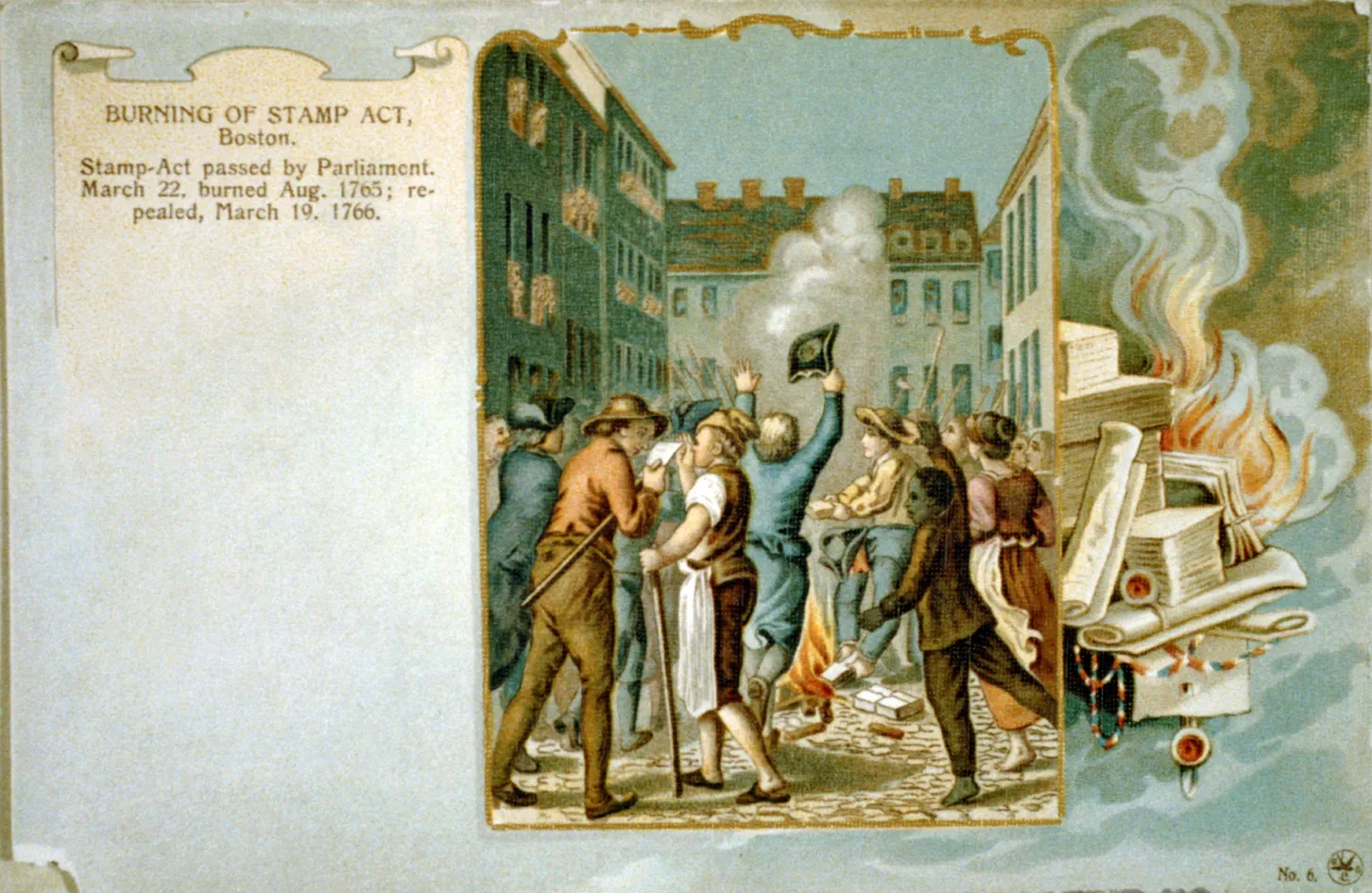
Burning of Stamp Act / Wikimedia Commons
The Stamp Act Congress of 1765 was a turning point in colonial American history. Held in New York City, this meeting brought together delegates from nine different colonies to discuss a serious problem: the British Parliament had recently passed the Stamp Act, requiring colonists to pay a tax on printed materials such as newspapers, legal documents, and playing cards. The Stamp Act was the first direct tax imposed by Britain on the colonies, and it caused widespread outrage.
The main problem facing the colonists was the issue of taxation without representation. Many colonists believed it was unfair for the British government to tax them when they had no representatives in Parliament to speak for their interests. The Stamp Act Congress was organized as a solution to coordinate a colonial response. Rather than acting alone, the colonies recognized the need for unity. By sending delegates to a central congress, they could share ideas and develop a common strategy.
At the Congress, delegates debated how best to respond to the Stamp Act. Some wanted to use peaceful petition and negotiation, while others believed stronger measures might be necessary. After much discussion, the Congress agreed to send a series of petitions and resolutions to King George III and the British Parliament. These documents clearly stated the colonists’ belief that only their own colonial assemblies had the legal authority to tax them.
The Congress also encouraged colonists to boycott British goods, a form of economic protest. This collective action put pressure on British merchants, who in turn urged Parliament to reconsider the Stamp Act. The coordinated resistance demonstrated that the colonies could work together to solve shared problems. It was an early example of intercolonial cooperation and political organization.
Although the Stamp Act Congress did not achieve immediate success, its efforts were not in vain. Parliament eventually repealed the Stamp Act in 1766, partly because of the widespread protests and economic impact. More importantly, the Congress set a precedent for future colonial cooperation. The methods and ideas developed during the Congress would later influence other important gatherings, such as the First Continental Congress in 1774.
The Stamp Act Congress revealed both the strengths and challenges of colonial unity. While delegates sometimes disagreed, their willingness to compromise paved the way for a stronger movement against British policies. The event showed that the colonies could act together for a common cause, a lesson that would become crucial in the years leading up to the American Revolution.
Interesting Fact: The Stamp Act Congress was the first unified meeting of American colonies against British rule, and only nine out of thirteen colonies participated, as some colonies were not ready to join in resistance.
What year was the Stamp Act Congress?
1765177617541787
Where did the Stamp Act Congress meet?
BostonPhiladelphiaNew York CityCharleston
How many colonies sent delegates?
ThirteenNineSevenTen
Why did colonists oppose the Stamp Act?
It lowered taxesNo representationIt gave new rightsIt ended trade
What was one colonial response to the Stamp Act?
Boycott British goodsSupport new taxesJoin British armyMove to England
What was the main achievement of the Congress?
Immediate repeal of all taxesColonial unity and petitionsNew British lawsBritish military support
The Congress encouraged colonies to work together.
TrueFalse
What does 'petition' mean in the passage?
A written requestA new taxA British lawA kind of boycott
Perfect For:
👩🏫 Teachers
• Reading comprehension practice
• Auto-graded assessments
• Literacy skill development
👨👩👧👦 Parents
• Reading practice at home
• Comprehension improvement
• Educational reading time
🏠 Homeschoolers
• Reading curriculum support
• Independent reading practice
• Progress monitoring
Reading Features:
📖
Reading Passage
Engaging fiction or nonfiction text
❓
Comprehension Quiz
Auto-graded questions
📊
Instant Feedback
Immediate results and scoring
📄
Printable Version
Download for offline reading
🔊
Read Aloud
Voice-over with word highlighting
Reviews & Ratings
No reviews yet. Be the first to share your experience!
Related Content
Pocahontas: Myth vs. Historical Reality
This passage explores the nuanced history of Pocahontas, moving beyond the myth made popular by movies and stories. Stud...
HSS 5.3.1RI.6-8.1RI.6-8.8
Roger Williams Religious Freedom
This passage explores the life and legacy of Roger Williams, a key figure in Colonial America who was banished from Mass...
HSS 5.4.38.2.2RI.6-8.1RI.6-8.6
Benjamin Franklin in Colonial America
This U.S. History reading passage explores the life and influence of Benjamin Franklin, a key colonial leader whose idea...
HSS 5.58.1RI.6-8.1RI.6-8.3
Colonial Apprenticeship System
This comprehensive passage explores the Colonial Apprenticeship System and its role in education during Colonial America...
HSS 5.4.6RI.6-8.1RI.6-8.2
Cities in Colonial America
This engaging U.S. history reading passage explores the rise of colonial American cities such as Boston, Philadelphia, a...
HSS 5.4.68.1RI.6-8.1RI.6-8.7
Frontier Life in Colonial America
This passage examines the realities of frontier life in colonial America, highlighting both the promise and peril faced ...
HSS 5.4.68.1RI.6-8.1RI.6-8.2
Colonial Printing Press
This passage explores the revolutionary impact of the colonial printing press in America, examining how it enabled the s...
HSS 5.58.1RI.6-8.1RI.6-8.2
Mercy Otis Warren: Political Writer
This passage explores the life and impact of Mercy Otis Warren, a significant political writer during the American Revol...
HSS 5.6.38.1RI.6-8.1RI.6-8.6
Crispus Attucks
This comprehensive U.S. History reading passage examines the life and legacy of Crispus Attucks, the first person killed...
HSS 5.5.38.1RI.6-8.1RI.6-8.3
Lewis and Clark Expedition
This comprehensive U.S. History reading passage explores the Lewis and Clark Expedition (1804-1806), a pivotal journey l...
HSS 8.4.18.8.2RI.6-8.1RI.6-8.3
Exodusters
This passage explores the migration of Exodusters—African Americans who left the South in the 1870s to escape discrimina...
HSS 8.12.1RI.6-8.1RI.6-8.2
Uncle Tom's Cabin
This passage explores the impact of Harriet Beecher Stowe’s Uncle Tom’s Cabin on American society in the 1850s. It exami...
HSS 8.9.48.10.2RI.6-8.1RI.6-8.6
Dred Scott Decision
This rigorous history reading passage delves into the 1857 Dred Scott Decision, a pivotal moment in the lead-up to the C...
HSS 8.9.48.10.3RI.6-8.1RI.6-8.8
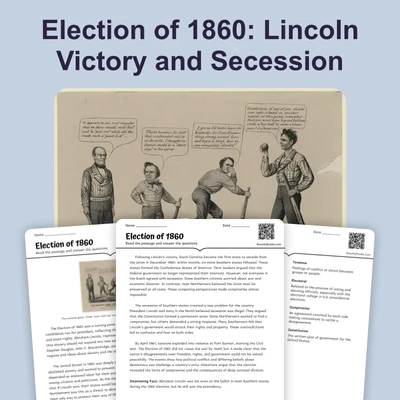
Election of 1860
This passage explores Abraham Lincoln’s election in 1860 and the critical reactions from Southern states, which set the ...
HSS 8.10.4RI.6-8.1RI.6-8.6
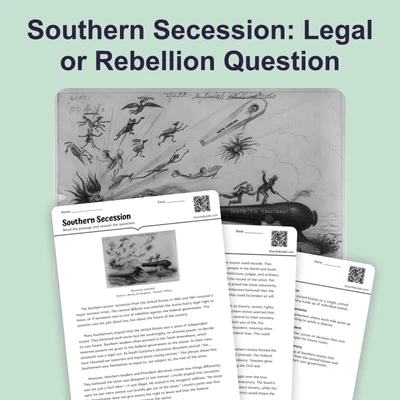
Southern Secession
This passage explores the significant moment in U.S. history when seven Southern states seceded from the Union after Abr...
HSS 8.10.4RI.6-8.1RI.6-8.2
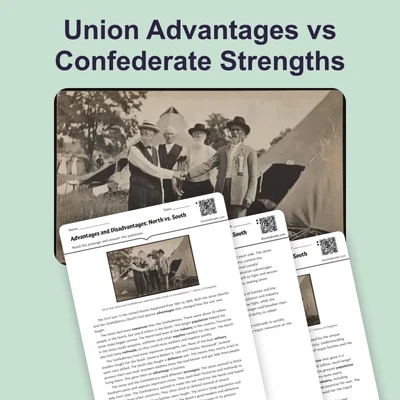
Advantages and Disadvantages: North vs. South
This history reading passage examines the contrasting strengths of the Union and Confederacy during the U.S. Civil War. ...
HSS 8.10.5RI.6-8.1RI.6-8.3
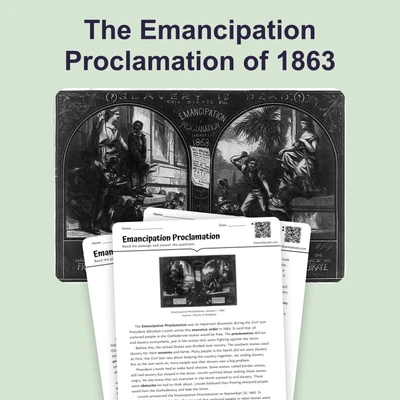
Emancipation Proclamation
This U.S. history passage explores the Emancipation Proclamation of 1863, an executive order issued by President Abraham...
HSS 8.10.6RI.6-8.1RI.6-8.3
Women's Roles in Civil War
This reading passage explores the critical roles women played during the U.S. Civil War, highlighting how they managed f...
HSS 8.10.7RI.6-8.1RI.6-8.2
Surrender at Appomattox
This reading passage explores the historic surrender at Appomattox Court House in April 1865, which marked the conclusio...