Tennessee Valley Authority
Interactive passage with audio narration, comprehension questions, and printable PDF.
By completing this purchase you agree to our Terms of Use and Privacy Policy. Your subscription renews automatically until you cancel. You can cancel anytime from your account settings. All sales are final and non-refundable. Digital content is available for download in your account immediately upon purchase.
What's included
Tennessee Valley Authority preview and details
About this printable Tennessee Valley Authority reading passage (Grades 6-8)
Sample passage and quiz from Tennessee Valley Authority
Reading passage and comprehension quiz preview
Tennessee Valley Authority
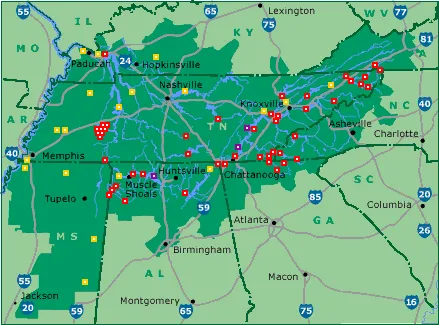
"TVA-sites-map" by Tennessee Valley Authority / Wikimedia Commons
The Tennessee Valley Authority (TVA) was created in 1933 as part of President Franklin D. Roosevelt’s New Deal to address the challenges of the Great Depression. The Tennessee Valley, which covers parts of seven Southern states, was one of the poorest regions in the United States at the time. Many people there lived in rural communities without electricity, modern plumbing, or access to good jobs. Flooding, soil erosion, and poor farmland made life difficult for families who depended on agriculture to survive.
To solve these problems, the TVA launched a massive program of development focused on building dams along the Tennessee River and its tributaries. These dams helped control floods, provided steady water for irrigation, and most importantly, generated hydroelectric power. The electrification of the region was a key goal. By bringing electricity to homes and farms, TVA made it possible for families to use electric lights, refrigerators, and new machinery. This change greatly improved the quality of life and helped modernize the South.
TVA’s impact was not limited to electricity. The organization created thousands of jobs for local workers during a time when employment was desperately needed. Workers built dams, power plants, and new roads. The TVA also taught farmers better ways to conserve soil and improve crop yields. These efforts helped restore the land and made farming more productive. In addition, TVA provided training and education, which helped people gain new skills for better-paying jobs.
Despite these benefits, the TVA faced significant challenges and controversies. Some landowners and families were forced to move when their land was flooded to make room for new dams and reservoirs. Critics argued that the federal government had too much control over local affairs. Environmentalists later raised concerns about how the dams affected fish and wildlife habitats. However, supporters believed the TVA was necessary to bring progress to a region that had been left behind.
The TVA’s work led to long-lasting changes in the South. More factories and businesses opened because they could now rely on affordable electricity. The region’s economy grew stronger, and people enjoyed better living conditions. The TVA became a model for using government programs to solve infrastructure problems and support economic development. Its example influenced similar projects in other countries around the world.
By examining the TVA’s successes and challenges, historians can see how the New Deal tried to balance immediate relief with long-term transformation. The TVA remains a powerful example of how government action can address complex social and economic issues, especially in areas that have been historically disadvantaged.
Interesting Fact: At the start of the TVA project, less than 10% of rural homes in the Tennessee Valley had electricity. Within 20 years, over 90% had electric power.
Comprehension quiz (8 questions)
1. When was the TVA created?
2. What region did the TVA help?
3. Who was president when TVA started?
4. How did TVA help farming?
5. Why did some people oppose TVA?
6. What was a main goal of TVA?
7. TVA provided electricity to the region.
8. What is a 'dam'?
Common Core standards for Tennessee Valley Authority
Explain events, procedures, ideas, or concepts in a historical, scientific, or technical text, including what happened and why, based on specific information in the text.
Determine the meaning of general academic and domain-specific words or phrases in a text relevant to a grade 4 topic or subject area.
Write informative/explanatory texts to examine a topic and convey ideas and information clearly.
Perfect for the way you teach
- Build comprehension skills
- Auto-graded quiz
- Differentiated reading
- Read together at home
- Improve fluency
- Quiet reading time
- Reading curriculum support
- Independent practice
- Track Lexile growth