The Columbian Exchange: Two Worlds Meet
Interactive passage with audio narration, comprehension questions, and printable PDF.
By completing this purchase you agree to our Terms of Use and Privacy Policy. Your subscription renews automatically until you cancel. You can cancel anytime from your account settings. All sales are final and non-refundable. Digital content is available for download in your account immediately upon purchase.
What's included
The Columbian Exchange: Two Worlds Meet preview and details
About this printable The Columbian Exchange: Two Worlds Meet reading passage (Grades 3-5)
Sample passage and quiz from The Columbian Exchange: Two Worlds Meet
Reading passage and comprehension quiz preview
Columbian Exchange
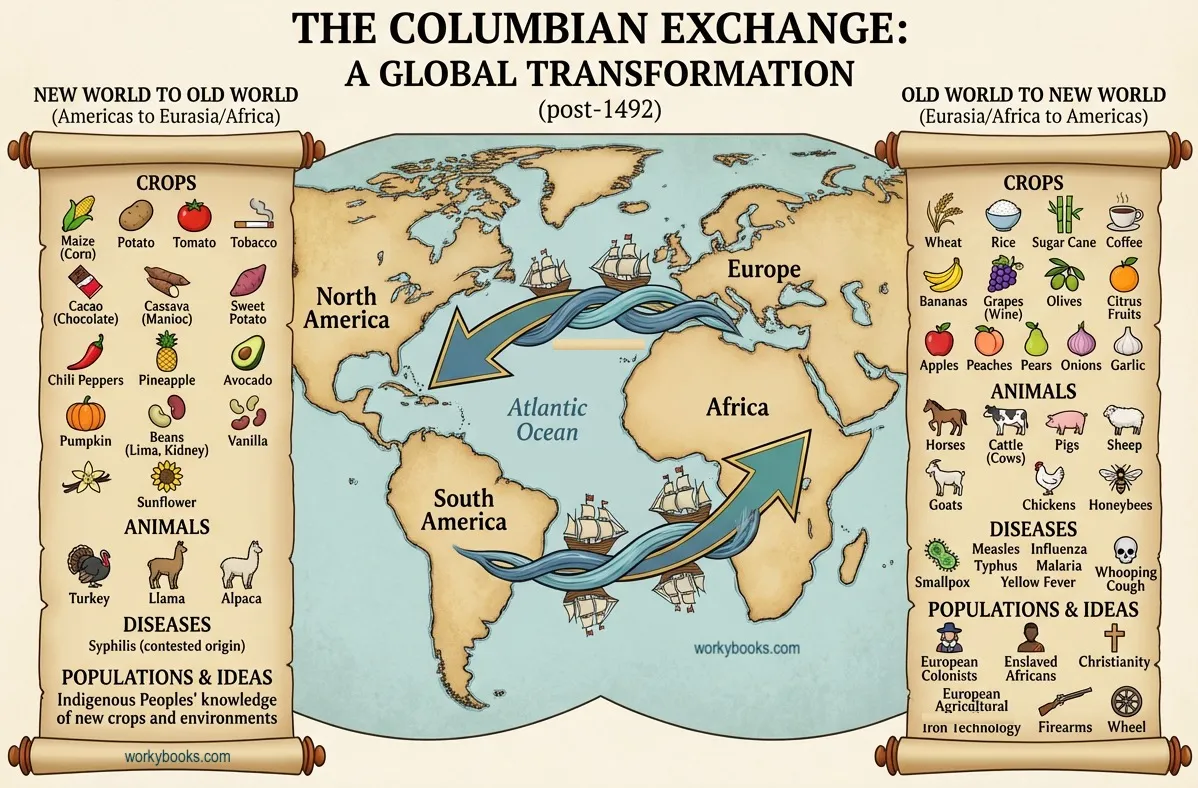
The Columbian Exchange was the big swap of plants, animals, people, and ideas between Europe and the Americas. This huge exchange began in 1492, when Christopher Columbus sailed from Spain to the Caribbean islands. His voyage started a chain of events that would change the whole world.
Before 1492, the people and lands of Europe, Africa, and Asia (the "Old World") were separate from the Americas (the "New World"). They had different foods, animals, and ways of life. But after Columbus landed, ships sailed back and forth across the Atlantic Ocean. These journeys carried living things, new foods, and new ideas in both directions.
Many crops from the Americas, like potatoes, corn, tomatoes, and cacao (used to make chocolate), were taken to Europe, Africa, and Asia. These foods became very important in the diets of people all over the world. For example, potatoes became a main food in Ireland, and tomatoes changed cooking in Italy.
At the same time, Europeans brought their own plants and animals to the Americas. Wheat, rice, and sugarcane were introduced. Horses, cattle, pigs, and sheep also came to the Americas for the first time. Horses changed the lives of many Native Americans, especially those who lived on the Great Plains. With horses, they could hunt buffalo and travel faster.
But not all parts of the Columbian Exchange were good. Europeans brought diseases like smallpox, measles, and influenza. Native Americans had never faced these sicknesses before, so many became very ill. Millions of Native people died from these diseases, which caused great sadness and loss.
The Columbian Exchange also moved people. Some people came by choice, but many Africans were forced to come to the Americas as slaves. This was a very hard and painful part of the exchange.
Because of the Columbian Exchange, the world became more connected. People learned from each other, traded goods, and mixed their cultures. The foods we eat, the animals we raise, and even the way we live today were shaped by this great exchange.
Interesting Fact: Did you know? Chocolate, made from cacao beans, was unknown in Europe until after the Columbian Exchange. It quickly became popular and is now loved by people around the world!
Comprehension quiz (8 questions)
1. When did the Columbian Exchange begin?
2. Who started the Columbian Exchange?
3. What animal changed Native American life?
4. Potatoes and tomatoes came from:
5. What was one effect of new diseases?
6. Why did the Exchange connect the world?
7. The Columbian Exchange only moved animals. True or false?
8. What does "diseases" mean?
Common Core standards for The Columbian Exchange: Two Worlds Meet
Explain events, procedures, ideas, or concepts in a historical, scientific, or technical text, including what happened and why, based on specific information in the text.
Determine the meaning of general academic and domain-specific words or phrases in a text relevant to a grade 4 topic or subject area.
Write informative/explanatory texts to examine a topic and convey ideas and information clearly.
Perfect for the way you teach
- Build comprehension skills
- Auto-graded quiz
- Differentiated reading
- Read together at home
- Improve fluency
- Quiet reading time
- Reading curriculum support
- Independent practice
- Track Lexile growth