Reading PassagePremium

The Cotton Gin Changes the South

Interactive passage with audio narration, comprehension questions, and printable PDF.

No ratings yet
Grades 6–8ElaSocial-studiesHistoryEnglish · SpanishInteractive · Printable
Just this resource
$1.50
One-time purchase
Best value
Unlock everything
$49.99$29.99/yr
40% off until Aug 1 — 10,000+ resources
Renews at $49.99/year.
Unlock above to use these actions

What's included

Reading passage
Audio narration
Comprehension quiz
Writing activity
Glossary & flashcards
Differentiated version
Spanish translation

The Cotton Gin Changes the South preview and details

About this printable The Cotton Gin Changes the South reading passage (Grades 6-8)

This history reading passage explores the invention of the cotton gin and its profound impact on the Southern United States. Students analyze how Eli Whitney’s invention changed cotton production, made slavery more profitable, and led to the dramatic expansion of the plantation system. The passage examines multiple perspectives, emphasizing the economic opportunities for planters and the hardships faced by enslaved people. Aligned with D2.His.1.6-8, D2.His.2.6-8, and RI.6.3, this resource challenges students to think critically about causes and consequences in history. The passage models historical reasoning, integrates a primary source, and covers key vocabulary. Included are read aloud audio, Spanish translations, differentiated versions for accessibility, and interactive activities. Students can deepen their understanding through quizzes, writing prompts, graphic organizers, and timeline exercises, making it ideal for developing historical thinking and literacy skills.
Written by Workybooks TeamPublished by Workybooks
Preview

Sample passage and quiz from The Cotton Gin Changes the South

Reading passage and comprehension quiz preview

The Cotton Gin Changes the South
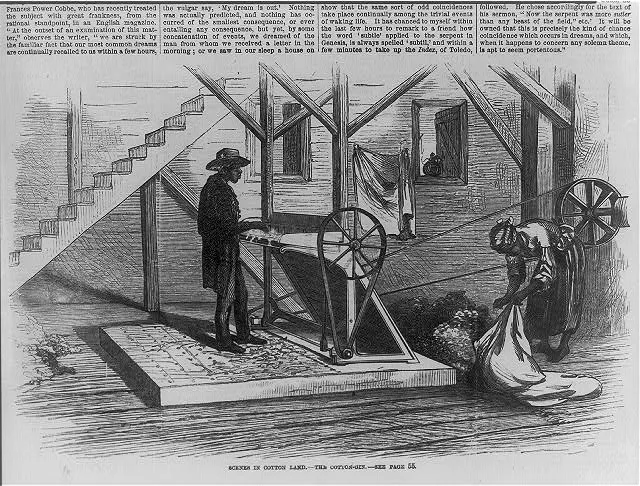
Scenes in cotton land: The cotton gin

"Scenes in cotton land: The cotton gin" / Library of Congress. 

The invention of the cotton gin by Eli Whitney in 1793 dramatically altered the Southern United States. Before this invention, cotton was difficult to process because the seeds had to be removed by hand. This process was slow and required a lot of labor. Only a small amount of cotton could be cleaned each day, which limited how much farmers could sell and made cotton less profitable compared to other crops like tobacco or rice.

Whitney's cotton gin changed everything. The machine used a system of rotating hooks and a wire screen to separate cotton fibers from their seeds quickly. Suddenly, one person could do the work of many in a single day. This technological advance solved the problem of slow processing and made cotton farming much more efficient. As a result, cotton became the dominant crop in the South.

The rapid increase in cotton production had significant effects on the Southern economy and society. Demand for Southern cotton grew, especially from textile mills in Britain and the northern United States. Plantations expanded, and new lands were used to grow more cotton. However, this growth had serious consequences: it greatly increased the demand for enslaved labor. Plantation owners depended on the forced labor of enslaved people to plant, tend, and harvest the large cotton crops. The institution of slavery became even more deeply rooted in Southern life.

This new agricultural system created wealth for many white landowners, but it also led to hardship and suffering for enslaved African Americans. Enslaved people had to work long hours in harsh conditions, and they were denied their freedom and basic rights. The expansion of slavery caused heated debate in the U.S. about whether new states should allow slavery. These disagreements would eventually contribute to the outbreak of the Civil War in 1861.

While the cotton gin was designed to make work easier, its impact was complex. It showed how technology can bring both progress and problems. The cotton gin increased efficiency and wealth, but it also deepened divisions in American society. The story of the cotton gin reminds us to think carefully about how inventions can shape our world in unexpected ways.

Interesting Fact: Eli Whitney did not make much money from his cotton gin, but his invention changed the course of American history.

Comprehension quiz (8 questions)

1. Who invented the cotton gin?

Eli Whitney
George Washington
Frederick Douglass
Abraham Lincoln

2. When was the cotton gin invented?

1793
1861
1800
1776

3. What main crop became dominant after the cotton gin?

Cotton
Tobacco
Rice
Corn

4. How did the cotton gin affect slavery?

Increased demand for enslaved labor
Ended slavery
No effect
Reduced cotton planting

5. Why did plantations expand after the cotton gin?

To grow more cotton
To build factories
To mine for gold
To raise cattle

6. What problem did the cotton gin solve?

Slow cotton seed removal
Lack of water
Travel difficulties
Food shortages

7. The cotton gin was invented in the 1800s. True or false?

True
False

8. Which word means 'work done by people forced to serve'?

Enslaved labor
Economy
Crop
Society
Who it's for

Perfect for the way you teach

Teachers
  • Build comprehension skills
  • Auto-graded quiz
  • Differentiated reading
Parents
  • Read together at home
  • Improve fluency
  • Quiet reading time
Homeschoolers
  • Reading curriculum support
  • Independent practice
  • Track Lexile growth

Topics

Reviews & Ratings

No reviews yet. Be the first to share your experience!

More reading you might love

20 more
Passage
Civil War Causes - reading educational content

Civil War Causes

Reading Passage · D2.HIS.2.3-5

$1.50
Passage
Women's Roles in Civil War - reading educational content

Women's Roles in Civil War

Reading Passage · HSS 8.10.7

$1.50
Passage
Challenges After the Civil War - reading educational content

Challenges After the Civil War

Reading Passage · D2.HIS.1-6.3-5RI.4.3

$1.50
Passage
African American Soldiers in Civil War - reading educational content

African American Soldiers in Civil War

Reading Passage · D2.HIS.2.3-5

$1.50
Passage
Children and Women During the Civil War - reading educational content

Children and Women During the Civil War

Reading Passage · D2.HIS.2.3-5

Free
Passage
Sharecropping System After Civil War - reading educational content

Sharecropping System After Civil War

Reading Passage · D2.HIS.2.3-5

$1.50
Passage
Home Front Life Civil War - reading educational content

Home Front Life Civil War

Reading Passage

$1.50
Passage
The Civil War Finally Ends - reading educational content

The Civil War Finally Ends

Reading Passage · D2.HIS.1-6.3-5

Free
Passage
Fort Sumter 1861: Civil War Begins - reading educational content

Fort Sumter 1861: Civil War Begins

Reading Passage · D2.HIS.2.3-5

$1.50
Passage
Clara Barton: Civil War Nurse and Founder - reading educational content

Clara Barton: Civil War Nurse and Founder

Reading Passage · D2.HIS.2.3-5

$1.50
Passage
Surrender at Appomattox - reading educational content

Surrender at Appomattox

Reading Passage · HSS 8.10.7

$1.50
Passage
Reconstruction Era After Civil War: American History Reading - reading educational content

Reconstruction Era After Civil War: American History Reading

Reading Passage · RH.9-10.2

Free
Passage
Rebuilding the South - reading educational content

Rebuilding the South

Reading Passage

$1.50
Passage
Civil Rights Act of 1964 - reading educational content

Civil Rights Act of 1964

Reading Passage · HSS 11.10.5

$1.50
Passage
Advantages and Disadvantages: North vs. South - reading educational content

Advantages and Disadvantages: North vs. South

Reading Passage · HSS 8.10.5

$1.50
Passage
Segregation in America After World War II - reading educational content

Segregation in America After World War II

Reading Passage · D2.HIS.2.3-5

$1.50
Passage
New York Draft Riots 1863 - reading educational content

New York Draft Riots 1863

Reading Passage · D2.HIS.2.3-5

$1.50
Passage
Reconstruction Era: Rebuilding America After Civil War - 9-1 - reading educational content

Reconstruction Era: Rebuilding America After Civil War - 9-1

Reading Passage · RH.9-10.2

Free
Passage
African Americans Fight for the Union - reading educational content

African Americans Fight for the Union

Reading Passage · HSS 5.10.3

$1.50
Passage
New Schools in the South - reading educational content

New Schools in the South

Reading Passage

$1.50
Copyright © 2026 Workybooks. Made with ♥ in California.