The Holocaust
Interactive passage with audio narration, comprehension questions, and printable PDF.
By completing this purchase you agree to our Terms of Use and Privacy Policy. Your subscription renews automatically until you cancel. You can cancel anytime from your account settings. All sales are final and non-refundable. Digital content is available for download in your account immediately upon purchase.
What's included
The Holocaust preview and details
About this printable The Holocaust reading passage (Grades 6-8)
Sample passage and quiz from The Holocaust
Reading passage and comprehension quiz preview
The Holocaust
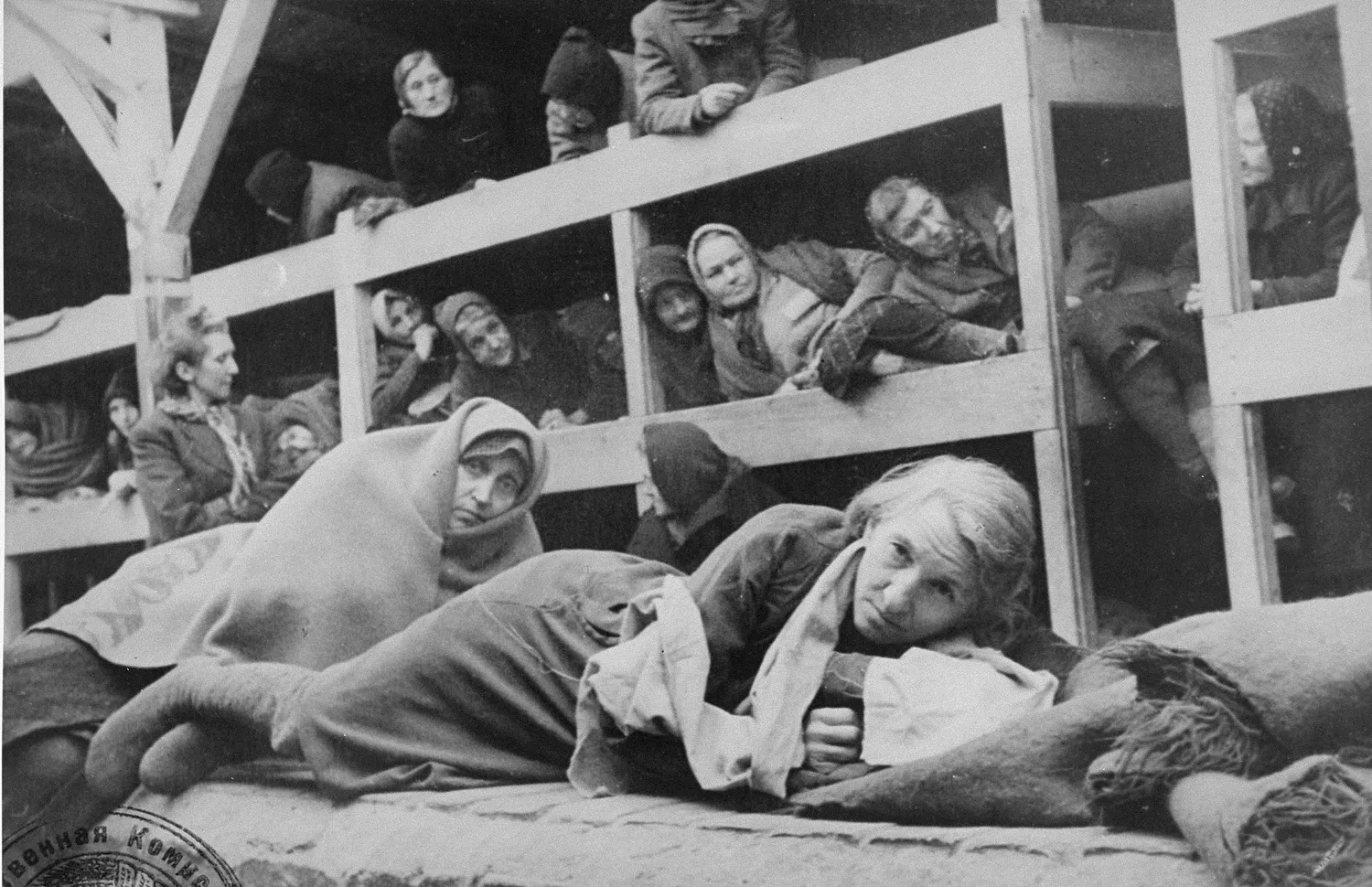
"Women in the barracks of Auschwitz" by Unknown authorUnknown author / Wikimedia Commons (Public domain).
The Holocaust was a period during World War II when Nazi Germany systematically persecuted and murdered six million Jews. This genocide also targeted millions of others, including Roma, disabled individuals, Slavic peoples, and political opponents. The Nazis, led by Adolf Hitler, believed in an extreme racist ideology that promoted the superiority of the so-called 'Aryan' race. Their policies resulted in one of the most devastating crimes in human history.
During the 1930s, Germany faced severe economic hardship after the Great Depression. The Nazi party used fear, propaganda, and promises of national revival to gain power. Once in control, they implemented laws that gradually removed rights from Jews and other 'undesirable' groups. This process of persecution included boycotts of Jewish businesses, exclusion from schools, and confiscation of property. These actions were justified by dangerous myths and stereotypes promoted by Nazi propaganda.
As World War II expanded, the Nazis escalated their efforts from discrimination to mass murder. The construction of concentration camps and extermination centers like Auschwitz, Treblinka, and Sobibor became a central part of what the Nazis called the "Final Solution." People were deported from across Europe and transported in overcrowded trains. Conditions in these camps were inhumane, with forced labor, starvation, and systematic killings through gas chambers. The word genocide was later created to describe this attempt to destroy an entire group of people.
Some individuals and groups resisted Nazi policies, risking their lives to save others. Acts of resistance included hiding Jews, forging documents, and smuggling people to safety. However, the vast scale and organization of the Nazi system made it extremely difficult for most to escape or fight back. Outside Germany, information about the Holocaust reached other nations, but responses were often slow and limited. Many countries, including the United States, were reluctant to accept large numbers of Jewish refugees, reflecting complex international and domestic challenges.
After the war ended in 1945, the world learned the full extent of the Holocaust’s horrors. The Nuremberg Trials prosecuted Nazi leaders for crimes against humanity. Survivors faced the challenge of rebuilding their lives, often with nowhere to return. The Holocaust prompted international efforts to prevent future atrocities, leading to the creation of the Universal Declaration of Human Rights and the concept of crimes against humanity.
The Holocaust remains a tragic example of what can happen when prejudice, intolerance, and unchecked power combine. Studying this history helps us recognize the importance of standing up against hatred and defending human rights everywhere.
Interesting Fact: The term "Holocaust" comes from a Greek word meaning "sacrifice by fire," but survivors often prefer the Hebrew word "Shoah," which means "catastrophe."
Comprehension quiz (8 questions)
1. Who led Nazi Germany?
2. What does 'genocide' mean?
3. When did World War II end?
4. Why did the Nazis target Jews and others?
5. What was the 'Final Solution'?
6. How did the world respond after the Holocaust?
7. The Holocaust only affected Jews. True or false?
8. What is 'persecution'?
Common Core standards for The Holocaust
Explain events, procedures, ideas, or concepts in a historical, scientific, or technical text, including what happened and why, based on specific information in the text.
Determine the meaning of general academic and domain-specific words or phrases in a text relevant to a grade 4 topic or subject area.
Write informative/explanatory texts to examine a topic and convey ideas and information clearly.
Perfect for the way you teach
- Build comprehension skills
- Auto-graded quiz
- Differentiated reading
- Read together at home
- Improve fluency
- Quiet reading time
- Reading curriculum support
- Independent practice
- Track Lexile growth