This learning resource is available in interactive and printable formats. The interactive worksheet can be played online and assigned to students. The Printable PDF version can be downloaded and printed for completion by hand.
This Grade 4-5 science passage, aligned to NGSS standards, introduces students to the Kuiper Belt—a distant region of our solar system filled with icy objects and dwarf planets. Students will learn about important scientific concepts such as the definition of the Kuiper Belt, what makes up this region, and its role in the solar system. Key terms like 'asteroids,' 'comets,' and 'dwarf planets' are highlighted and defined to build scientific vocabulary. The passage is designed for easy comprehension and is supported by an interactive multiple-choice quiz, writing prompts, and a Spanish translation. Real-world connections, fun facts, and audio integration make this resource engaging for learners. This science resource helps students understand how scientists study space and encourages curiosity about our universe.
CONTENT PREVIEW
Expand content preview
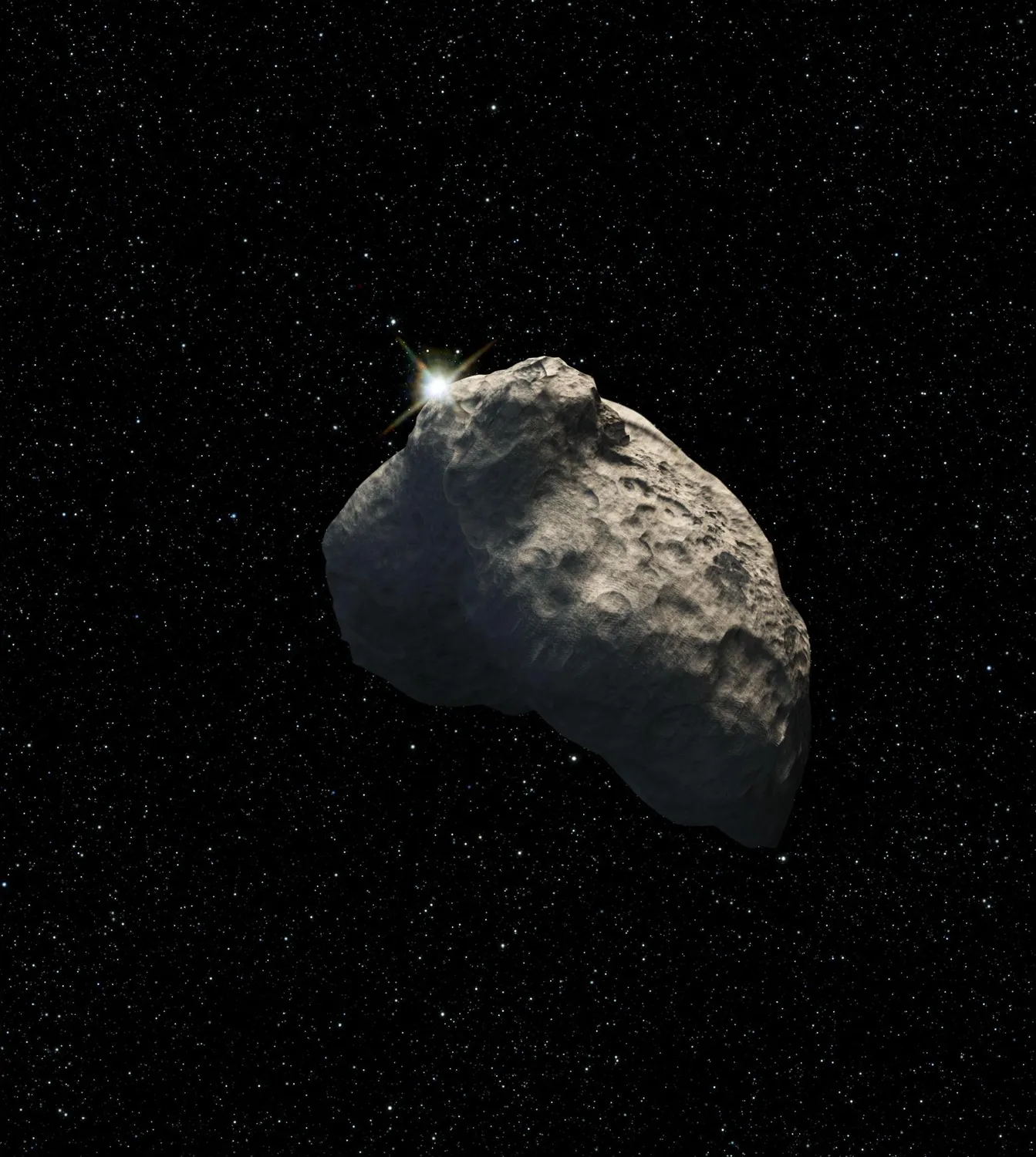
"Smallest Kuiper Belt Object" by NASA / Wikimedia Commons (Public domain).
The Kuiper Belt is a large area in our solar system that is full of icy objects. It is located beyond the planet Neptune, which is the eighth planet from the Sun. The Kuiper Belt is like a giant ring or doughnut that circles the Sun. This region is very far from Earth and even farther from the Sun, so it is very cold.
Many different objects are found in the Kuiper Belt. Some of these are called dwarf planets. A famous dwarf planet in the Kuiper Belt is Pluto. Dwarf planets are not as large as the eight main planets, but they still travel, or orbit, around the Sun. The Kuiper Belt also has small icy bodies called comets. When some comets leave the Kuiper Belt and get close to the Sun, they grow bright tails that we can see from Earth.
The objects in the Kuiper Belt are made mostly of ice, rock, and dust. Because the Kuiper Belt is so far from the Sun, the ice there stays frozen. Scientists believe the Kuiper Belt is left over from when the solar system first formed. Studying the Kuiper Belt helps us learn about the history of our solar system and how planets and other objects were created.
Scientists use telescopes to look at the Kuiper Belt. In 2015, a space mission called New Horizons flew past Pluto and sent back amazing pictures and information. This helped us learn more about the Kuiper Belt and its icy worlds.
Interesting Fact: Some comets that we see in the night sky come from the Kuiper Belt and travel millions of miles to reach us!
Where is the Kuiper Belt located?
Beyond NeptuneBefore EarthBetween Mars and JupiterNear the Sun
What is Pluto?
A dwarf planetA cometA telescopeAn asteroid
What are comets made of?
Ice, rock, and dustOnly metalHot gasWater and plants
Why do comets have tails?
They melt near the SunThey orbit the EarthThey are planetsThey are made of fire
How do scientists study the Kuiper Belt?
Using telescopesWith microscopesBy diving underwaterWith magnifying glasses
What did New Horizons do?
Visited PlutoLanded on MarsBuilt the SunCreated the Kuiper Belt
The Kuiper Belt is made of hot gas.
TrueFalse
Which word means 'to travel around'?
OrbitFreezeShineMelt
Perfect For:
👩🏫 Teachers
• Reading comprehension practice
• Auto-graded assessments
• Literacy skill development
👨👩👧👦 Parents
• Reading practice at home
• Comprehension improvement
• Educational reading time
🏠 Homeschoolers
• Reading curriculum support
• Independent reading practice
• Progress monitoring
Reading Features:
📖
Reading Passage
Engaging fiction or nonfiction text
❓
Comprehension Quiz
Auto-graded questions
📊
Instant Feedback
Immediate results and scoring
📄
Printable Version
Download for offline reading
🔊
Read Aloud
Voice-over with word highlighting
Reviews & Ratings
No reviews yet. Be the first to share your experience!
Related Content
Earth: Our Home in Space
This engaging Grade 4-5 science passage, aligned to NGSS, introduces students to Earth's special place in the solar syst...
Tools and Technology in Earth Science
This middle school science reading passage explores the wide range of tools and technologies used in Earth science, from...
MS-ESS2-2MS-ESS3-2MS-ETS1-1MS-PS4-3
Earth's Place in the Universe
This reading passage explains Earth's place in the universe, supporting NGSS 1-ESS1-1. It describes how Earth is one of ...
1-ESS1-1
Scientific Inquiry in Earth Science
This passage explores scientific inquiry in Earth science for grades 6-8, aligned with NGSS standards MS-ESS1-4, MS-ESS2...
MS-ESS1-4MS-ESS2-1MS-ESS3-5SEP
What Is Space Weather and How Does It Affect the Earth?
This NGSS-aligned science passage for middle school explains what space weather is and how it affects Earth. Students le...
MS-ESS2-2
Escape Velocity and Space Travel
This middle school science passage introduces students to the concept of escape velocity—the minimum speed required to b...
MS-ESS1-2MS-PS2-4
Space Stations
This informational science reading passage for grades 6-8 explores the complex systems and technology behind space stati...
MS-ESS1-3MS-ETS1-1
What Is Earth Science?
This engaging middle school science passage introduces students to the field of Earth science, aligning with NGSS standa...
MS-ESS1MS-ESS2MS-ESS3SEP
The Space Garden
This innovative passage combines plant science with space exploration, aligning with NGSS standards for life sciences an...
RL.3.1RL.2.1RL.4.9
Measuring Distances in Space
This middle school science passage explores how astronomers measure the vast distances in space, aligning with NGSS stan...
MS-ESS1-3
Earth: Our Home Planet
This comprehensive science passage for grades 6-8 explores Earth’s unique characteristics and the interconnected systems...
MS-ESS1-2
Meteorite Impacts on Earth
This engaging science reading passage for Grades 4-5 explores meteorite impacts on Earth, aligning with NGSS standards. ...
Exploring Space: Rockets and Spacecraft
Space exploration has been one of humanity's greatest achievements, made possible by rockets and spacecraft. Rockets act...
RI.4.4RI.4.2
Earth's Rotation
This middle school science passage, aligned with NGSS standard MS-ESS1-1, focuses on Earth's rotation—how Earth spins on...
MS-ESS1-1
Facts About Earth
This engaging science reading passage introduces Grade 4 and 5 students to Earth, our home planet. Aligned with NGSS sta...
International Space Station
Discover the wonders of the International Space Station with this informative coloring page showcasing the orbiting outpost where astronauts live and work in space. As children color the complex modul...
Earth's Moon Facts
This engaging science passage, 'The Moon: Earth's Companion,' is designed for Grade 4-5 students and aligns with NGSS ge...
The Space Needle
Students read a passage about the history and features of Seattle's Space Needle, then answer comprehension questions to...
RI.4.2
Earth's Seasons
This comprehensive reading passage for grades 6-8 explains why Earth has seasons, revealing the scientific mechanisms be...
MS-ESS1-1
Venus: Earth's Twin?
This comprehensive science passage for grades 6-8 examines Venus—often called Earth's twin—by exploring its similarities...