The Pueblo Revolt of 1680
Interactive passage with audio narration, comprehension questions, and printable PDF.
By completing this purchase you agree to our Terms of Use and Privacy Policy. Your subscription renews automatically until you cancel. You can cancel anytime from your account settings. All sales are final and non-refundable. Digital content is available for download in your account immediately upon purchase.
What's included
The Pueblo Revolt of 1680 preview and details
About this printable The Pueblo Revolt of 1680 reading passage (Grades 6-8)
Sample passage and quiz from The Pueblo Revolt of 1680
Reading passage and comprehension quiz preview
Pueblo Revolt of 1680
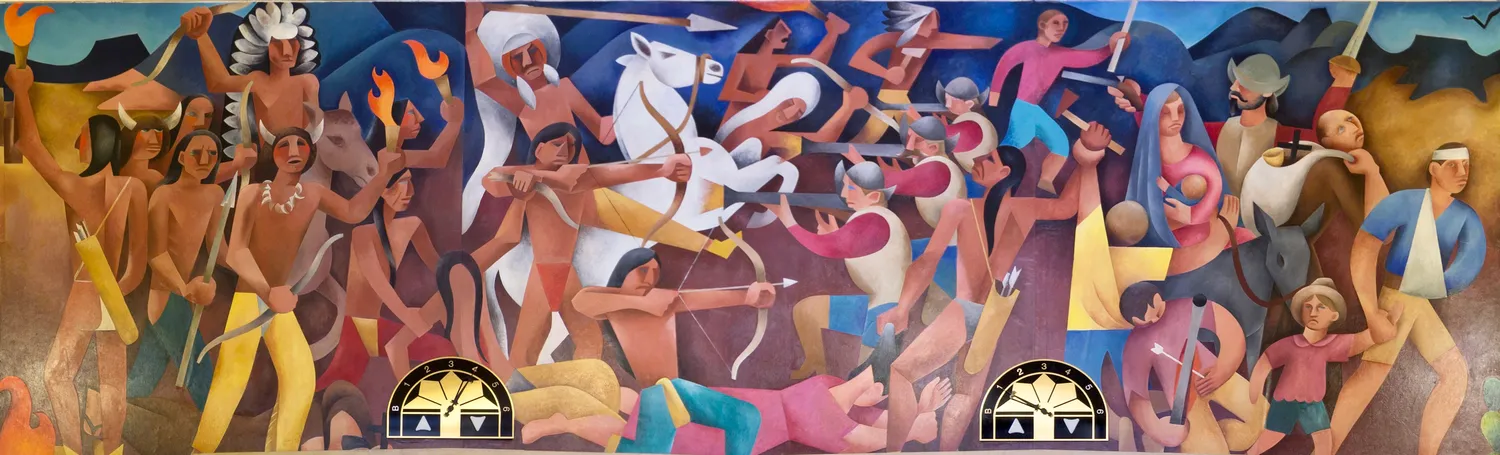
Loren Mozley Pueblo Revolt 1680 installed 1936 ABQ NM by Loren Mozley for TRAP (USgov), 1936 / Wikimedia Commons
The Pueblo Revolt of 1680 was one of the most significant examples of Native American resistance to European colonization in North America. This event took place in what is now New Mexico, where the Spanish had established settlements and missions. The Spanish colonizers imposed strict control over the Pueblo peoples, forcing them to abandon their traditional customs and religions. As a result, conflicts over land, religion, and power increased between the Spanish and the Pueblo communities.
One of the main causes of the revolt was the Spanish policy of forcing the Pueblo people to convert to Christianity and work in the Spanish economic system, known as the encomienda. This system demanded that Native people provide labor and goods to the Spanish. The suppression of Pueblo religious ceremonies and harsh punishments for practicing their beliefs led to growing anger. Drought and famine further increased the hardships, making life even more difficult for the Pueblo tribes.
In response to these problems, a spiritual leader named Popé emerged as the main organizer of the revolt. Popé secretly united the different Pueblo villages, who spoke various languages and had their own traditions. Through careful planning and communication, Popé and his supporters set a date for the uprising. On August 10, 1680, the Pueblo people launched a coordinated attack against Spanish settlements and missions throughout the region.
The revolt was highly organized and effective. Pueblo warriors destroyed Spanish churches, killed many colonists, and drove survivors out of their territory. The Spanish were forced to retreat south to El Paso, abandoning their settlements for twelve years. During this time, the Pueblo people restored their own systems of governance and returned to their traditional religious practices. The successful rebellion is considered the most successful Native American uprising against European power in colonial history.
However, the period of independence was not without challenges. The Pueblo communities had to address internal disagreements and threats from neighboring tribes. In 1692, the Spanish returned to New Mexico with a new approach, offering some religious tolerance and seeking to rebuild relationships with the Pueblo people. Although the Spanish reestablished control, they made significant changes in their methods, showing greater respect for Pueblo sovereignty and traditions.
The Pueblo Revolt of 1680 had a lasting impact on the history of the American Southwest. It showed that Native Americans could successfully organize and resist European colonization. It also forced the Spanish to change their policies, leading to a more complex and blended society in New Mexico. Historians see the revolt as a turning point, highlighting the importance of cultural survival and adaptation.
Interesting Fact: The Pueblo Revolt is the only successful Native American uprising that completely expelled European colonizers from their territory for over a decade.
Comprehension quiz (8 questions)
1. Who led the Pueblo Revolt?
2. What year did the revolt begin?
3. Where did the revolt take place?
4. Why did the Pueblo people revolt?
5. What was one effect of the revolt?
6. What did the Spanish change after returning?
7. The Pueblo Revolt lasted over 20 years. True or false?
8. What does 'sovereignty' mean?
Common Core standards for The Pueblo Revolt of 1680
Explain events, procedures, ideas, or concepts in a historical, scientific, or technical text, including what happened and why, based on specific information in the text.
Determine the meaning of general academic and domain-specific words or phrases in a text relevant to a grade 4 topic or subject area.
Write informative/explanatory texts to examine a topic and convey ideas and information clearly.
Perfect for the way you teach
- Build comprehension skills
- Auto-graded quiz
- Differentiated reading
- Read together at home
- Improve fluency
- Quiet reading time
- Reading curriculum support
- Independent practice
- Track Lexile growth