The Sahara Desert
Interactive passage with audio narration, comprehension questions, and printable PDF.
By completing this purchase you agree to our Terms of Use and Privacy Policy. Your subscription renews automatically until you cancel. You can cancel anytime from your account settings. All sales are final and non-refundable. Digital content is available for download in your account immediately upon purchase.
What's included
The Sahara Desert preview and details
About this printable The Sahara Desert science reading passage, NGSS-aligned (Grades 5-8)
Sample passage and quiz from The Sahara Desert
Reading passage and comprehension quiz preview
The Sahara Desert
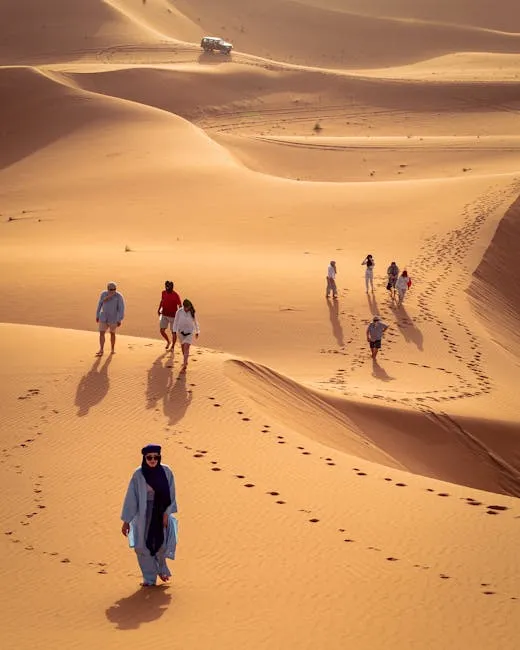
"Travelers explore the vast Sahara Desert dunes in Morocco led by a Berber guide." by Henrik Le-Botos / Pexels.
The Sahara Desert stretches across northern Africa, covering about 9 million square kilometers. It is recognized as the world’s largest hot desert. The Sahara’s vast size and harsh conditions make it a place of scientific interest. Scientists study how its extreme environment shapes the ecosystems and the way living things adapt to survive.
Extreme Temperatures and Landscapes
Temperatures in the Sahara can rise above 50°C (122°F) during the day, but drop below freezing at night. These dramatic changes are caused by the desert’s dry air and lack of cloud cover, which allows heat to escape quickly after sunset. The Sahara’s landscapes are not just endless sand. Only about 20% of the Sahara is covered by sand dunes. Much of it consists of rocky plateaus called hamadas, gravel plains, mountains, and scattered oases where water is found. Each type of landform affects how plants and animals survive, influencing the distribution of life in the desert.
Adaptation and Survival
Surviving in the Sahara requires special adaptations. For example, the fennec fox has large ears that help release body heat, and a pale coat that reflects sunlight. The dromedary camel stores fat in its hump and can go for days without water, using physical and behavioral adaptations to conserve water and energy. The addax, a type of antelope, has wide hooves for walking on sand and can survive on moisture from plants. These examples show how the Sahara’s wildlife has evolved specialized features to meet the challenges of their ecosystem.
Climate Change and Sahara’s History
Today, the Sahara is one of the driest places on Earth, but scientific evidence shows it was not always this way. Ancient fossils, cave paintings, and pollen samples suggest the Sahara was once a green region with rivers, lakes, and forests. About 8,000 years ago, changes in Earth’s orbit shifted rainfall patterns, turning lush land into desert over thousands of years. These changes demonstrate how Earth’s systems interact and how climate can transform an entire region, affecting both human societies and natural habitats.
The Sahara Desert is a living laboratory for understanding adaptation, climate change, and the complex relationships between land, water, and life. Studying its past and present teaches scientists how ecosystems respond to environmental changes and what the future might hold for deserts worldwide.
Interesting Fact:
Sahara comes from the Arabic word for “desert,” so calling it the “Sahara Desert” actually means “Desert Desert.”
Comprehension quiz (10 questions)
1. What percentage of the Sahara Desert is covered by sand dunes?
2. What is an adaptation that helps the fennec fox survive the desert's heat?
3. Which of the following is NOT one of the main landscapes found in the Sahara?
4. What causes the extreme temperature changes between day and night in the Sahara?
5. What evidence shows that the Sahara was once much greener?
6. What does the word 'adaptation' mean in the context of the passage?
7. Why are oases important in the Sahara Desert?
8. How did changes in Earth’s orbit affect the Sahara’s climate?
9. The Sahara is the world’s largest hot desert. (True/False)
10. The addax can survive in the Sahara because it stores water in its ears. (True/False)
Perfect for the way you teach
- Build comprehension skills
- Auto-graded quiz
- Differentiated reading
- Read together at home
- Improve fluency
- Quiet reading time
- Reading curriculum support
- Independent practice
- Track Lexile growth