The Search for Alien Life
Interactive passage with audio narration, comprehension questions, and printable PDF.
By completing this purchase you agree to our Terms of Use and Privacy Policy. Your subscription renews automatically until you cancel. You can cancel anytime from your account settings. All sales are final and non-refundable. Digital content is available for download in your account immediately upon purchase.
What's included
The Search for Alien Life preview and details
About this printable The Search for Alien Life science reading passage, NGSS-aligned (Grades 5-8)
Sample passage and quiz from The Search for Alien Life
Reading passage and comprehension quiz preview
The Search for Alien Life
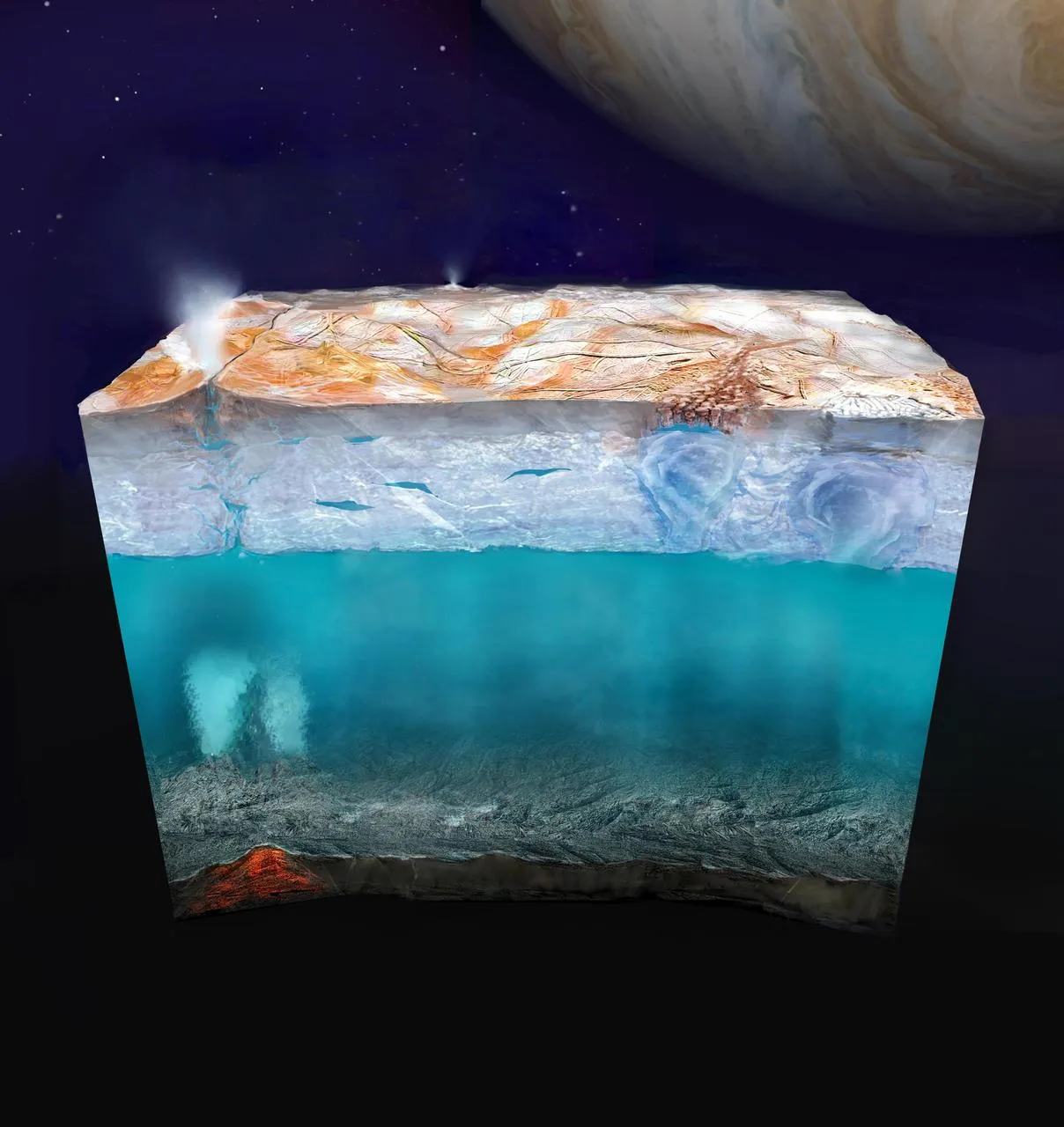
Are we alone in the universe? Scientists are working to answer this question through carefully planned space missions. Evidence shows that several locations in our solar system may have conditions suitable for life. Over the next decade, new missions will search for signs of life beyond Earth.
Three major missions will lead the search. The Europa Clipper will explore Jupiter's moon Europa. Scientists observe that Europa has a thick ice shell covering a deep ocean. This ocean may contain twice as much water as all of Earth's oceans combined. The spacecraft will fly by Europa nearly 50 times. Its instruments will measure the ice thickness and analyze the ocean below. If the ocean has the right chemicals and energy sources, life could exist there.
The Mars Sample Return mission will bring Martian rocks to Earth. Previous missions found evidence that Mars once had liquid water on its surface. The new mission will collect rock samples that may contain fossils or chemical signs of ancient life. Scientists will study these samples in laboratories with powerful equipment. This direct analysis can reveal details that rovers cannot detect on Mars.
New space telescopes will study exoplanets, which are planets orbiting other stars. These telescopes will analyze the atmospheres of distant planets. Scientists look for biosignatures, which are gases that living things produce. On Earth, plants release oxygen through photosynthesis. If scientists detect similar gases on an exoplanet, it may indicate life exists there.
Each mission uses different methods to search for life. Europa Clipper will probe beneath an icy surface. Mars Sample Return will examine ancient rocks. Space telescopes will study planetary atmospheres from millions of miles away. Together, these missions tighten the search for life. The evidence they gather will help scientists understand where life can exist. The next decade may bring humanity's first confirmed discovery of life beyond Earth. This discovery would change our understanding of life in the universe.
Interesting Fact: Europa's ocean may have hydrothermal vents on its seafloor, similar to vents on Earth where unusual creatures thrive without sunlight. These vents could provide energy for alien life forms.
Comprehension quiz (10 questions)
1. What is the main purpose of the Europa Clipper mission?
2. How many times will Europa Clipper fly by Europa?
3. What does the term 'biosignatures' mean in the passage?
4. Based on the passage, what evidence suggests Mars may have once supported life?
5. Why will scientists bring Martian rocks back to Earth instead of studying them only on Mars?
6. How do new space telescopes search for life on exoplanets?
7. If scientists detect oxygen in an exoplanet's atmosphere, what might this suggest?
8. What makes hydrothermal vents on Europa potentially important for alien life?
9. True or False: Europa's ocean may contain twice as much water as all of Earth's oceans combined.
10. True or False: All three missions described in the passage use the same method to search for life.
Perfect for the way you teach
- Build comprehension skills
- Auto-graded quiz
- Differentiated reading
- Read together at home
- Improve fluency
- Quiet reading time
- Reading curriculum support
- Independent practice
- Track Lexile growth