The Second Great Awakening
Interactive passage with audio narration, comprehension questions, and printable PDF.
By completing this purchase you agree to our Terms of Use and Privacy Policy. Your subscription renews automatically until you cancel. You can cancel anytime from your account settings. All sales are final and non-refundable. Digital content is available for download in your account immediately upon purchase.
What's included
The Second Great Awakening preview and details
About this printable The Second Great Awakening reading passage (Grades 6-8)
Sample passage and quiz from The Second Great Awakening
Reading passage and comprehension quiz preview
The Second Great Awakening
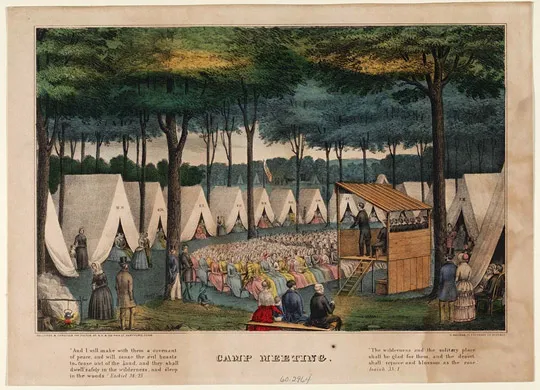
"Tent revival during the Second Great Awakening" by Kelloggs & Comstock / Wikimedia Commons (Public domain).
The Second Great Awakening was a powerful religious revival that took place in the United States during the early 1800s. This movement began as a response to social and economic changes that left many Americans searching for meaning and community. Preachers traveled throughout the country, holding large outdoor meetings called camp meetings, where they encouraged people to seek personal salvation and to improve society through moral actions.
One major feature of the Second Great Awakening was its focus on evangelism, or spreading religious beliefs to others. Ministers and laypeople alike felt it was their duty to bring religious renewal to their communities. This led to the growth of new Christian denominations, particularly among Methodists and Baptists, which attracted large numbers of followers. The movement was inclusive, reaching out to women, African Americans, and people from different economic backgrounds.
As religious excitement spread, many Americans began to believe they could help build a better society. This belief encouraged a wave of reform movements that addressed major social issues. One such reform was the temperance movement, which aimed to reduce alcohol consumption. Supporters argued that alcohol caused poverty, violence, and the breakdown of families. Temperance societies organized rallies, distributed pamphlets, and lobbied for laws to limit the sale of alcohol.
Another significant reform inspired by the Second Great Awakening was the push for public education. Reformers like Horace Mann argued that a strong democracy required educated citizens. As a result, states began to build more public schools and train teachers. The movement also promoted opportunities for women and African Americans to receive an education, although progress was uneven.
The abolition movement, which sought to end slavery, was perhaps the most far-reaching reform of the era. Many abolitionists were motivated by their religious beliefs, seeing slavery as a moral evil. They published newspapers, gave speeches, and petitioned Congress to end slavery. These efforts often met with fierce opposition, especially in the South, where slavery was deeply rooted in the economy and culture.
The Second Great Awakening created both cooperation and conflict. While it inspired people to work together for positive change, it also led to divisions over issues like slavery and women's rights. These conflicts would later play a role in the growing tensions that led to the Civil War. The movement showed how religious ideas could drive both unity and disagreement in American society.
In summary, the Second Great Awakening was more than a religious revival; it was a catalyst for widespread social change. Through revival meetings and passionate preaching, Americans were encouraged to seek not only personal faith but also a more just and moral society. The legacy of this movement can still be seen in the ongoing struggle for social justice and equality.
Interesting Fact: One of the most famous preachers of the Second Great Awakening, Charles Grandison Finney, held revival meetings in upstate New York that became known as the "Burned-Over District" because of the intense religious excitement there.
Comprehension quiz (8 questions)
1. When did the Second Great Awakening occur?
2. What were camp meetings?
3. Who was a famous preacher in this movement?
4. Why did temperance supporters want to limit alcohol?
5. How did the movement affect education?
6. What was the goal of the abolition movement?
7. The Second Great Awakening only united people. True or false?
8. What does 'revival' mean in this passage?
Perfect for the way you teach
- Build comprehension skills
- Auto-graded quiz
- Differentiated reading
- Read together at home
- Improve fluency
- Quiet reading time
- Reading curriculum support
- Independent practice
- Track Lexile growth