The Statue of Liberty Welcomes Newcomers — Reading Comprehension
Rate this
Premium Resource
Present
Present in classroom. No work saved
Assign
Classroom with student accounts, Track progress
Quick Play
No student accounts, assign with a link
Grades
3
4
5
Standards
D2.HIS.1-4.3-5
RI.4.3
RI.4.4
PRINT+DIGITAL RESOURCE
This learning resource is available in interactive and printable formats. The interactive worksheet can be played online and assigned to students. The Printable PDF version can be downloaded and printed for completion by hand.
This engaging history reading passage explores the story of the Statue of Liberty and its role as a symbol of hope for newcomers arriving in the United States. Students will learn about the statue’s construction, its arrival from France, and how it welcomed millions of immigrants entering through Ellis Island. The passage uses clear, simple language, includes grade-appropriate vocabulary, and features a glossary for key terms. Activities include a multiple-choice quiz, writing prompts that encourage historical analysis and making connections to today, and a timeline highlighting important events. The content aligns with the C3 Framework and Common Core standards for history and literacy. Additional features include a Spanish translation of the passage and read aloud audio, making it accessible for diverse learners. This resource is designed to build foundational knowledge about U.S. history, promote critical thinking, and inspire students with stories of bravery and unity.
CONTENT PREVIEW
Expand content preview
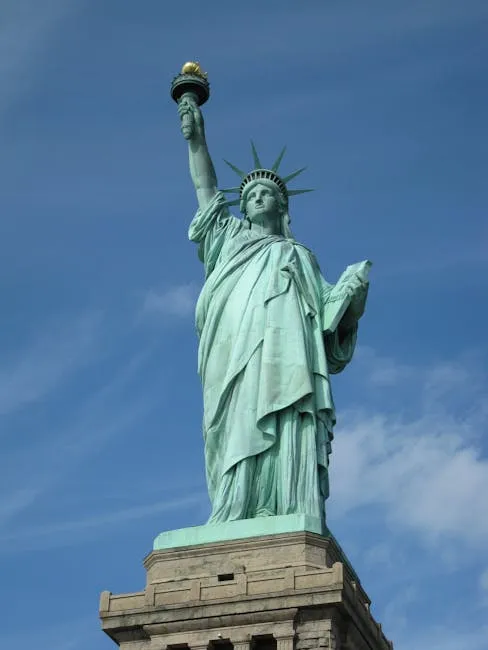
The Statue of Liberty serves as a symbol of freedom against a clear blue sky in New York City. Source: Pexels - Pixabay
The Statue of Liberty stands on Liberty Island in New York Harbor. This giant statue is a symbol of freedom and hope for people all over the world. It was a gift from the people of France to the United States in 1886. The statue was meant to celebrate friendship and the values of liberty and democracy.
When the Statue of Liberty arrived in New York, it was packed in over 200 crates. Workers had to put the pieces together like a huge puzzle. Lady Liberty stands over 300 feet tall, holding a torch high in her right hand. In her left arm, she carries a tablet with the date July 4, 1776, the day the Declaration of Independence was signed.
During the late 1800s and early 1900s, millions of immigrants came to the United States by ship. As these newcomers sailed into New York Harbor, the first thing they saw was the Statue of Liberty. The statue welcomed them to their new home and gave them hope for a better life. Many immigrants felt nervous and afraid when they arrived, but seeing Lady Liberty made them feel welcome and safe.
On a plaque at the base of the statue, there are famous words written by poet Emma Lazarus: "Give me your tired, your poor, your huddled masses yearning to breathe free." These words show that the United States wanted to help people looking for freedom and a new beginning. The Statue of Liberty became a sign that America welcomed people from many different places.
The statue is made of copper and has turned green over time. It has survived storms, wars, and many years of change. Today, millions of people visit the Statue of Liberty each year. It is a reminder of the bravery and dreams of those who came to America looking for a better life.
The Statue of Liberty is not just a monument. It is a promise that freedom and opportunity belong to everyone. Its torch lights the way for people who believe in hope, courage, and a new start.
Interesting Fact: The Statue of Liberty’s full name is "Liberty Enlightening the World."
Where is the Statue of Liberty?
New York HarborSan Francisco BayBoston HarborChicago River
Who gave the statue to the US?
FranceEnglandGermanyItaly
What does Lady Liberty hold in her right hand?
A torchA flagA bookA crown
Why did immigrants feel hope seeing the statue?
It welcomed themIt was tallIt was greenIt was famous
What message does the statue share?
Freedom and welcomeOnly for touristsFrench friendshipMoney and power
How did the statue arrive in New York?
In pieces in cratesAlready builtBy airplaneBy train
The statue is made of copper. True or false?
TrueFalse
What is a symbol?
It stands for an ideaIt is a kind of foodIt is a type of shipIt is a type of animal
Perfect For:
👩🏫 Teachers
• Reading comprehension practice
• Auto-graded assessments
• Literacy skill development
👨👩👧👦 Parents
• Reading practice at home
• Comprehension improvement
• Educational reading time
🏠 Homeschoolers
• Reading curriculum support
• Independent reading practice
• Progress monitoring
Reading Features:
📖
Reading Passage
Engaging fiction or nonfiction text
❓
Comprehension Quiz
Auto-graded questions
📊
Instant Feedback
Immediate results and scoring
📄
Printable Version
Download for offline reading
🔊
Read Aloud
Voice-over with word highlighting
Reviews & Ratings
No reviews yet. Be the first to share your experience!
Related Content
Trade and Trading Routes Between Tribes
This engaging history reading passage explores the important role of trade and trading routes between Native American tr...
D2.HIS.1-4.3-5RI.4.1RI.4.3RI.4.4
The 13 Original Colonies: An Overview
This engaging U.S. history reading passage introduces students to the 13 original colonies. It presents the story of how...
D2.HIS.1-4.3-5RI.4.3RI.4.4RI.4.10
The French and Indian War
This educational history reading passage explores the French and Indian War, a major conflict in North America before th...
D2.HIS.1-4.3-5RI.4.1RI.4.3RI.4.4
Unfair Taxes and the Stamp Act
This engaging U.S. history reading passage explores the story of the Stamp Act and unfair taxes in colonial America. Ali...
D2.HIS.1-4.3-5RI.4.1RI.4.3
Paul Revere's Midnight Ride
This U.S. History reading passage explores the famous Midnight Ride of Paul Revere, a key event in the American Revoluti...
D2.HIS.1-4.3-5RI.4.3RI.4.4RI.4.10
The Declaration of Independence and Thomas Jefferson
This engaging passage teaches students about the Declaration of Independence and Thomas Jefferson, one of America's Foun...
D2.HIS.1-4.3-5RI.4.1RI.4.2RI.4.3
Soldiers at Valley Forge in Winter
Explore the inspiring story of the Continental Army at Valley Forge during the harsh winter of 1777-1778. This history r...
D2.HIS.1-4.3-5RI.4.3RI.4.4RI.5.3
The Treaty of Paris 1783
This passage introduces students to the Treaty of Paris 1783, the important agreement that officially ended the American...
D2.HIS.1-4.3-5RI.4.3RI.4.4RI.4.10
The Star-Spangled Banner and War
This reading passage explores the inspiring story of 'The Star-Spangled Banner' and its origins during the War of 1812. ...
D2.HIS.1-4.3-5RI.4.1RI.4.3RI.4.4
Thomas Jefferson and the Louisiana Purchase
This engaging U.S. history reading passage teaches students about Thomas Jefferson and the Louisiana Purchase, one of th...
D2.HIS.1-4.3-5RI.4.3RI.5.3
James Madison and the War of 1812
This engaging U.S. history reading passage focuses on James Madison and the War of 1812. Students learn about key events...
D2.HIS.1-4.3-5RI.4.1RI.4.3RI.4.4
The First Political Parties Form
This engaging passage explores the formation of America's first political parties, highlighting the Federalists and Demo...
D2.HIS.1-4.3-5RI.4.3RI.4.4
James Monroe and the Monroe Doctrine
This engaging U.S. history reading passage introduces students to President James Monroe and the Monroe Doctrine, a key ...
D2.HIS.1-4.3-5RI.4.1RI.4.2RI.4.3
Americans Move West: The Oregon Trail
This engaging history passage explores the Oregon Trail and the westward movement of Americans in the 1800s. Students wi...
D2.HIS.1-4.3-5RI.4.3RI.4.4RI.5.3
Cowboys and Cattle Drives
This engaging U.S. History reading passage introduces students to the world of cowboys and cattle drives, a key part of ...
D2.HIS.1-4.3-5RI.4.3RI.4.4RI.5.3
Life in a Frontier Town
This passage explores the daily life and challenges faced by people living in a frontier town in the early United States...
D2.HIS.1-4.3-5RI.4.3RI.4.4W.4.2
Homestead Act: Free Land for Settlers
This engaging history reading passage explores the Homestead Act and its impact on American settlers moving west. Studen...
D2.HIS.1-4.3-5RI.4.3RI.4.4
Dangers on the Oregon Trail
This reading passage explores the many dangers faced by pioneers on the Oregon Trail, one of the most significant journe...
D2.HIS.1-4.3-5RI.4.1RI.4.3RI.4.4
Native Americans Lose Their Lands: The Trail of Tears
This reading passage explores the story of the Trail of Tears, focusing on the experiences of Native Americans as they l...
D2.HIS.1-4.3-5RI.4.3RI.4.4RI.4.7
Sherman's March to the Sea
This U.S. history reading passage explores Sherman's March to the Sea, a turning point during the Civil War. Students wi...