Three-Fifths Compromise and Slavery in Constitution
Interactive passage with audio narration, comprehension questions, and printable PDF.
By completing this purchase you agree to our Terms of Use and Privacy Policy. Your subscription renews automatically until you cancel. You can cancel anytime from your account settings. All sales are final and non-refundable. Digital content is available for download in your account immediately upon purchase.
What's included
Three-Fifths Compromise and Slavery in Constitution preview and details
About this printable Three-Fifths Compromise and Slavery in Constitution reading passage (Grades 6-8)
Sample passage and quiz from Three-Fifths Compromise and Slavery in Constitution
Reading passage and comprehension quiz preview
Three-Fifths Compromise and Slavery
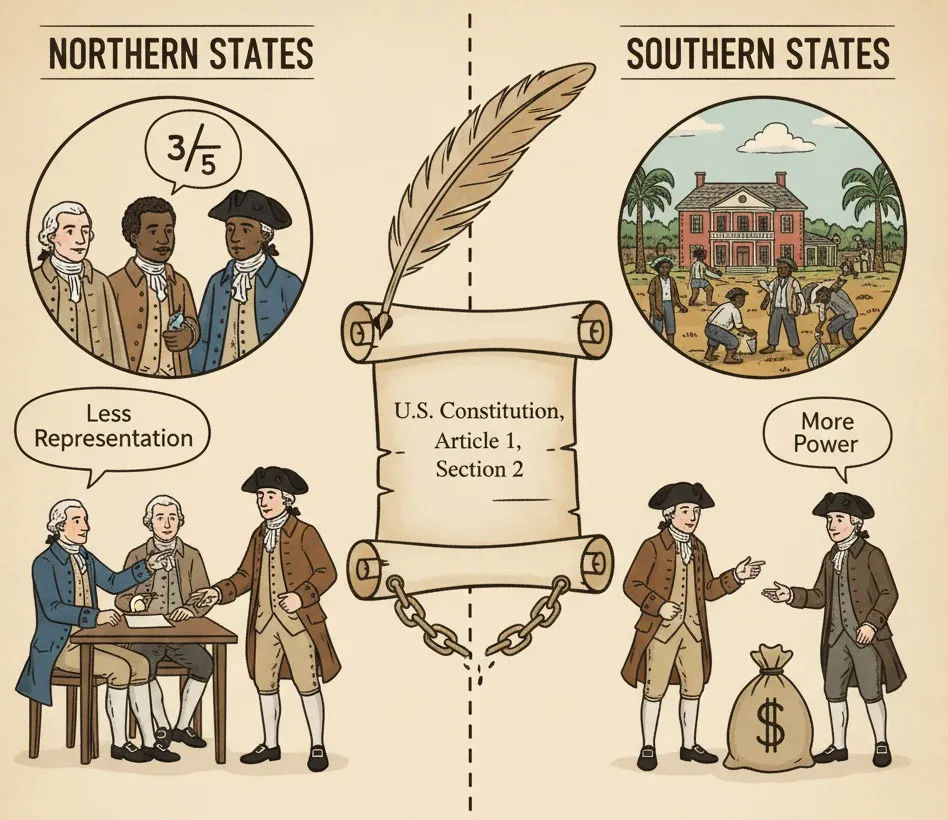
The Three-Fifths Compromise was an important agreement made during the Constitutional Convention of 1787. Delegates from the original thirteen states gathered in Philadelphia to create a new Constitution for the United States. One of the biggest debates was about how states would be represented in the new Congress. The issue centered on whether and how enslaved people would be counted for representation and taxation purposes.
At the time, the population of Southern states included a large number of enslaved people, while Northern states had far fewer. Southern delegates wanted to count enslaved people fully when determining how many representatives each state would have in the House of Representatives. This would give the South more political power. However, Northern delegates argued that since enslaved people had no rights as citizens, they should not be counted at all for representation. This conflict made it difficult for the delegates to reach an agreement.
In order to move forward, the delegates sought a compromise. After heated debate, they decided that each enslaved person would be counted as three-fifths of a person for the purpose of enumeration. This meant that only three out of every five enslaved people would be included when determining a state's population for both representation in Congress and taxation by the federal government. The Three-Fifths Compromise was written into Article I, Section 2 of the new Constitution.
The compromise solved the immediate problem of political gridlock at the Constitutional Convention, allowing the delegates to complete their work and form a new government. However, the solution was deeply flawed. By counting enslaved people as only a fraction of a person, the compromise denied their full humanity. It also gave Southern states more influence in Congress than they would have had if only free people were counted, strengthening the political power of slaveholding states.
The effects of the Three-Fifths Compromise lasted for many decades. It increased the number of Southern representatives in the House and affected the outcome of many important national decisions, including elections and the passage of new laws. The compromise did not address the moral problem of slavery itself. Instead, it showed how political decisions sometimes ignore or worsen injustices in order to maintain unity or achieve ratification of important documents.
The Three-Fifths Compromise is a clear example of how the struggle for power, the need for negotiation, and the realities of regional differences shaped the early history of the United States. Understanding this compromise helps us see how the foundations of the nation's government were built on both cooperation and conflict, and how the consequences of those choices continued to affect American society for generations.
Interesting Fact: The Three-Fifths Compromise was officially ended by the 13th Amendment in 1865, when slavery was abolished throughout the United States.
Comprehension quiz (8 questions)
1. When was the Three-Fifths Compromise made?
2. Where did the Constitutional Convention meet?
3. Who wanted enslaved people counted fully?
4. Why did Northern states oppose counting enslaved people fully?
5. How did the compromise affect Congress?
6. What was a negative result of the compromise?
7. The Three-Fifths Compromise ended in 1865. True or false?
8. What does compromise mean?
Common Core standards for Three-Fifths Compromise and Slavery in Constitution
Explain events, procedures, ideas, or concepts in a historical, scientific, or technical text, including what happened and why, based on specific information in the text.
Determine the meaning of general academic and domain-specific words or phrases in a text relevant to a grade 4 topic or subject area.
Write informative/explanatory texts to examine a topic and convey ideas and information clearly.
Perfect for the way you teach
- Build comprehension skills
- Auto-graded quiz
- Differentiated reading
- Read together at home
- Improve fluency
- Quiet reading time
- Reading curriculum support
- Independent practice
- Track Lexile growth