Title IX 1972: Gender Equality in Education — Reading Comprehension
Rate this
Premium Resource
Present
Present in classroom. No work saved
Assign
Classroom with student accounts, Track progress
Quick Play
No student accounts, assign with a link
Grades
6
7
8
Standards
D2.HIS.2.3-5
D2.HIS.3.3-5
RI.4.3
RI.4.4
W.4.2
PRINT+DIGITAL RESOURCE
This learning resource is available in interactive and printable formats. The interactive worksheet can be played online and assigned to students. The Printable PDF version can be downloaded and printed for completion by hand.
This reading passage explores the history and impact of Title IX, the groundbreaking 1972 U.S. law that prohibited gender discrimination in educational programs receiving federal funding. Students will analyze the causes, motivations, and consequences of Title IX from multiple perspectives, including lawmakers, educators, and students. The passage models the use of primary sources and disciplinary vocabulary, encouraging historical thinking and textual analysis. Activities include a multiple-choice quiz, writing prompts, timeline, and a graphic organizer to deepen understanding of complex issues related to gender equality and civil rights. The resource aligns with C3 Framework (D2.His.2.3-5, D2.His.3.3-5) and Common Core standards (RI.4.3, RI.4.4, W.4.2). Spanish translation and read aloud audio are included to support diverse learners. This is an ideal resource for classrooms focusing on U.S. history, social justice, and the evolution of educational rights.
CONTENT PREVIEW
Expand content preview
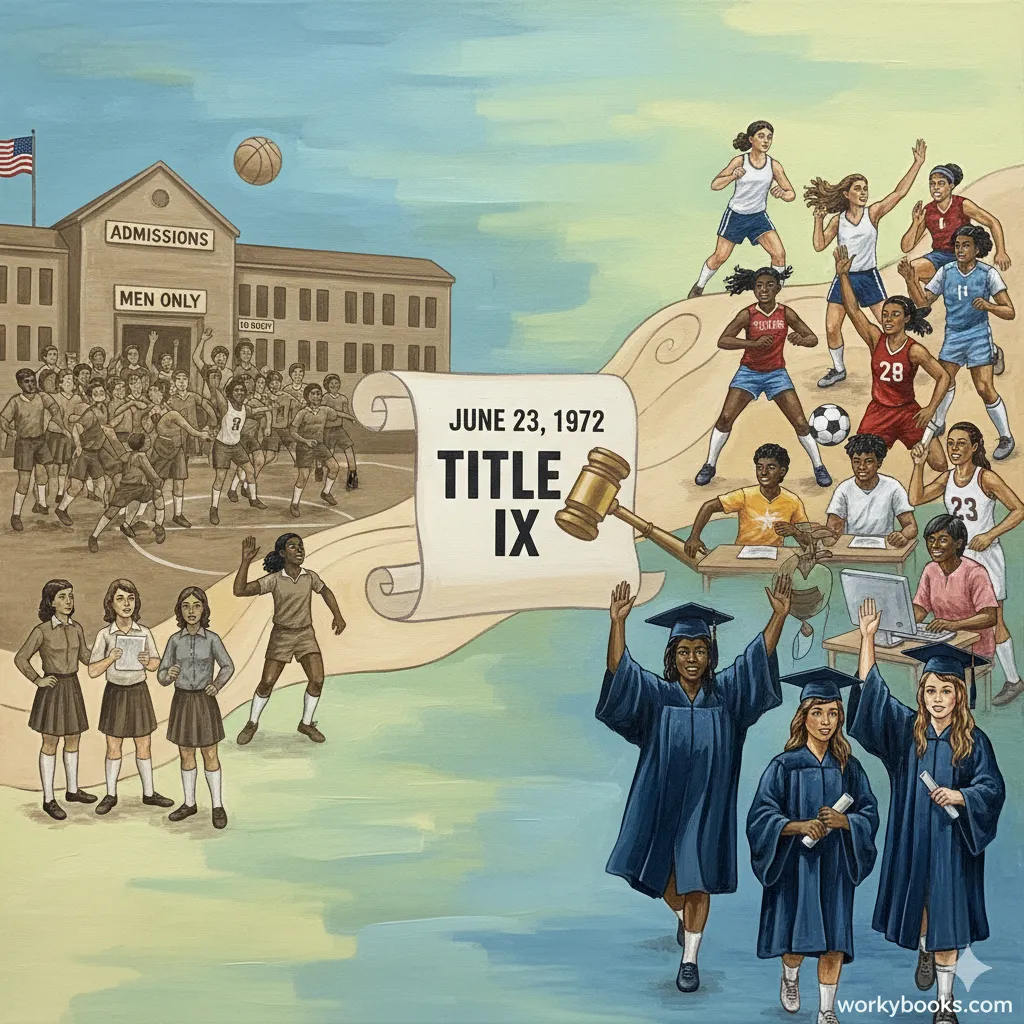
Artist Representation Title IX's impact on educational and athletic equality.
Title IX is a federal law passed in 1972 that transformed education in the United States. This important legislation made it illegal for schools and colleges that receive federal money to discriminate based on gender. Before Title IX, girls and women were often denied equal opportunities in sports, clubs, and even certain classes. Many schools spent far less on girls’ athletic programs and facilities, and female students sometimes faced barriers to advanced courses or leadership roles.
The push for gender equality in education grew out of the broader Civil Rights Movement. Activists and lawmakers recognized that discrimination was not only about race, but also about gender. Congress responded to these demands for fairness by including Title IX as part of the Education Amendments of 1972. The law’s language was clear and direct: "No person in the United States shall, on the basis of sex, be excluded from participation in, be denied the benefits of, or be subjected to discrimination under any education program or activity receiving Federal financial assistance."
Title IX brought major changes, especially in athletics. For decades, girls’ sports teams were rare, and most resources went to boys’ programs. After 1972, schools had to provide equal opportunities for girls and women to participate in sports. This led to a dramatic increase in the number of female athletes. According to historical data, before Title IX fewer than 300,000 girls played high school sports; by 2012, over 3 million participated. Colleges also expanded women’s athletic scholarships and teams.
The impact of Title IX extends beyond sports. The law also protects students from harassment and unfair treatment in academic programs, admissions, and extracurricular activities. Schools must ensure that all students have equal access to classes, clubs, and leadership roles. If a school violates Title IX, it can lose federal funding, which is a strong incentive to comply.
However, enforcing Title IX has not always been simple. Some schools resisted change, and debates arose about what "equal opportunity" really means. Questions about how to measure fairness in athletic spending and facilities, or how to handle complaints of discrimination, have led to court cases and policy changes over the years. Title IX does not require identical programs for boys and girls, but it does require schools to provide comparable opportunities and resources.
Despite ongoing challenges, Title IX remains a powerful tool for promoting gender equality in American education. It has inspired generations of women and girls to pursue sports, academics, and leadership, and encouraged schools to build more inclusive environments. The law continues to evolve as new issues of gender equity arise, showing that the struggle for fairness is an ongoing process.
Interesting Fact: The phrase "Title IX" refers to the ninth section, or "title," of the Education Amendments of 1972. It is only 37 words long, but those words have changed millions of lives.
What year was Title IX passed?
1972196419801954
Which area saw the biggest change after Title IX?
AthleticsSchool lunchesTransportationMath classes
What could happen if a school violates Title IX?
Lose federal fundingClose immediatelyExpel studentsFire teachers
Why was Title IX created?
To stop gender discriminationTo lower taxesTo build new schoolsTo improve lunch menus
How did Title IX affect girls' sports?
More girls joined teamsFewer sports for girlsNo changeOnly boys played sports
What is a challenge faced with Title IX?
Defining equal opportunityBuilding more schoolsHiring more teachersWriting longer laws
Title IX protects against harassment. True or false?
TrueFalse
What does 'legislation' mean?
A law or set of lawsA type of sportA school clubA math problem
Perfect For:
👩🏫 Teachers
• Reading comprehension practice
• Auto-graded assessments
• Literacy skill development
👨👩👧👦 Parents
• Reading practice at home
• Comprehension improvement
• Educational reading time
🏠 Homeschoolers
• Reading curriculum support
• Independent reading practice
• Progress monitoring
Reading Features:
📖
Reading Passage
Engaging fiction or nonfiction text
❓
Comprehension Quiz
Auto-graded questions
📊
Instant Feedback
Immediate results and scoring
📄
Printable Version
Download for offline reading
🔊
Read Aloud
Voice-over with word highlighting
Reviews & Ratings
No reviews yet. Be the first to share your experience!
Related Content
Native American Tribes Across America
This engaging history reading passage introduces students to Native American tribes across America, focusing on their da...
D2.HIS.1.3-5D2.HIS.2.3-5RI.4.1RI.4.2
Teepees: Homes on the Great Plains
This engaging history reading passage introduces students to teepees, the unique homes of Native American tribes on the ...
D2.HIS.2.3-5D2.HIS.14.3-5RI.4.1RI.4.2RI.4.4
Traditional Native American Clothing
This engaging history passage explores traditional Native American clothing and how it reflected the environment, values...
D2.HIS.2.3-5D2.HIS.3.3-5RI.4.3RI.4.4
The Iroquois Confederacy: A System of Peace
This engaging U.S. History reading passage introduces students to the Iroquois Confederacy, a powerful alliance of Nativ...
D2.HIS.2.3-5D2.HIS.3.3-5RI.4.3RI.4.4
The Cherokee Nation: History and Culture
This reading passage explores the rich history and culture of the Cherokee Nation, one of the largest Native American tr...
D2.HIS.2.3-5D2.HIS.14.3-5RI.4.3RI.4.4RI.4.10
The Sioux: Warriors and Tribal Leaders
This history reading passage explores the Sioux Nation, focusing on their roles as warriors and tribal leaders. Students...
D2.HIS.1.3-5D2.HIS.2.3-5RI.4.1RI.4.3
Native American Respect for Nature
This engaging history reading passage explores Native American respect for nature, emphasizing the close relationship be...
D2.HIS.2.3-5D2.HIS.3.3-5RI.4.3RI.4.4
Jamestown: The First Permanent English Colony
This engaging history passage explores the founding of Jamestown, the first permanent English colony in America. Aligned...
D2.HIS.1.3-5D2.HIS.2.3-5RI.4.3RI.4.4
Pocahontas and the Powhatan People
This engaging reading passage explores the life of Pocahontas and the Powhatan people and their important role in early ...
D2.HIS.1.3-5D2.HIS.2.3-5RI.4.1RI.4.3
Colonial Children: School and Chores
This reading passage explores the daily lives of colonial children, focusing on their experiences at school and their ma...
D2.HIS.2.3-5D2.HIS.3.3-5RI.4.1RI.4.2RI.4.4
Colonial Clothing and Homemade Goods
This engaging U.S. history passage explores the daily life of early American colonists with a focus on colonial clothing...
D2.HIS.2.3-5RI.4.3RI.4.4
Colonial Jobs: Blacksmiths, Bakers, and Craftsmen
This engaging history reading passage explores the vital roles of blacksmiths, bakers, and craftsmen in colonial America...
D2.HIS.2.3-5D2.HIS.3.3-5RI.4.3RI.4.4
Colonial Towns and Village Life
This engaging history reading passage explores the daily life, work, and unity found in colonial towns and villages. Ali...
D2.HIS.1.3-5D2.HIS.2.3-5RI.4.3RI.4.4
Colonial Trade with England and Africa
This history reading passage explores colonial trade between the American colonies, England, and Africa, focusing on the...
D2.HIS.2.3-5D2.HIS.14.3-5RI.4.3RI.4.4
Benjamin Franklin: Printer, Inventor, and Leader
This history reading passage explores the life and achievements of Benjamin Franklin, one of America's most important ea...
D2.HIS.2.3-5D2.HIS.3.3-5RI.4.1RI.4.3
George Washington Leads the Army
This engaging history reading passage explores how George Washington bravely led the Continental Army during the America...
D2.HIS.1.3-5D2.HIS.2.3-5RI.4.3RI.4.4
Women and Children During the Revolutionary War
This reading passage explores the important roles women and children played during the Revolutionary War. Students will ...
D2.HIS.2.3-5RI.4.3RI.5.3
African Americans Fight for Freedom
This educational passage explores the brave and inspiring story of how African Americans fought for freedom in the Unite...
D2.HIS.2.3-5D2.HIS.3.3-5RI.4.3RI.4.4
The Battle of Yorktown Ends War
This engaging U.S. history reading passage explores the Battle of Yorktown, a key event that ended the American Revoluti...
D2.HIS.1.3-5D2.HIS.2.3-5RI.4.1RI.4.3
Loyalists vs. Patriots: Divided Families
This engaging U.S. history reading passage explores the division between Loyalists and Patriots during the American Revo...