Triangular Trade and Slavery
Interactive passage with audio narration, comprehension questions, and printable PDF.
By completing this purchase you agree to our Terms of Use and Privacy Policy. Your subscription renews automatically until you cancel. You can cancel anytime from your account settings. All sales are final and non-refundable. Digital content is available for download in your account immediately upon purchase.
What's included
Triangular Trade and Slavery preview and details
About this printable Triangular Trade and Slavery reading passage (Grades 6-8)
Sample passage and quiz from Triangular Trade and Slavery
Reading passage and comprehension quiz preview
Triangular Trade and Slavery
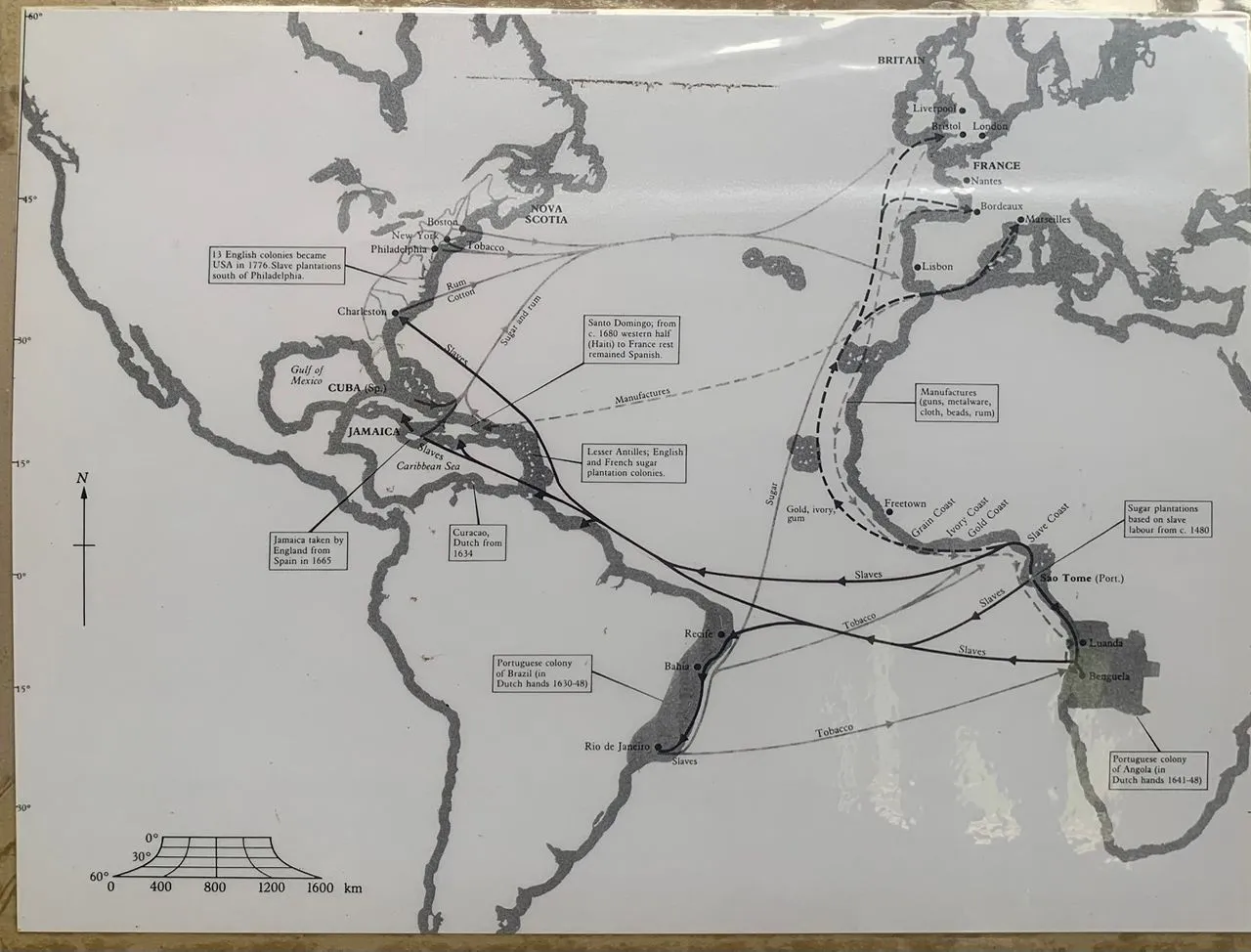
"Transatlantic slave trade" by Khobbyyyy / Wikimedia Commons (CC0).
The Triangular Trade was a system that connected Europe, Africa, and the Americas through the exchange of goods and enslaved people. During the 1600s and 1700s, ships left European ports loaded with manufactured goods such as rum, guns, and textiles. These goods were transported to West Africa, where they were traded for humans. The people captured and sold as slaves suffered a terrible journey known as the Middle Passage.
The ships then crossed the Atlantic Ocean to the Americas. In the colonies, enslaved Africans were sold to work on plantations, especially in the production of sugar, tobacco, and cotton. These goods, which were known as exports, were shipped back to Europe. This three-part route formed a triangle on the map, giving the trade its name. Each leg of the journey had its own challenges and consequences, but all were linked by the pursuit of profit.
The economic benefits of the Triangular Trade were enormous for European and colonial merchants. Cities like Boston, Charleston, and Liverpool grew wealthy from the commerce, or business, generated by shipping goods and enslaved people. They depended on a steady supply of raw materials and labor. However, this prosperity came at a devastating cost to millions of Africans, whose families and societies were torn apart by the slave trade.
African leaders sometimes participated in the trade by capturing and selling rivals or prisoners of war, but many communities were destroyed. The loss of so many people weakened entire regions. This exploitation—using others unfairly for profit—led to suffering and instability that still affects parts of Africa today.
In contrast, European economies grew stronger. Merchants gained wealth, and the demand for goods increased. The system also changed American society. Some colonists protested the cruelty of slavery, but others became even more dependent on slave labor. Over time, this created deep divisions in American society that would eventually lead to conflict and calls for abolition.
While the Triangular Trade built fortunes for some, it caused lasting harm for others. The legacy of slavery and the inequalities it created still influence the world. Understanding this history helps us recognize the connections between economic interests and human rights.
Interesting Fact: The Middle Passage, the journey enslaved Africans took to the Americas, often lasted up to three months. Many did not survive the harsh conditions on board.
Comprehension quiz (8 questions)
1. Which continents formed the Triangular Trade?
2. What was the Middle Passage?
3. Which goods were sent from plantations to Europe?
4. Why did merchants support the Triangular Trade?
5. How did the trade hurt Africa?
6. Why did some colonists oppose slavery?
7. The Triangular Trade harmed only Africa. True or false?
8. What does 'exploitation' mean in this passage?
Common Core standards for Triangular Trade and Slavery
Explain events, procedures, ideas, or concepts in a historical, scientific, or technical text, including what happened and why, based on specific information in the text.
Determine the meaning of general academic and domain-specific words or phrases in a text relevant to a grade 4 topic or subject area.
Write informative/explanatory texts to examine a topic and convey ideas and information clearly.
Perfect for the way you teach
- Build comprehension skills
- Auto-graded quiz
- Differentiated reading
- Read together at home
- Improve fluency
- Quiet reading time
- Reading curriculum support
- Independent practice
- Track Lexile growth