Upton Sinclair's Jungle
Interactive passage with audio narration, comprehension questions, and printable PDF.
By completing this purchase you agree to our Terms of Use and Privacy Policy. Your subscription renews automatically until you cancel. You can cancel anytime from your account settings. All sales are final and non-refundable. Digital content is available for download in your account immediately upon purchase.
What's included
Upton Sinclair's Jungle preview and details
About this printable Upton Sinclair's Jungle reading passage (Grades 6-8)
Sample passage and quiz from Upton Sinclair's Jungle
Reading passage and comprehension quiz preview
Upton Sinclair's Jungle: Exposing the Meatpacking Industry
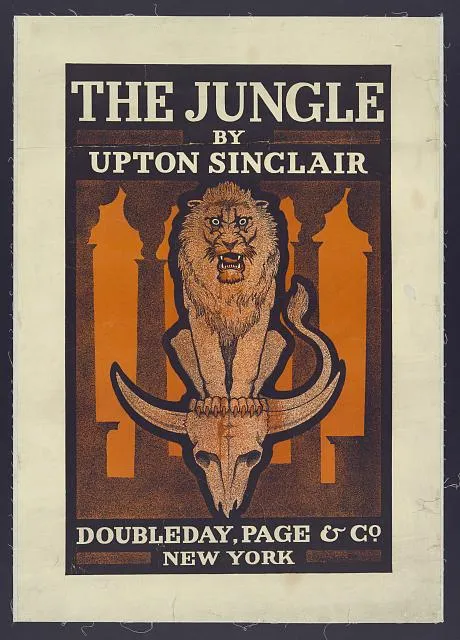
Source: Library of Congress
In 1906, American author Upton Sinclair published a novel titled The Jungle. This book revealed the disturbing realities of Chicago’s meatpacking industry during the Progressive Era. At the time, the United States was rapidly industrializing, and millions of immigrants sought jobs in factories and plants. Sinclair’s novel shocked the nation by exposing both unfair treatment of workers and unsanitary conditions in the food supply.
Sinclair was considered a muckraker, a journalist who investigated and published stories about corruption and social problems. His main goal was to bring attention to the harsh lives of immigrant workers who faced long hours, low wages, and dangerous conditions. However, what truly captured the public’s attention were his vivid descriptions of contaminated meat and filthy factory practices. Readers learned that spoiled meat was being processed, and that chemicals and dirt sometimes ended up in food products.
The problem Sinclair described was not limited to one company. Meatpacking was a major industry in Chicago and other American cities. Many companies put profits before safety, ignoring basic sanitation rules. Workers, desperate for jobs, had little power to demand safer conditions. The lack of government regulation meant that companies could cut corners without fear of punishment.
As more people read The Jungle, public outrage grew. Newspapers reported on the book’s findings, and citizens demanded action. President Theodore Roosevelt, already known for his interest in reform, ordered an official investigation into the meatpacking industry. Inspectors confirmed Sinclair’s claims, finding dirty equipment, spoiled meat, and a lack of proper oversight.
As a result of this growing concern, Congress passed new legislation to protect American consumers. The Pure Food and Drug Act and the Meat Inspection Act were both signed into law in 1906. These laws established federal standards for food safety and required regular inspections of meatpacking plants. For the first time, the government was responsible for making sure that food sold to the public was safe and clean.
Although Sinclair’s goal had been to highlight the struggles of workers, his book’s greatest impact was on food safety. Americans became more aware of what they were eating, and public trust in the food supply improved as stricter regulations were enforced. The Jungle remains an important example of how investigative journalism can influence society and lead to lasting change.
Interesting Fact: President Roosevelt reportedly told Sinclair that he aimed to "protect the public stomach," showing how seriously the government took the issue of food safety after The Jungle was published.
Comprehension quiz (8 questions)
1. Who wrote The Jungle?
2. What year was The Jungle published?
3. Which city had the meatpacking plants?
4. What was Sinclair's main goal in writing?
5. How did the government respond?
6. What does 'muckraker' mean?
7. The Pure Food and Drug Act was passed in 1906. True or false?
8. Which word means 'laws passed by government'?
Common Core standards for Upton Sinclair's Jungle
Explain events, procedures, ideas, or concepts in a historical, scientific, or technical text, including what happened and why, based on specific information in the text.
Determine the meaning of general academic and domain-specific words or phrases in a text relevant to a grade 4 topic or subject area.
Write informative/explanatory texts to examine a topic and convey ideas and information clearly.
Perfect for the way you teach
- Build comprehension skills
- Auto-graded quiz
- Differentiated reading
- Read together at home
- Improve fluency
- Quiet reading time
- Reading curriculum support
- Independent practice
- Track Lexile growth