This learning resource is available in interactive and printable formats. The interactive worksheet can be played online and assigned to students. The Printable PDF version can be downloaded and printed for completion by hand.
This passage, designed for grades 6-8 and aligned to NGSS MS-ESS3-2, examines the wide range of hazards produced by volcanic eruptions. Students will learn about the mechanisms behind lava flows, pyroclastic flows, tephra falls, lahars, volcanic gases, and volcanic tsunamis, as well as their environmental and human impacts. The passage includes quantitative details, historical case studies like Pompeii and Nevado del Ruiz, and explores how distance from a volcano changes the type of hazard experienced. With an integrated glossary, Spanish translation, differentiated version, writing prompts, quizzes, and graphic organizers, this resource supports diverse learners. Teachers will find this passage ideal for lessons on earth systems, natural disasters, and human-environment interactions. Audio integration and accessibility features are included for inclusive science instruction.
CONTENT PREVIEW
Expand content preview
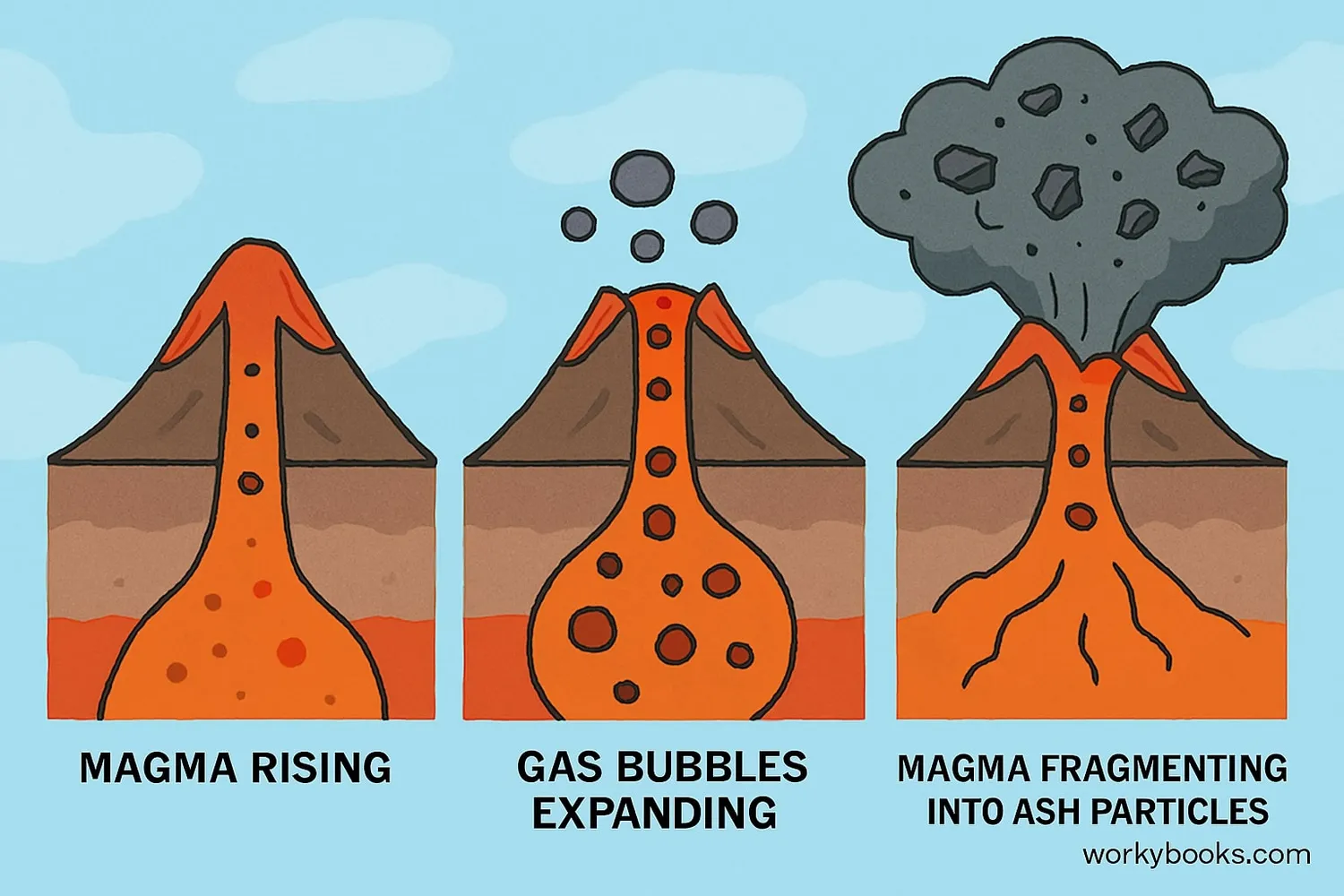
Formation of volcanic ash during an explosive eruption
Volcanic hazards are powerful natural events that can cause destruction to people, property, and the environment. When a volcano erupts, it releases various materials and forces, each creating different types of risks. Understanding these hazards helps scientists, emergency planners, and communities reduce damage and save lives. The dangers posed by volcanic activity depend on factors like the type of eruption, the materials involved, and how far people are from the volcano.
Lava Flows and Pyroclastic Flows One common volcanic hazard is the lava flow. Lava is molten rock that erupts from a volcano and moves slowly across the ground, often at speeds of less than 10 km/h. While lava flows can destroy everything in their path—including homes, roads, and forests—they usually move slowly enough for people to evacuate safely. In contrast, pyroclastic flows are extremely dangerous. These are fast-moving clouds of hot gas, ash, and rock that can travel at speeds over 100 km/h and reach temperatures up to 700°C. Pyroclastic flows are unsurvivable for anyone caught in their path, as demonstrated by the famous eruption of Mount Vesuvius in 79 CE, which buried the city of Pompeii under a thick layer of ash and hot debris.
Tephra, Lahars, and Volcanic Gases Volcanoes also eject tephra, which includes all sizes of airborne volcanic material, from fine ash to large rocks. Tephra can collapse roofs, bury crops, and disrupt aviation because ash can damage jet engines. Breathing volcanic ash can also cause health problems. Another hazard is the lahar, a fast-moving mudflow formed when volcanic ash mixes with water, such as from rain or melting snow. Lahars can travel long distances down river valleys, burying entire communities. The 1985 eruption of Nevado del Ruiz in Colombia caused a lahar that killed 23,000 people. Volcanic eruptions also release volcanic gases such as carbon dioxide and sulfur dioxide. Carbon dioxide, being heavier than air, can collect in low-lying areas and cause suffocation, while sulfur dioxide can create acid rain and worsen respiratory illnesses.
Tsunamis and Secondary Hazards Volcanoes near coastlines can trigger tsunamis (large ocean waves) if parts of the volcano collapse or if a caldera forms suddenly. Tsunamis can flood coastal areas and cause loss of life far from the eruption site. Volcanic eruptions can also have secondary hazards, such as climate changes. For example, large eruptions can send ash and gases into the atmosphere, blocking sunlight and causing global temperatures to drop. This can lead to crop failures and famine, affecting people around the world, not just near the volcano.
Each volcanic hazard has different effects depending on distance from the volcano, local geography, and weather conditions. By studying past eruptions, scientists can better predict and prepare for future events, helping to protect lives and property.
Interesting Fact: The 1815 eruption of Mount Tambora in Indonesia caused “the year without a summer” in 1816, leading to widespread crop failures and hunger in North America and Europe.
Which volcanic hazard is usually slow enough for people to evacuate safely?
Lava flowPyroclastic flowTsunamiLahar
What happened to the city of Pompeii during the eruption of Mount Vesuvius?
It was destroyed by a tsunamiIt was buried by pyroclastic flowsIt was covered by lava flowsIt was flooded by a lahar
A fast-moving mudflow formed from ash and waterA slow lava flowA type of volcanic gasA large ocean wave
What does the word 'secondary hazards' mean in the passage?
Hazards that appear after an eruption, like climate effectsHazards that only happen underwaterHazards from molten rockHazards that can be prevented easily
Which volcanic gas is heavier than air and can cause suffocation?
OxygenSulfur dioxideCarbon dioxideNitrogen
Why are pyroclastic flows more deadly than lava flows?
They move faster and are much hotter, making escape impossibleThey create tsunamisThey are less visibleThey only occur underwater
If a volcano near the ocean collapses, what hazard can it create far from the eruption site?
A laharA volcanic gas cloudA tsunamiA tephra fall
True or False: Lahars can travel long distances down river valleys and bury entire communities.
TrueFalse
True or False: All volcanic hazards can be predicted with complete accuracy.
TrueFalse
Perfect For:
👩🏫 Teachers
• Reading comprehension practice
• Auto-graded assessments
• Literacy skill development
👨👩👧👦 Parents
• Reading practice at home
• Comprehension improvement
• Educational reading time
🏠 Homeschoolers
• Reading curriculum support
• Independent reading practice
• Progress monitoring
Reading Features:
📖
Reading Passage
Engaging fiction or nonfiction text
❓
Comprehension Quiz
Auto-graded questions
📊
Instant Feedback
Immediate results and scoring
📄
Printable Version
Download for offline reading
🔊
Read Aloud
Voice-over with word highlighting
Reviews & Ratings
No reviews yet. Be the first to share your experience!
Related Content
Natural Disaster: Earthquake
Earthquakes occur when tectonic plates move, causing the ground to shake. Understanding earthquakes helps us prepare and...
RI.3.1RI.4.4RI.4.2RI.5.2
Volcanic Eruptions: Causes, Types, and Key Features
This science passage explains volcanic eruptions, aligned with NGSS MS-ESS3-2 (natural hazards) and ESS2-2 (Earth’s syst...
MS-ESS3-2MS-ESS2-2RST.6-8.3
Kīlauea Volcano: Hawaii’s Ever-Changing Landscape
This passage details Kīlauea's volcanic history and status, aligned with NGSS MS-ESS3-2 (natural hazards) and ESS2-3 (Ea...
MS-ESS3-2MS-ESS2-3RST.6-8.2
All About Seismometers
This informational science passage explores seismometers and their role in measuring earthquakes, designed specifically ...
MS-ESS3-2MS-ESS2-3RST.6-8.2
What Is the Difference Between Magma and Lava?
This educational reading passage explains the critical difference between magma and molten rock beneath Earth's surface ...
MS-ESS2-3MS-ESS3-2RST.6-8.4
Obsidian: The Natural Glass Rock
This science reading passage explores obsidian, a volcanic glass that forms when lava cools so rapidly that crystals can...
MS-ESS2-3MS-ESS3-2RST.6-8.4
Measuring Hurricane Intensity – The Saffir-Simpson Hurricane Wind Scale
This NGSS-aligned science reading passage explains how the Saffir-Simpson Hurricane Wind Scale is used to measure the in...
MS-ESS3-2
Tools and Technology in Earth Science
This middle school science reading passage explores the wide range of tools and technologies used in Earth science, from...
MS-ESS2-2MS-ESS3-2MS-ETS1-1MS-PS4-3
Types of Maps
This engaging science passage for grades 6-8 introduces students to the various types of maps and their uses, supporting...
MS-ESS2-2MS-ESS3-2MS-ETS1-1MS-ETS1-4
Mass Movements
This NGSS-aligned passage introduces middle school students to the science of mass movements—gravity-driven motions of r...
MS-ESS2-1MS-ESS3-2
What Causes Earthquakes?
This middle school science passage explains what causes earthquakes, focusing on the interactions between tectonic plate...
MS-ESS2-2MS-ESS3-2
Floods: Causes and Types
This middle school science passage provides a comprehensive look at floods, their causes, types, and impacts, addressing...
MS-ESS3-2
Hurricanes and Tropical Cyclones
This in-depth passage for grades 6-8 covers hurricanes and tropical cyclones, aligning with NGSS standards MS-ESS3-2 and...
MS-ESS3-2MS-ESS2-5
Hurricane Preparedness and Safety
This passage explores the science and practical strategies of hurricane preparedness and safety, designed for middle sch...
MS-ESS3-2MS-ETS1-1
Tornadoes
This informational science passage for grades 6-8 explores the science of tornadoes, aligning with NGSS standards MS-ESS...
MS-ESS3-2MS-ESS2-5
Tsunamis
This middle school science passage explores tsunamis, focusing on their causes, characteristics, and impacts. Students w...
MS-ESS3-2
Tsunami Warning and Safety
This comprehensive middle school science passage examines the systems and science behind tsunami warning and safety. Ali...
MS-ESS3-2
Earthquake Hazards and Damage
This middle school science reading passage examines the hazards and damage caused by earthquakes, aligned with NGSS MS-E...
MS-ESS3-2
Earthquake Zones and Patterns
This informational science passage introduces middle school students to the global distribution of earthquakes, focusing...
MS-ESS2-2MS-ESS3-2
Seismic Waves
This comprehensive middle school passage introduces students to seismic waves, the energy released during earthquakes. A...