Wagner Act 1935: Protecting Labor Unions
Interactive passage with audio narration, comprehension questions, and printable PDF.
By completing this purchase you agree to our Terms of Use and Privacy Policy. Your subscription renews automatically until you cancel. You can cancel anytime from your account settings. All sales are final and non-refundable. Digital content is available for download in your account immediately upon purchase.
What's included
Wagner Act 1935: Protecting Labor Unions preview and details
About this printable Wagner Act 1935: Protecting Labor Unions reading passage (Grades 6-8)
Sample passage and quiz from Wagner Act 1935: Protecting Labor Unions
Reading passage and comprehension quiz preview
The Wagner Act of 1935: Transforming Workers' Rights in the U.S.
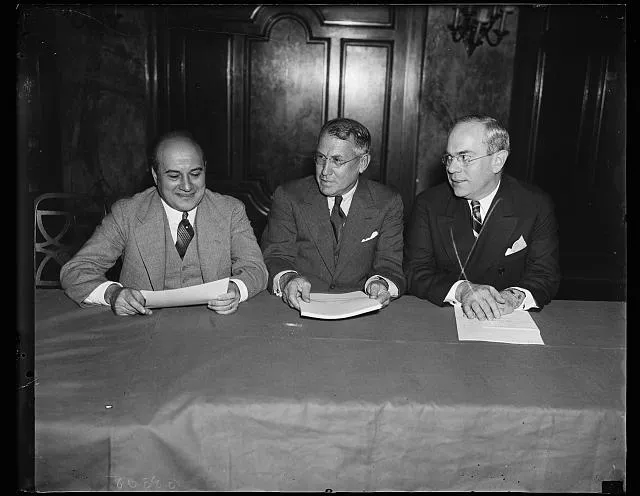
"Liberty league lawyers. A report on the (un)constitutionality of the Wagner Labor Relations Act discussed by this group of lawyers of the American Liberty League. From the left: R.E. Desvernine, Chairman of the Lawyers comm.; Jouett Schouse and Earl F. Reed. 9/18/35" by Harris & Ewing / Library of Congress.
The Wagner Act of 1935, officially known as the National Labor Relations Act, was a turning point in American labor history. During the Great Depression, unemployment was high and many workers faced unsafe conditions and low wages. Workers who tried to organize unions or demand better treatment were often fired or threatened by employers. The lack of labor rights created a problem that affected millions of families across the country.
Before 1935, there were few laws to protect workers. Many employers refused to recognize unions and sometimes used violence or intimidation to prevent workers from joining together. This led to frequent strikes and conflicts between workers and business owners. The struggle for collective bargaining—the right of workers to negotiate as a group with their employer—became a central issue for the labor movement.
In response to these challenges, Congress passed the Wagner Act in 1935. This legislation guaranteed workers the right to organize unions and to bargain collectively with employers. It also prohibited employers from interfering with these rights, such as by firing union members or retaliating against organizers. The law aimed to balance the power between workers and employers and to reduce industrial conflict.
One of the most important features of the Wagner Act was the creation of the National Labor Relations Board (NLRB). This government agency was established to enforce the rights of workers and to investigate complaints of unfair labor practices. The NLRB could order employers to reinstate workers who had been fired for union activity and could organize secret-ballot elections to determine if employees wanted union representation.
The effects of the Wagner Act were significant and long-lasting. Union membership in the United States increased rapidly after the act was passed, giving millions of workers a stronger voice in the workplace. As a result, many workers won higher wages, safer working conditions, and better benefits through collective bargaining. However, not everyone agreed with the law. Some business owners argued that it gave too much power to unions and made it harder to manage their companies. There were also debates about which industries and workers should be covered by the law.
Despite these controversies, the Wagner Act remains a foundation of American labor law. It has influenced later laws and continues to shape the relationship between workers, unions, and employers. The act is still enforced today, although it has been modified by other laws over time. By protecting the basic rights of workers, the Wagner Act helped build a fairer and more balanced economy during a difficult period in U.S. history.
Interesting Fact: After the passage of the Wagner Act, union membership in the United States more than tripled during the late 1930s and 1940s, dramatically changing the American workplace.
Comprehension quiz (8 questions)
1. What year was the Wagner Act passed?
2. What did the Wagner Act create?
3. Who signed the Wagner Act into law?
4. Why was the Wagner Act important?
5. How did the law help workers?
6. What is collective bargaining?
7. The Wagner Act is still enforced today.
8. What does 'legislation' mean?
Common Core standards for Wagner Act 1935: Protecting Labor Unions
Explain events, procedures, ideas, or concepts in a historical, scientific, or technical text, including what happened and why, based on specific information in the text.
Determine the meaning of general academic and domain-specific words or phrases in a text relevant to a grade 4 topic or subject area.
Write informative/explanatory texts to examine a topic and convey ideas and information clearly.
Perfect for the way you teach
- Build comprehension skills
- Auto-graded quiz
- Differentiated reading
- Read together at home
- Improve fluency
- Quiet reading time
- Reading curriculum support
- Independent practice
- Track Lexile growth