Weather Safety and Preparedness — Reading Comprehension
Rate this
Premium Resource
Present
Present in classroom. No work saved
Assign
Classroom with student accounts, Track progress
Quick Play
No student accounts, assign with a link
Grades
5
6
7
8
Standards
MS-ESS3-2
PRINT+DIGITAL RESOURCE
This learning resource is available in interactive and printable formats. The interactive worksheet can be played online and assigned to students. The Printable PDF version can be downloaded and printed for completion by hand.
This comprehensive passage for grades 6-8 focuses on weather safety and preparedness, aligning with NGSS standard MS-ESS3-2. Students learn how to recognize severe weather hazards, distinguish between watches and warnings, and understand the scientific basis for safety procedures during thunderstorms, tornadoes, hurricanes, winter storms, heat waves, and flash floods. The passage explains cause-and-effect relationships and mechanisms behind weather events and safety guidelines, integrating real-world applications and broader implications for health and community resilience. Key vocabulary is highlighted and defined, supporting academic language development. Activities include comprehension questions, writing prompts, and graphic organizers for deeper engagement. The resource is audio integrated, making it accessible to diverse learners. This passage is an ideal supplement for science classrooms focusing on earth science, meteorology, and public health.
CONTENT PREVIEW
Expand content preview
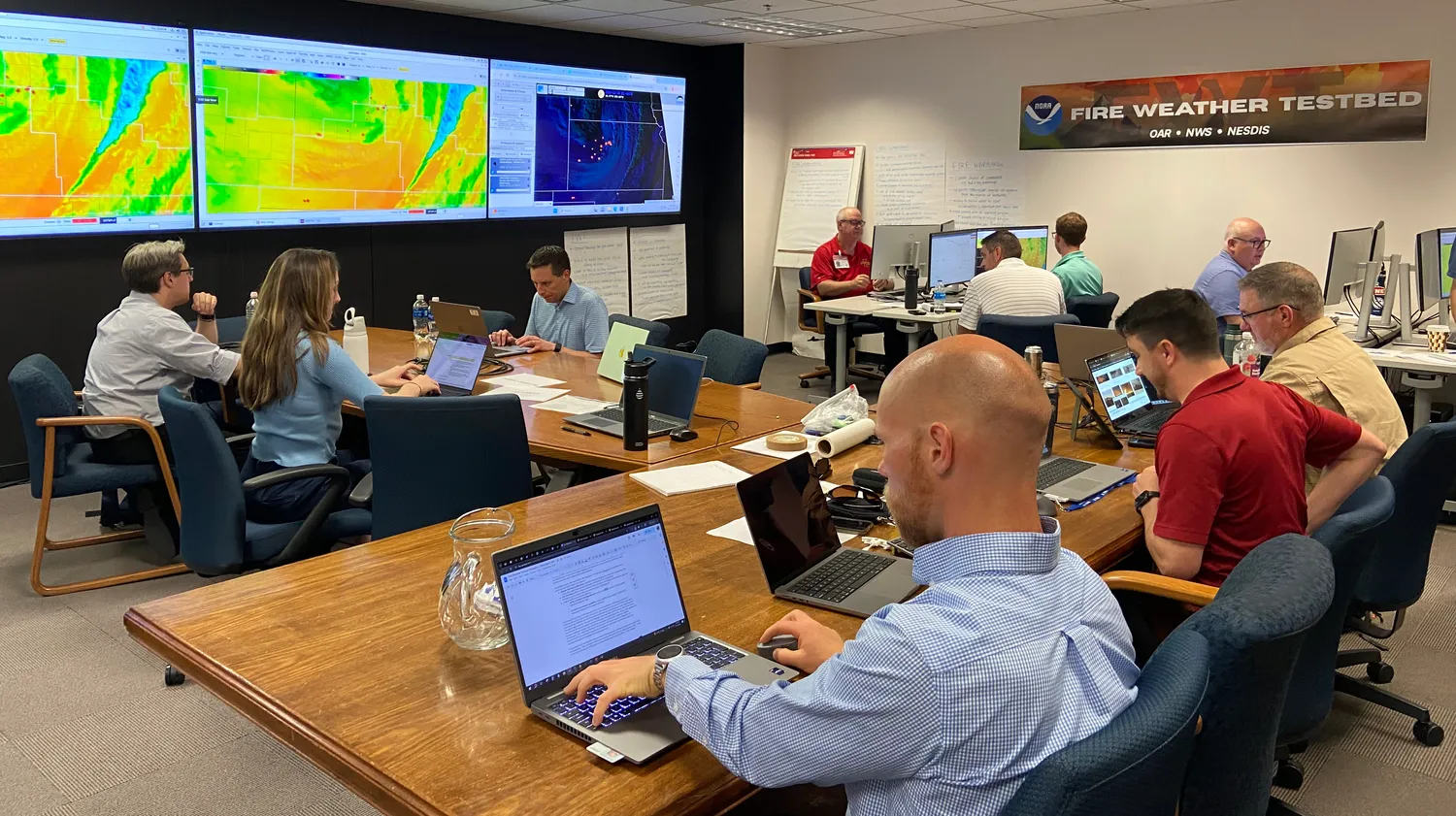
As wildfires become more frequent and severe, accurate forecasting is essential for saving lives, protecting property, and managing resources effectively. NOAA's Fire Weather Testbed (FWT) is a new innovative collaborative platform that brings together researchers, meteorologists, and fire managers to evaluate and improve fire weather forecasting tools and techniques, NOAA / Wikimedia Commons
Severe weather events can cause major disruptions to daily life, damage property, and even threaten lives. Understanding how to prepare for these events is essential for personal and community safety. Scientists and emergency officials use observations and data to predict hazardous conditions and develop safety guidelines. By learning about different types of weather hazards and how to respond, people can reduce risks and stay safer during emergencies.
Recognizing and Responding to Weather Hazards
Weather agencies issue watches and warnings to alert the public about possible or likely severe weather. A watch means conditions are favorable for dangerous weather, such as tornadoes or thunderstorms. A warning means the hazard is happening or is about to happen. Responding quickly and correctly to these alerts is critical. For example, during a thunderstorm warning, people should seek sturdy indoor shelter, stay away from windows, and avoid using electrical devices. If outside, it is important to avoid open fields, isolated trees, and bodies of water, and to use the lightning safety position by crouching low with feet together. These actions help reduce the risk of injury from lightning or falling debris.
Preparing for Different Types of Severe Weather
Specific weather hazards require tailored safety strategies. For tornadoes, the safest place is on the lowest floor of a sturdy building, in an interior room without windows, under heavy furniture if possible. Mobile homes are not safe during tornadoes. In hurricanes, people should follow evacuation orders, create an emergency kit with water, food, and medical supplies, and secure their property by boarding up windows and moving outdoor items inside. If not in a flood zone, sheltering in place may be safest. Winter storms can cause power outages and dangerous travel conditions, so it is important to stay indoors, dress warmly in layers, and avoid unnecessary travel. During heat waves, staying hydrated, limiting outdoor activity, and recognizing symptoms of heat illness are key. Flash floods can develop rapidly; if water covers a road, the rule is "Turn Around, Don’t Drown" because just 6 inches of moving water can knock a person over, and 12 inches can sweep away a car.
Preparedness and Community Resilience
Personal and community preparedness increases safety and resilience. Families should create emergency kits with supplies for at least three days, including food, water, medications, flashlights, and batteries. Communication plans help everyone know how to reach each other if separated. Scientists study past disasters to improve warning systems and safety recommendations, using technology like Doppler radar and computer models. With better preparedness and understanding of weather hazards, communities can recover more quickly from disasters and prevent loss of life. These actions reflect the interconnectedness of science, technology, and society in reducing the impact of natural hazards.
Interesting Fact: The National Weather Service estimates that effective warning systems and preparedness have reduced U.S. tornado deaths by more than 80% since the 1950s.
What is a main goal of weather safety and preparedness?
To protect people and communities from severe weather hazardsTo predict the exact time of every stormTo stop all weather events from happeningTo make weather less interesting
What does a 'watch' mean when issued by weather agencies?
Conditions are favorable for dangerous weather to developThe weather event is definitely happening nowThere is no danger at allThe storm has already passed
Which is the safest action during a tornado?
Go to the lowest floor and stay in an interior roomStand outside to watch the tornadoStay in a mobile homeDrive around looking for the tornado
What does the term 'flash flood' mean as used in the passage?
A slow rise in ocean tidesA sudden, intense flood that develops quicklyA snowstorm with high windsA long drought with no rain
What is the recommended rule if you see water covering a road during a flood?
Turn Around, Don’t DrownDrive faster to get throughWait for the water to rise moreWalk through to check the depth
In context, what does 'preparedness' mean?
Taking actions before an emergency to stay safeWaiting for help to arriveIgnoring safety warningsWatching the weather for fun
Why do scientists study past disasters?
To improve warning systems and safety recommendationsTo predict every storm exactlyTo make storms strongerSo people ignore future warnings
If someone is caught outside during a thunderstorm, what should they do?
Avoid trees and open areas, crouch low with feet togetherRun to the nearest treeLay flat on the ground in the openContinue playing sports
People should drink water and limit outdoor activity during heat waves. (True/False)
TrueFalse
Mobile homes are safe during tornadoes. (True/False)
TrueFalse
Perfect For:
👩🏫 Teachers
• Reading comprehension practice
• Auto-graded assessments
• Literacy skill development
👨👩👧👦 Parents
• Reading practice at home
• Comprehension improvement
• Educational reading time
🏠 Homeschoolers
• Reading curriculum support
• Independent reading practice
• Progress monitoring
Reading Features:
📖
Reading Passage
Engaging fiction or nonfiction text
❓
Comprehension Quiz
Auto-graded questions
📊
Instant Feedback
Immediate results and scoring
📄
Printable Version
Download for offline reading
🔊
Read Aloud
Voice-over with word highlighting
Reviews & Ratings
No reviews yet. Be the first to share your experience!
Related Content
Natural Disaster: Earthquake
Earthquakes occur when tectonic plates move, causing the ground to shake. Understanding earthquakes helps us prepare and...
RI.3.1RI.4.4RI.4.2RI.5.2
Volcanic Eruptions: Causes, Types, and Key Features
This science passage explains volcanic eruptions, aligned with NGSS MS-ESS3-2 (natural hazards) and ESS2-2 (Earth’s syst...
MS-ESS3-2MS-ESS2-2RST.6-8.3
Kīlauea Volcano: Hawaii’s Ever-Changing Landscape
This passage details Kīlauea's volcanic history and status, aligned with NGSS MS-ESS3-2 (natural hazards) and ESS2-3 (Ea...
MS-ESS3-2MS-ESS2-3RST.6-8.2
All About Seismometers
This informational science passage explores seismometers and their role in measuring earthquakes, designed specifically ...
MS-ESS3-2MS-ESS2-3RST.6-8.2
What Is the Difference Between Magma and Lava?
This educational reading passage explains the critical difference between magma and molten rock beneath Earth's surface ...
MS-ESS2-3MS-ESS3-2RST.6-8.4
Obsidian: The Natural Glass Rock
This science reading passage explores obsidian, a volcanic glass that forms when lava cools so rapidly that crystals can...
MS-ESS2-3MS-ESS3-2RST.6-8.4
Measuring Hurricane Intensity – The Saffir-Simpson Hurricane Wind Scale
This NGSS-aligned science reading passage explains how the Saffir-Simpson Hurricane Wind Scale is used to measure the in...
MS-ESS3-2
Tools and Technology in Earth Science
This middle school science reading passage explores the wide range of tools and technologies used in Earth science, from...
MS-ESS2-2MS-ESS3-2MS-ETS1-1MS-PS4-3
Types of Maps
This engaging science passage for grades 6-8 introduces students to the various types of maps and their uses, supporting...
MS-ESS2-2MS-ESS3-2MS-ETS1-1MS-ETS1-4
Mass Movements
This NGSS-aligned passage introduces middle school students to the science of mass movements—gravity-driven motions of r...
MS-ESS2-1MS-ESS3-2
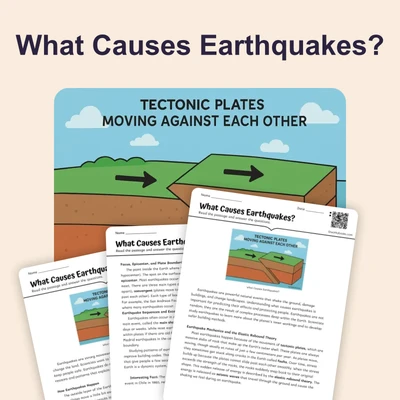
What Causes Earthquakes?
This middle school science passage explains what causes earthquakes, focusing on the interactions between tectonic plate...
MS-ESS2-2MS-ESS3-2
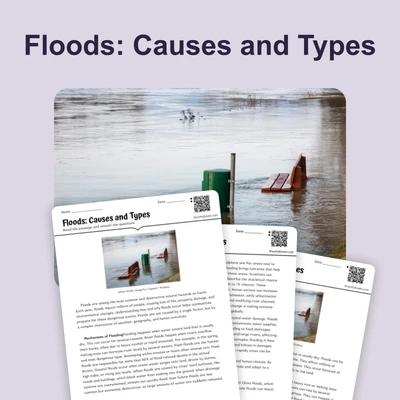
Floods: Causes and Types
This middle school science passage provides a comprehensive look at floods, their causes, types, and impacts, addressing...
MS-ESS3-2
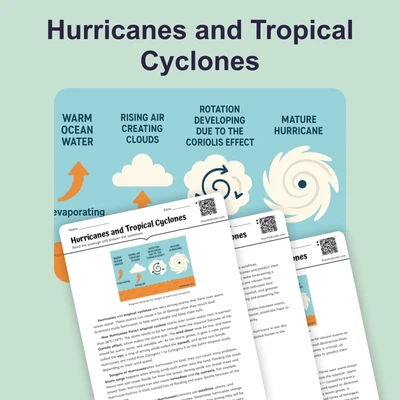
Hurricanes and Tropical Cyclones
This in-depth passage for grades 6-8 covers hurricanes and tropical cyclones, aligning with NGSS standards MS-ESS3-2 and...
MS-ESS3-2MS-ESS2-5
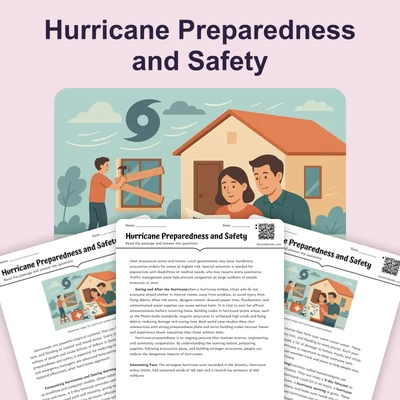
Hurricane Preparedness and Safety
This passage explores the science and practical strategies of hurricane preparedness and safety, designed for middle sch...
MS-ESS3-2MS-ETS1-1
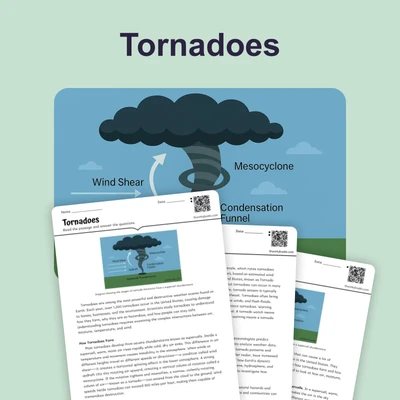
Tornadoes
This informational science passage for grades 6-8 explores the science of tornadoes, aligning with NGSS standards MS-ESS...
MS-ESS3-2MS-ESS2-5
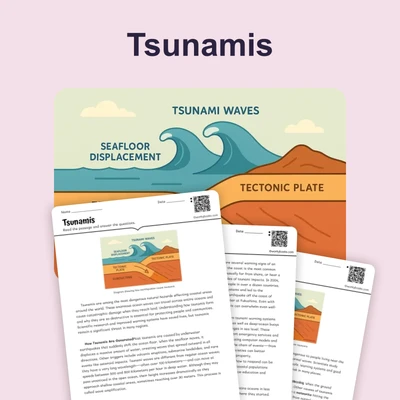
Tsunamis
This middle school science passage explores tsunamis, focusing on their causes, characteristics, and impacts. Students w...
MS-ESS3-2
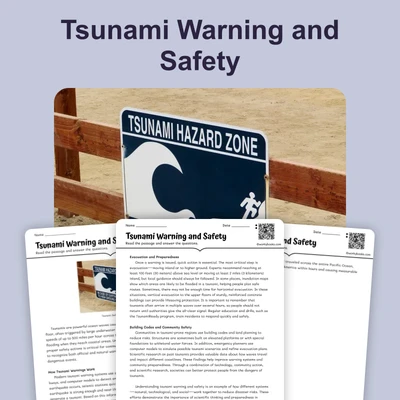
Tsunami Warning and Safety
This comprehensive middle school science passage examines the systems and science behind tsunami warning and safety. Ali...
MS-ESS3-2
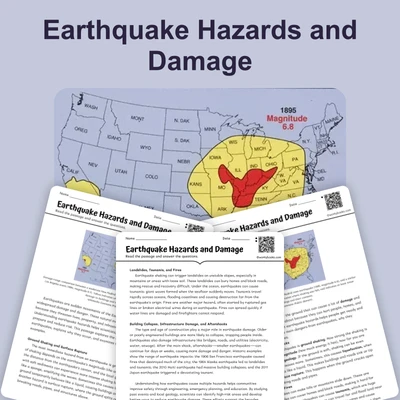
Earthquake Hazards and Damage
This middle school science reading passage examines the hazards and damage caused by earthquakes, aligned with NGSS MS-E...
MS-ESS3-2
Earthquake Zones and Patterns
This informational science passage introduces middle school students to the global distribution of earthquakes, focusing...
MS-ESS2-2MS-ESS3-2
Seismic Waves
This comprehensive middle school passage introduces students to seismic waves, the energy released during earthquakes. A...