What Are Batholiths and Stocks
Interactive passage with audio narration, comprehension questions, and printable PDF.
By completing this purchase you agree to our Terms of Use and Privacy Policy. Your subscription renews automatically until you cancel. You can cancel anytime from your account settings. All sales are final and non-refundable. Digital content is available for download in your account immediately upon purchase.
What's included
What Are Batholiths and Stocks preview and details
About this printable What Are Batholiths and Stocks science reading passage, NGSS-aligned (Grades 6-8)
Sample passage and quiz from What Are Batholiths and Stocks
Reading passage and comprehension quiz preview
What Are Batholiths and Stocks
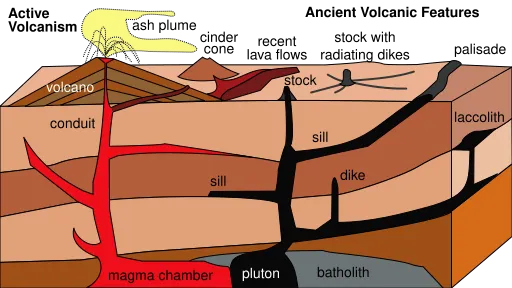
A schematic geological cross-section of a sequence of sedimentary rocks that are later intruded by igneous rocks accompanied by volcanic activity. Image by United States Geological Surveyderivative work: Hardwigg/ Wikimedia Commons
Deep beneath Earth's surface, massive bodies of molten rock called magma sometimes cool and solidify without ever reaching the surface. When this happens, the magma forms large structures called intrusions. Two important types of intrusions are batholiths and stocks. These geological features play a crucial role in building mountain ranges and shaping the landscape we see today.
A batholith is an enormous mass of igneous rock that forms when magma cools slowly deep underground. To be classified as a batholith, the intrusion must cover an area of at least 100 square kilometers (about 40 square miles). Batholiths are typically made of granite, a light-colored rock with large visible crystals. The large crystals form because the magma cools very slowly, giving minerals time to grow. Batholiths often form the cores of major mountain ranges, providing the foundation for the peaks we see above ground.
The Sierra Nevada mountain range in California contains one of the largest batholiths in North America. This massive granite intrusion extends for hundreds of kilometers and forms the backbone of these mountains. The batholith formed millions of years ago when magma pushed up into Earth's crust but never erupted. Over time, erosion wore away the overlying rock layers, gradually exposing the granite at the surface. Today, famous landmarks like Half Dome and El Capitan in Yosemite National Park are visible parts of this ancient batholith.
A stock is similar to a batholith but smaller in size. Stocks cover less than 100 square kilometers and often have a more dome-like or cylindrical shape. Like batholiths, stocks form when magma cools underground and are usually composed of granite. Stocks may actually be the tops of larger batholiths that extend deeper into the crust, or they may be separate, smaller intrusions. Because they are smaller, stocks are sometimes easier to study than batholiths.
Stone Mountain in Georgia is a well-known example of an exposed stock. This massive dome of granite rises about 250 meters (825 feet) above the surrounding landscape. The stock formed underground about 300 million years ago during a period of mountain building. As millions of years passed, erosion removed the softer rock layers that once covered the granite. The hard granite resisted erosion better than the surrounding rocks, leaving the distinctive dome we see today. This process demonstrates how intrusions can become surface features through the constant work of weathering and erosion.
Both batholiths and stocks are examples of plutonic rocks, meaning they formed from magma that cooled beneath Earth's surface. The slow cooling process is key to understanding these features. When magma cools slowly underground, it has time to form large mineral crystals, creating the coarse-grained texture characteristic of granite. In contrast, volcanic rocks that cool quickly at the surface have small crystals or no visible crystals at all. By studying batholiths and stocks, geologists can learn about the processes that occur deep within Earth's crust and how these processes shape the surface over millions of years.
Interesting Fact: The largest known batholith in the world is the Coast Range Batholith in British Columbia, Canada, which extends for over 1,800 kilometers and contains enough granite to cover the entire state of California with a layer of rock several kilometers thick.
Comprehension quiz (10 questions)
1. What is a batholith?
2. How do batholiths and stocks differ from each other?
3. What does the term 'plutonic' mean?
4. Why do batholiths and stocks have large visible crystals?
5. According to the passage, what is the term 'erosion' referring to?
6. Which real-world example is given as a batholith in the passage?
7. How does erosion help expose batholiths and stocks at Earth's surface?
8. What can geologists learn by studying batholiths and stocks?
9. True or False: Stocks are always separate intrusions and are never connected to larger batholiths below.
10. True or False: Granite forms large crystals because magma cools slowly underground.
Perfect for the way you teach
- Build comprehension skills
- Auto-graded quiz
- Differentiated reading
- Read together at home
- Improve fluency
- Quiet reading time
- Reading curriculum support
- Independent practice
- Track Lexile growth