What Are Extrusive Igneous Rocks — Reading Comprehension
Rate this
Premium Resource
Present
Present in classroom. No work saved
Assign
Classroom with student accounts, Track progress
Quick Play
No student accounts, assign with a link
Grades
6
7
8
Standards
MS-ESS2-1
PRINT+DIGITAL RESOURCE
This learning resource is available in interactive and printable formats. The interactive worksheet can be played online and assigned to students. The Printable PDF version can be downloaded and printed for completion by hand.
This comprehensive 650-word reading passage introduces middle school students to extrusive igneous rocks and their formation processes. Aligned with NGSS standard MS-ESS2-1, the passage explains how extrusive igneous rocks form when lava cools rapidly at Earth's surface, producing fine-grained or glassy textures with small or invisible crystals. Students explore how rapid cooling prevents large crystal growth and examine common extrusive rocks including basalt, rhyolite, and obsidian. The passage connects these rocks to volcanic environments where they form, helping students understand the relationship between cooling rates and rock textures. Audio-integrated features support diverse learners, while differentiated versions ensure accessibility for all students. Activities include comprehension questions, writing prompts, and graphic organizers that reinforce key concepts about igneous rock formation, volcanic processes, and the rock cycle.
CONTENT PREVIEW
Expand content preview
Extrusive igneous rocks are rocks that form when lava cools and solidifies at Earth's surface.
Extrusive igneous rocks are rocks that form when lava cools and solidifies at Earth's surface. These rocks are different from intrusive igneous rocks, which form deep underground. The word "extrusive" means "pushed out," which describes how molten rock is pushed out of a volcano or crack in Earth's crust. When lava reaches the surface, it encounters much cooler temperatures than it experienced underground, causing it to cool rapidly.
The cooling rate of lava has a major effect on the texture of extrusive igneous rocks. When lava cools quickly at the surface, there is not enough time for large crystals to grow. Instead, the rock develops a fine-grained texture, meaning the crystals are so small they cannot be seen without a microscope. In some cases, lava cools so rapidly that crystals do not form at all, creating a smooth, glassy texture. This is similar to what happens when you freeze water quickly to make ice—the faster it freezes, the smaller the ice crystals become.
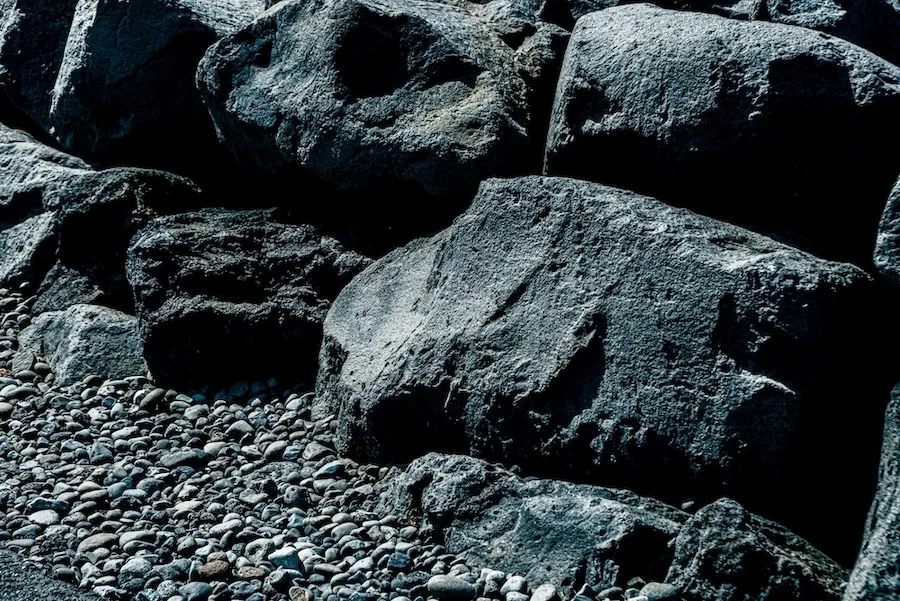
Basalt is the most common extrusive igneous rock on Earth. It forms from lava that is low in silica and flows easily from volcanoes. Basalt has a dark color, usually black or dark gray, and contains minerals like pyroxene and plagioclase feldspar. Because basalt cools quickly, its crystals are too small to see with the naked eye. Ocean floors are made mostly of basalt, and many volcanic islands, including Hawaii, are built from layers of basalt that erupted underwater and on land.
Another important extrusive rock is rhyolite, which forms from lava that is high in silica. This type of lava is thick and sticky, so it does not flow as easily as basalt lava. Rhyolite is usually light in color, ranging from pink to gray to white. Like basalt, rhyolite has a fine-grained texture because it cools rapidly at the surface. Rhyolite eruptions can be explosive because the thick lava traps gases that build up pressure inside the volcano.
Obsidian is a unique extrusive igneous rock that looks like dark glass. It forms when lava cools so quickly that crystals have no time to grow at all. Obsidian is usually black or dark brown and breaks with sharp edges. Ancient people used obsidian to make cutting tools and arrowheads because of its sharp fracture. Obsidian forms in the same volcanic environments as rhyolite, but only when cooling happens extremely fast.
The environment where extrusive rocks form is always connected to volcanic activity. Volcanoes bring molten rock from deep within Earth to the surface. When this material erupts, it can flow as lava or explode into the air as volcanic ash and fragments. All of these materials cool quickly in the air or water, forming extrusive igneous rocks. The type of extrusive rock that forms depends on the chemical composition of the lava and how quickly it cools. Understanding extrusive igneous rocks helps scientists learn about volcanic processes and the history of Earth's surface.
Interesting Fact: Some volcanic glass, like obsidian, can be so sharp that it is used in modern surgical scalpels because it cuts more precisely than steel blades.
Where do extrusive igneous rocks form?
Deep underground in Earth's mantleAt Earth's surface when lava coolsIn the ocean onlyInside the core of Earth
Why do extrusive igneous rocks have small or invisible crystals?
Because they contain no mineralsBecause they form underwaterBecause lava cools rapidly at the surface, preventing large crystal growthBecause they are made of glass
What is the most common extrusive igneous rock on Earth?
ObsidianRhyoliteGraniteBasalt
What does the term 'fine-grained texture' mean?
The rock has large crystals that are easy to seeThe rock has crystals so small they cannot be seen without a microscopeThe rock is smooth like glass with no crystalsThe rock has holes from gas bubbles
Which extrusive rock forms from thick, sticky lava that is high in silica?
BasaltObsidianRhyolitePumice
What makes obsidian different from other extrusive igneous rocks?
It has very large crystalsIt cools so quickly that no crystals form, creating a glassy textureIt only forms underwaterIt is always light in color
If lava cooled very slowly underground instead of quickly at the surface, what would happen to crystal size?
Crystals would be smallerNo crystals would formCrystals would be largerThe rock would become glassy
Based on the passage, why were ancient people able to use obsidian for cutting tools?
Because it was soft and easy to shapeBecause it breaks with sharp edgesBecause it was the most common rock availableBecause it was colorful
True or False: All extrusive igneous rocks form in environments connected to volcanic activity.
TrueFalse
True or False: Basalt and rhyolite both have fine-grained textures because they cool rapidly at Earth's surface.
TrueFalse
Perfect For:
👩🏫 Teachers
• Reading comprehension practice
• Auto-graded assessments
• Literacy skill development
👨👩👧👦 Parents
• Reading practice at home
• Comprehension improvement
• Educational reading time
🏠 Homeschoolers
• Reading curriculum support
• Independent reading practice
• Progress monitoring
Reading Features:
📖
Reading Passage
Engaging fiction or nonfiction text
❓
Comprehension Quiz
Auto-graded questions
📊
Instant Feedback
Immediate results and scoring
📄
Printable Version
Download for offline reading
🔊
Read Aloud
Voice-over with word highlighting
Reviews & Ratings
No reviews yet. Be the first to share your experience!
Related Content
Frost Wedging: How Ice Splits Rock
This passage explains frost wedging as a mechanical weathering process. Aligned with NGSS MS-ESS2-1 (Earth’s systems) a...
MS-ESS2-1MS-ESS2-2RST.6-8.3
Limestone Caves: Nature’s Underground Wonders
This passage explains limestone cave formation through carbonation, aligned with NGSS MS-ESS2-1 (Earth’s systems) and L...
MS-ESS2-1LS2.CRST.6-8.7
Chemical Weathering: The Breakdown of Rocks Through Chemical Reactions
This passage explains chemical weathering processes, aligned with NGSS MS-ESS2-1 (Earth’s systems) and ESS2-2 (surface ...
MS-ESS2-1MS-ESS2-2RST.6-8.4
Talus Slopes: Formation and Features
This earth science passage explains talus slope formation through mechanical weathering processes, aligning with NGSS MS...
MS-ESS2-1MS-ESS2-2RST.6-8.4
Biological Weathering: Types and Examples
This passage details biological weathering processes, connecting to NGSS MS-ESS2-1 (Earth's systems) and LS2.B (ecosyste...
MS-ESS2-1MS-PS1-2RST.6-8.3
The Coldest City in the World: Yakutsk
This NGSS-aligned science passage introduces middle school readers to Yakutsk, the coldest city on Earth. Students will ...
MS-ESS2-1
Igneous Rocks
This comprehensive passage introduces middle school students to igneous rocks, focusing on how these rocks form from mol...
MS-ESS2-1MS-ESS3-1
Sedimentary Rocks
This comprehensive middle school science passage introduces students to sedimentary rocks, detailing their step-by-step ...
MS-ESS2-1MS-ESS2-3MS-ESS3-1
Metamorphic Rocks
This engaging middle school science passage introduces students to the fascinating world of metamorphic rocks. Aligned w...
MS-ESS2-1MS-ESS3-1
Scientific Inquiry in Earth Science
This passage explores scientific inquiry in Earth science for grades 6-8, aligned with NGSS standards MS-ESS1-4, MS-ESS2...
MS-ESS1-4MS-ESS2-1MS-ESS3-5SEP
Contour Lines and Elevation
This passage, designed for grades 6-8 and aligned with NGSS standards MS-ESS2-2 and MS-ESS2-1, introduces students to th...
MS-ESS2-2MS-ESS2-1SEP.4SEP.8
Weathering
This comprehensive science reading passage for grades 6-8 focuses on the concept of weathering, aligning with NGSS stand...
MS-ESS2-1
Erosion
This comprehensive middle school science passage explains erosion—the process that transports weathered rock and soil fr...
MS-ESS2-1
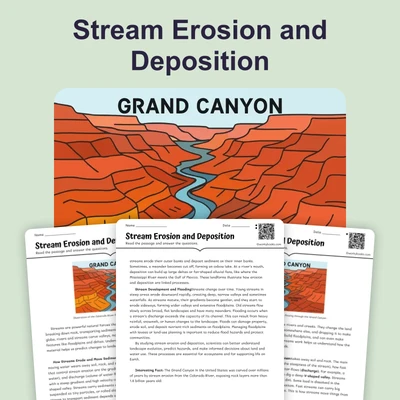
Stream Erosion and Deposition
This middle school science passage, aligned to NGSS MS-ESS2-1, introduces students to the dynamic processes of stream er...
MS-ESS2-1
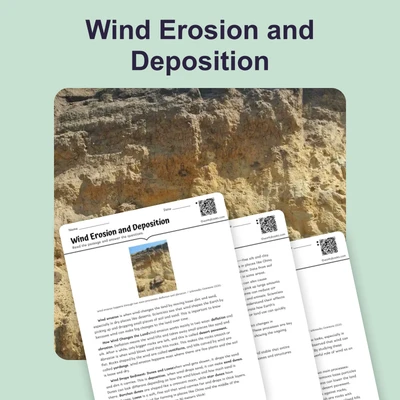
Wind Erosion and Deposition
This comprehensive science reading passage for grades 6-8 explores the processes of wind erosion and deposition, alignin...
MS-ESS2-1
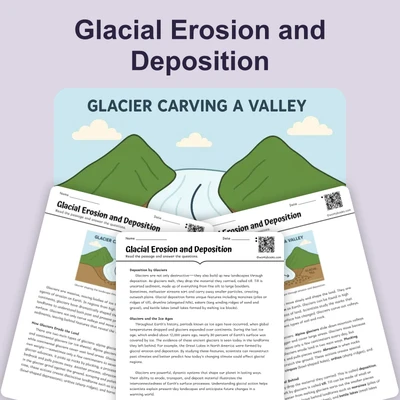
Glacial Erosion and Deposition
This middle school science passage explores glacial erosion and deposition, focusing on the mechanisms by which glaciers...
MS-ESS2-1
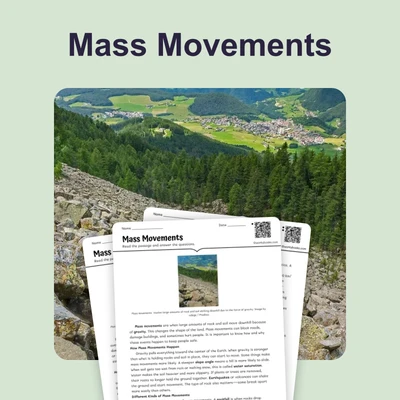
Mass Movements
This NGSS-aligned passage introduces middle school students to the science of mass movements—gravity-driven motions of r...
MS-ESS2-1MS-ESS3-2
Soil Formation and Composition
This comprehensive middle school science passage explores soil formation and composition, perfectly aligned to NGSS stan...
MS-ESS2-1
Constructive and Destructive Forces
This middle school science passage explores how Earth's surface is constantly shaped by the interplay of constructive an...
MS-ESS2-1
Mountains and Mountain Building
This NGSS-aligned passage for grades 6-8 covers the fascinating processes that create Earth's highest landforms—mountain...