What Are Intrusive Igneous Rocks — Reading Comprehension
Rate this
Premium Resource
Present
Present in classroom. No work saved
Assign
Classroom with student accounts, Track progress
Quick Play
No student accounts, assign with a link
Grades
6
7
8
Standards
MS-ESS2-1
PRINT+DIGITAL RESOURCE
This learning resource is available in interactive and printable formats. The interactive worksheet can be played online and assigned to students. The Printable PDF version can be downloaded and printed for completion by hand.
This comprehensive middle school science passage explores intrusive igneous rocks and their formation deep within Earth's crust. Students learn how magma cooling slowly underground creates the distinctive coarse-grained textures and large visible crystals characteristic of intrusive rocks like granite and gabbro. The passage aligns with NGSS standard MS-ESS2-1, examining Earth's systems and rock-forming processes. Through clear explanations and real-world examples, students discover the relationship between cooling rate and crystal size, understanding why underground formation produces different rock textures than surface volcanic rocks. The audio-integrated content includes differentiated versions for varied reading levels, Spanish translations, vocabulary support, and engaging activities. Students apply their knowledge through multiple-choice questions, writing prompts, and graphic organizers that reinforce understanding of geological processes, crystal formation, and the deep Earth environments where intrusive rocks develop over thousands of years.
CONTENT PREVIEW
Expand content preview
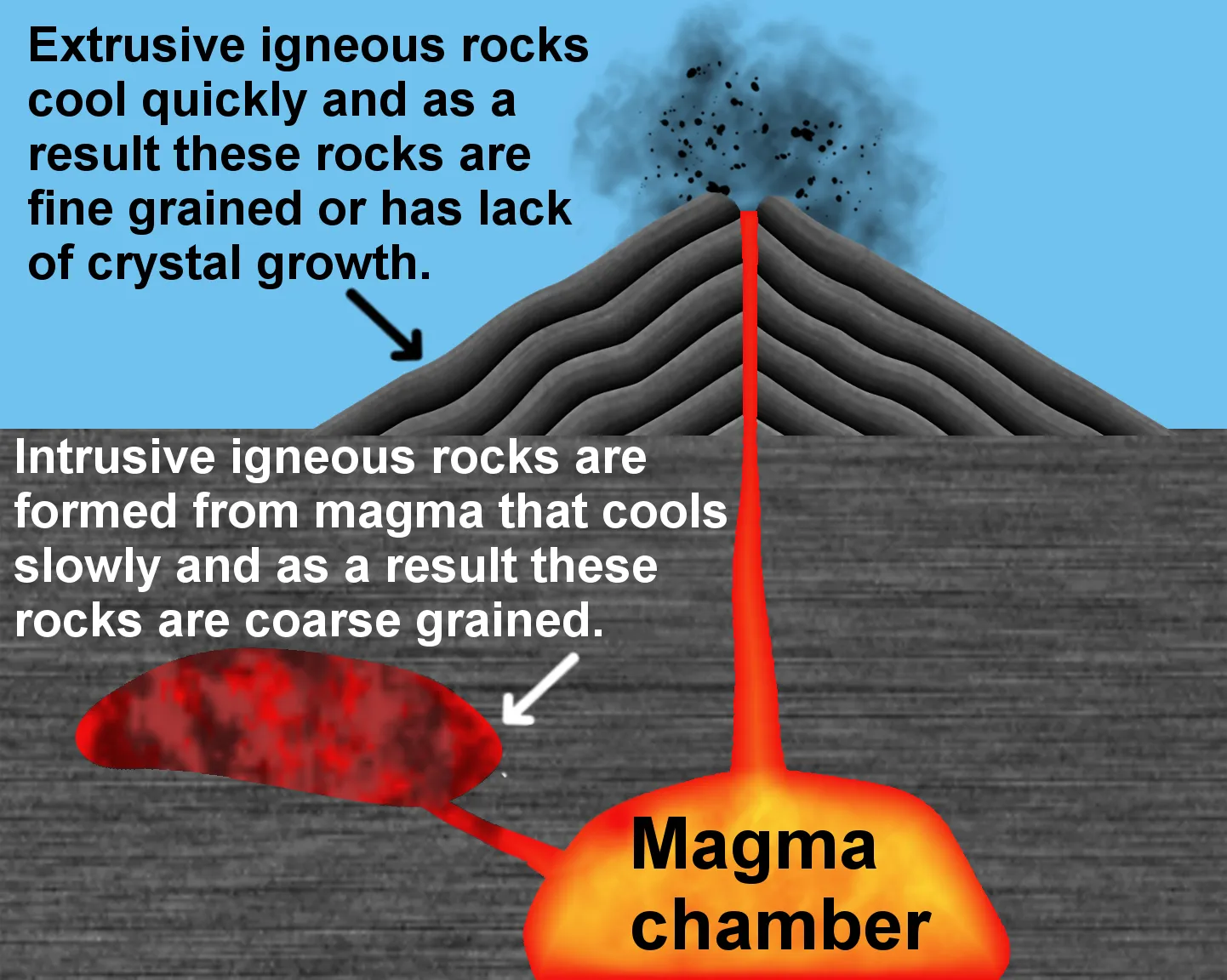
Intrusive igneous rocks are rocks that form deep beneath Earth's surface when hot, molten rock called magma cools and hardens slowly. . Image by Jasmin Ros / Wikimedia Commons
Intrusive igneous rocks are rocks that form deep beneath Earth's surface when hot, molten rock called magma cools and hardens slowly. Unlike volcanic rocks that form quickly on the surface, intrusive rocks develop far underground where temperatures remain high for long periods. This underground location is critical because it creates the perfect conditions for a very slow cooling process. As the magma cools over thousands or even millions of years, atoms and molecules have plenty of time to arrange themselves into organized patterns, forming crystals. The slower the cooling, the larger the crystals can grow.
The most distinctive feature of intrusive igneous rocks is their coarse-grained texture, which means the mineral crystals are large enough to see without a microscope. When you look at a piece of granite or gabbro, you can easily identify individual crystals of different minerals. This visible crystal structure tells geologists that the rock formed deep underground. In contrast, rocks that cool quickly on Earth's surface have fine-grained textures with crystals too small to see. The connection between cooling rate and crystal size is one of the most important concepts in understanding igneous rocks.
Two common examples of intrusive igneous rocks are granite and gabbro. Granite is light-colored and contains minerals like quartz, feldspar, and mica. You can often see pink, white, and black crystals when examining granite closely. This rock forms from magma rich in silica, a chemical compound that makes the magma thick and sticky. Gabbro, on the other hand, is dark-colored and contains minerals like pyroxene and plagioclase feldspar. It forms from magma that is lower in silica and more fluid. Both rocks share the characteristic large crystals that reveal their intrusive origin.
Intrusive igneous rocks form in specific geological settings deep within Earth's crust. Large underground bodies of magma called plutons can take various shapes and sizes. Some plutons are massive formations called batholiths that extend for hundreds of kilometers. These enormous underground reservoirs of magma cool extremely slowly, sometimes taking millions of years to solidify completely. Smaller plutons, such as dikes and sills, also form intrusive rocks but on a smaller scale. The depth at which these rocks form typically ranges from several hundred meters to many kilometers below the surface.
The process of crystal formation in intrusive rocks follows predictable patterns. As magma begins to cool, minerals with higher melting points crystallize first. These early-forming crystals can grow quite large because they have access to abundant liquid magma containing the atoms they need. As cooling continues, other minerals begin to crystallize in the remaining liquid. This sequential crystallization creates the interlocking crystal structure characteristic of intrusive rocks. The crystals fit together like pieces of a puzzle, making these rocks very strong and durable.
Intrusive igneous rocks eventually reach Earth's surface through a process called uplift and erosion. Over millions of years, tectonic forces can push buried rocks upward while weathering and erosion remove the overlying material. When intrusive rocks finally appear at the surface, they reveal their underground origin through their distinctive coarse-grained texture. Many mountain ranges, including parts of the Sierra Nevada in California, expose massive granite formations that once cooled deep underground. These exposed intrusive rocks provide valuable information about Earth's interior processes and geological history.
Interesting Fact: The granite used in many kitchen countertops and building materials formed millions of years ago deep underground, and the crystals you see in polished granite surfaces grew slowly over thousands of years in ancient magma chambers.
Where do intrusive igneous rocks form?
On Earth's surface during volcanic eruptionsDeep beneath Earth's surface where magma cools slowlyIn ocean water where lava hardens quicklyIn the atmosphere from cooling gases
What is the main reason intrusive igneous rocks have large, visible crystals?
They form from very hot magmaThey contain special mineralsThey cool slowly over long periods of timeThey are exposed to high pressure
What does the term 'coarse-grained texture' mean?
The rock feels rough to touchThe rock has mineral crystals large enough to see without a microscopeThe rock is made of sand particlesThe rock has many small holes
Which two rocks are examples of intrusive igneous rocks mentioned in the passage?
Sandstone and limestoneBasalt and pumiceGranite and gabbroMarble and slate
What are plutons?
Small crystals found in volcanic rocksLarge underground bodies of magmaSurface features created by erosionTypes of minerals in granite
Based on the passage, what can you infer about rocks that cool quickly on Earth's surface?
They have larger crystals than intrusive rocksThey have small crystals that are hard to seeThey do not contain any crystalsThey are always light-colored
How do intrusive igneous rocks eventually reach Earth's surface?
Through volcanic eruptions that bring them up quicklyThrough uplift and erosion over millions of yearsBy melting and reforming at the surfaceThrough earthquakes that crack the crust
If you found a rock with crystals too small to see without a microscope, what could you conclude about how it formed?
It cooled slowly deep undergroundIt cooled quickly, probably at or near Earth's surfaceIt formed from sediment layersIt was changed by heat and pressure
Intrusive igneous rocks always form on Earth's surface.
TrueFalse
The slower magma cools, the larger the crystals can grow.
TrueFalse
Perfect For:
👩🏫 Teachers
• Reading comprehension practice
• Auto-graded assessments
• Literacy skill development
👨👩👧👦 Parents
• Reading practice at home
• Comprehension improvement
• Educational reading time
🏠 Homeschoolers
• Reading curriculum support
• Independent reading practice
• Progress monitoring
Reading Features:
📖
Reading Passage
Engaging fiction or nonfiction text
❓
Comprehension Quiz
Auto-graded questions
📊
Instant Feedback
Immediate results and scoring
📄
Printable Version
Download for offline reading
🔊
Read Aloud
Voice-over with word highlighting
Reviews & Ratings
No reviews yet. Be the first to share your experience!
Related Content
Frost Wedging: How Ice Splits Rock
This passage explains frost wedging as a mechanical weathering process. Aligned with NGSS MS-ESS2-1 (Earth’s systems) a...
MS-ESS2-1MS-ESS2-2RST.6-8.3
Limestone Caves: Nature’s Underground Wonders
This passage explains limestone cave formation through carbonation, aligned with NGSS MS-ESS2-1 (Earth’s systems) and L...
MS-ESS2-1LS2.CRST.6-8.7
Chemical Weathering: The Breakdown of Rocks Through Chemical Reactions
This passage explains chemical weathering processes, aligned with NGSS MS-ESS2-1 (Earth’s systems) and ESS2-2 (surface ...
MS-ESS2-1MS-ESS2-2RST.6-8.4
Talus Slopes: Formation and Features
This earth science passage explains talus slope formation through mechanical weathering processes, aligning with NGSS MS...
MS-ESS2-1MS-ESS2-2RST.6-8.4
Biological Weathering: Types and Examples
This passage details biological weathering processes, connecting to NGSS MS-ESS2-1 (Earth's systems) and LS2.B (ecosyste...
MS-ESS2-1MS-PS1-2RST.6-8.3
The Coldest City in the World: Yakutsk
This NGSS-aligned science passage introduces middle school readers to Yakutsk, the coldest city on Earth. Students will ...
MS-ESS2-1
Igneous Rocks
This comprehensive passage introduces middle school students to igneous rocks, focusing on how these rocks form from mol...
MS-ESS2-1MS-ESS3-1
Sedimentary Rocks
This comprehensive middle school science passage introduces students to sedimentary rocks, detailing their step-by-step ...
MS-ESS2-1MS-ESS2-3MS-ESS3-1
Metamorphic Rocks
This engaging middle school science passage introduces students to the fascinating world of metamorphic rocks. Aligned w...
MS-ESS2-1MS-ESS3-1
Scientific Inquiry in Earth Science
This passage explores scientific inquiry in Earth science for grades 6-8, aligned with NGSS standards MS-ESS1-4, MS-ESS2...
MS-ESS1-4MS-ESS2-1MS-ESS3-5SEP
Contour Lines and Elevation
This passage, designed for grades 6-8 and aligned with NGSS standards MS-ESS2-2 and MS-ESS2-1, introduces students to th...
MS-ESS2-2MS-ESS2-1SEP.4SEP.8
Weathering
This comprehensive science reading passage for grades 6-8 focuses on the concept of weathering, aligning with NGSS stand...
MS-ESS2-1
Erosion
This comprehensive middle school science passage explains erosion—the process that transports weathered rock and soil fr...
MS-ESS2-1
Stream Erosion and Deposition
This middle school science passage, aligned to NGSS MS-ESS2-1, introduces students to the dynamic processes of stream er...
MS-ESS2-1
Wind Erosion and Deposition
This comprehensive science reading passage for grades 6-8 explores the processes of wind erosion and deposition, alignin...
MS-ESS2-1
Glacial Erosion and Deposition
This middle school science passage explores glacial erosion and deposition, focusing on the mechanisms by which glaciers...
MS-ESS2-1
Mass Movements
This NGSS-aligned passage introduces middle school students to the science of mass movements—gravity-driven motions of r...
MS-ESS2-1MS-ESS3-2
Soil Formation and Composition
This comprehensive middle school science passage explores soil formation and composition, perfectly aligned to NGSS stan...
MS-ESS2-1
Constructive and Destructive Forces
This middle school science passage explores how Earth's surface is constantly shaped by the interplay of constructive an...
MS-ESS2-1
Mountains and Mountain Building
This NGSS-aligned passage for grades 6-8 covers the fascinating processes that create Earth's highest landforms—mountain...