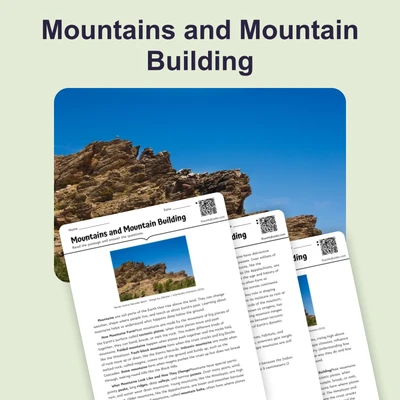
This learning resource is available in interactive and printable formats. The interactive worksheet can be played online and assigned to students. The Printable PDF version can be downloaded and printed for completion by hand.
This comprehensive 650-word reading passage introduces middle school students to the major types of landforms and the geological forces that create them. Aligned with NGSS standard MS-ESS2-1, the passage explores mountains, plateaus, plains, and valleys while explaining processes like tectonic plate movement, erosion, and weathering. Students examine how these forces shape Earth's surface over millions of years. The passage includes clear definitions of key scientific vocabulary, real-world examples, and connections to plate tectonics. Audio-integrated content supports diverse learners, while differentiated versions ensure accessibility for all students. Activities include comprehension questions, writing prompts, and graphic organizers that help students analyze cause-and-effect relationships and compare different landform types. This resource provides essential background knowledge for understanding Earth's dynamic surface processes.
CONTENT PREVIEW
Expand content preview
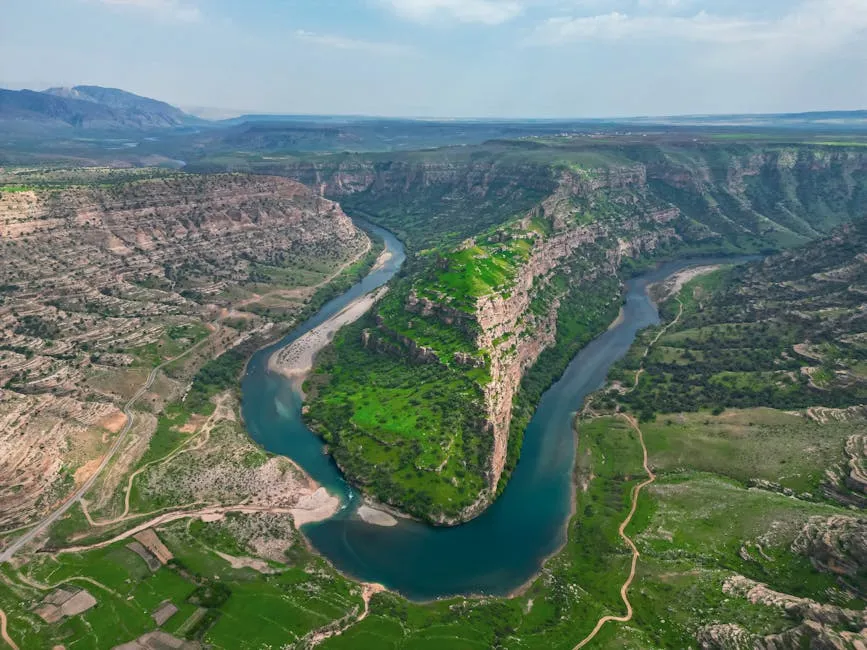
Scientists classify landforms into four major types: mountains, plateaus, plains, and valleys. Aerial view of the lush green Sulak Valley with meandering river in Şırnak, Türkiye." by Mehmet Karaca / Pexels.
Earth's surface is covered with different shapes and features called landforms. A landform is a natural feature of Earth's solid surface that has a characteristic shape. Scientists classify landforms into four major types: mountains, plateaus, plains, and valleys. Each type has distinct characteristics that help us identify it.
Mountains are landforms that rise high above the surrounding land with steep sides and a peak or ridge at the top. They typically rise at least 1,000 feet above their base. Mountains form through several geological processes. The most common process involves tectonic plates, which are massive slabs of Earth's crust that slowly move. When two tectonic plates collide, they push rock upward, creating mountain ranges like the Himalayas. Volcanic activity can also build mountains when molten rock erupts and hardens over time. The Rocky Mountains in North America formed from tectonic plate collisions millions of years ago.
Plateaus are elevated flatlands that rise sharply above the surrounding area. Unlike mountains, plateaus have flat or gently rolling tops. They form when tectonic forces lift large areas of rock upward without folding or tilting them significantly. Erosion, the process of wearing away rock and soil by wind and water, can also create plateaus by removing softer rock layers and leaving harder rock behind. The Colorado Plateau in the southwestern United States contains the Grand Canyon, carved by millions of years of erosion.
Plains are broad, flat or gently rolling areas of land with low elevation. They are the most common landform on Earth. Plains form in several ways. Coastal plains develop when ocean levels drop, exposing the seafloor. River plains form when rivers deposit sediment over thousands of years. The Great Plains of central North America stretch from Canada to Texas and were shaped by ancient seas and rivers depositing layers of sediment.
Valleys are low areas of land between hills or mountains. They typically have a V-shape or U-shape depending on how they formed. Rivers carve V-shaped valleys through erosion as water cuts through rock over millions of years. Glaciers, which are massive sheets of moving ice, carve U-shaped valleys by scraping and pushing rock as they advance. The process of weathering, which breaks down rock through physical and chemical changes, works alongside erosion to shape valleys.
All landforms change continuously through geological processes. Tectonic plate movements build new mountains while erosion wears them down. Rivers deposit sediment in some areas while carving valleys in others. These processes operate on timescales of millions of years, making changes difficult to observe directly. Scientists study landforms to understand Earth's history and predict future changes. By examining rock layers and landform shapes, they can determine what forces created specific features and when those events occurred.
Interesting Fact: Mount Everest, the world's tallest mountain, grows about 4 millimeters taller each year because the tectonic plates beneath it continue to collide and push the mountain upward.
What is a landform?
A natural feature of Earth's solid surface that has a characteristic shapeAny type of plant or animal living on EarthA man-made structure built on Earth's surfaceThe layer of air surrounding Earth
How tall must a mountain typically be above its base?
At least 500 feetAt least 1,000 feetAt least 5,000 feetAt least 10,000 feet
What is the main difference between mountains and plateaus?
Mountains are shorter than plateausPlateaus have flat tops while mountains have peaksPlateaus are formed by water while mountains are formed by windMountains are more common than plateaus
According to the passage, erosion is the process of:
Building up new mountains through volcanic activityMoving tectonic plates beneath Earth's surfaceWearing away rock and soil by wind and waterDepositing sediment in river valleys
What does the term 'sediment' mean in the context of the passage?
Large boulders carried by glaciersMolten rock from volcanic eruptionsSmall pieces of rock and soil deposited by waterLayers of ice in frozen valleys
Which landform is created when glaciers scrape and push rock as they advance?
V-shaped valleysU-shaped valleysCoastal plainsMountain peaks
Why do landform changes happen slowly and are difficult to observe directly?
Because scientists don't have the right tools to measure themBecause the processes operate on timescales of millions of yearsBecause landforms only change during earthquakesBecause erosion only happens once every thousand years
What can scientists learn by examining rock layers and landform shapes?
The exact weather patterns for the next yearWhat forces created specific features and when those events occurredHow many animals lived in the areaThe temperature of Earth's core
Plains are the most common landform on Earth.
TrueFalse
Mount Everest is getting shorter each year due to erosion.
TrueFalse
Perfect For:
👩🏫 Teachers
• Reading comprehension practice
• Auto-graded assessments
• Literacy skill development
👨👩👧👦 Parents
• Reading practice at home
• Comprehension improvement
• Educational reading time
🏠 Homeschoolers
• Reading curriculum support
• Independent reading practice
• Progress monitoring
Reading Features:
📖
Reading Passage
Engaging fiction or nonfiction text
❓
Comprehension Quiz
Auto-graded questions
📊
Instant Feedback
Immediate results and scoring
📄
Printable Version
Download for offline reading
🔊
Read Aloud
Voice-over with word highlighting
Reviews & Ratings
No reviews yet. Be the first to share your experience!
Related Content
Frost Wedging: How Ice Splits Rock
This passage explains frost wedging as a mechanical weathering process. Aligned with NGSS MS-ESS2-1 (Earth’s systems) a...
MS-ESS2-1MS-ESS2-2RST.6-8.3
Limestone Caves: Nature’s Underground Wonders
This passage explains limestone cave formation through carbonation, aligned with NGSS MS-ESS2-1 (Earth’s systems) and L...
MS-ESS2-1LS2.CRST.6-8.7
Chemical Weathering: The Breakdown of Rocks Through Chemical Reactions
This passage explains chemical weathering processes, aligned with NGSS MS-ESS2-1 (Earth’s systems) and ESS2-2 (surface ...
MS-ESS2-1MS-ESS2-2RST.6-8.4
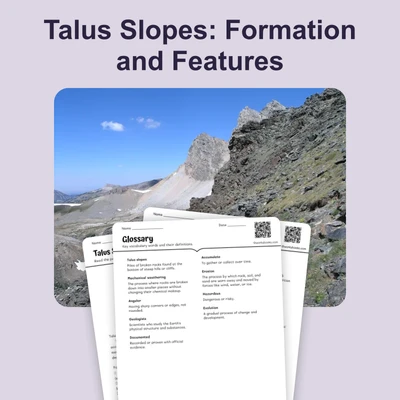
Talus Slopes: Formation and Features
This earth science passage explains talus slope formation through mechanical weathering processes, aligning with NGSS MS...
MS-ESS2-1MS-ESS2-2RST.6-8.4
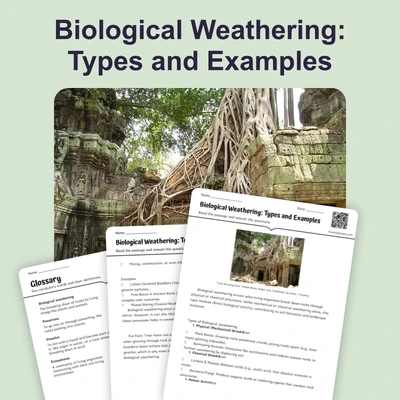
Biological Weathering: Types and Examples
This passage details biological weathering processes, connecting to NGSS MS-ESS2-1 (Earth's systems) and LS2.B (ecosyste...
MS-ESS2-1MS-PS1-2RST.6-8.3
The Coldest City in the World: Yakutsk
This NGSS-aligned science passage introduces middle school readers to Yakutsk, the coldest city on Earth. Students will ...
MS-ESS2-1
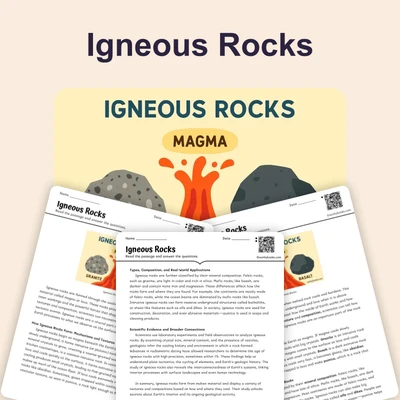
Igneous Rocks
This comprehensive passage introduces middle school students to igneous rocks, focusing on how these rocks form from mol...
MS-ESS2-1MS-ESS3-1
Sedimentary Rocks
This comprehensive middle school science passage introduces students to sedimentary rocks, detailing their step-by-step ...
MS-ESS2-1MS-ESS2-3MS-ESS3-1
Metamorphic Rocks
This engaging middle school science passage introduces students to the fascinating world of metamorphic rocks. Aligned w...
MS-ESS2-1MS-ESS3-1
Scientific Inquiry in Earth Science
This passage explores scientific inquiry in Earth science for grades 6-8, aligned with NGSS standards MS-ESS1-4, MS-ESS2...
MS-ESS1-4MS-ESS2-1MS-ESS3-5SEP
Contour Lines and Elevation
This passage, designed for grades 6-8 and aligned with NGSS standards MS-ESS2-2 and MS-ESS2-1, introduces students to th...
MS-ESS2-2MS-ESS2-1SEP.4SEP.8
Weathering
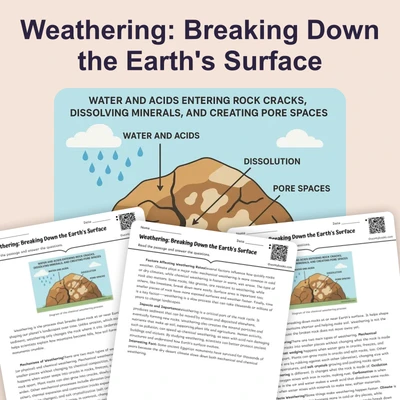
This comprehensive science reading passage for grades 6-8 focuses on the concept of weathering, aligning with NGSS stand...
MS-ESS2-1
Erosion
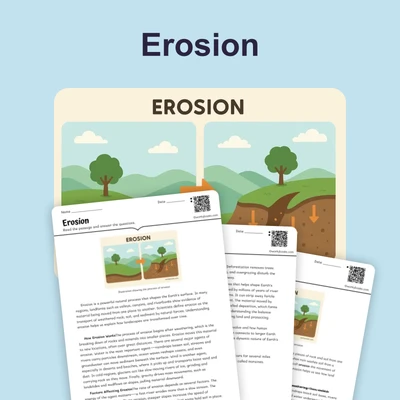
This comprehensive middle school science passage explains erosion—the process that transports weathered rock and soil fr...
MS-ESS2-1
Stream Erosion and Deposition
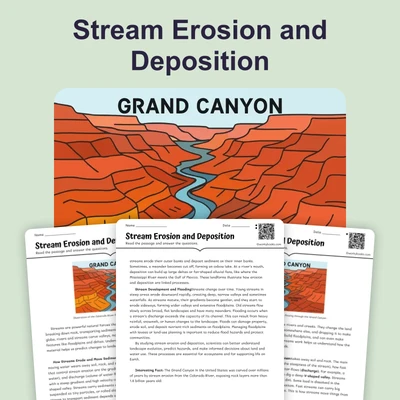
This middle school science passage, aligned to NGSS MS-ESS2-1, introduces students to the dynamic processes of stream er...
MS-ESS2-1
Wind Erosion and Deposition
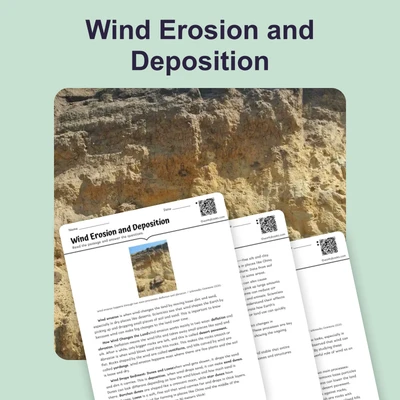
This comprehensive science reading passage for grades 6-8 explores the processes of wind erosion and deposition, alignin...
MS-ESS2-1
Glacial Erosion and Deposition
This middle school science passage explores glacial erosion and deposition, focusing on the mechanisms by which glaciers...
MS-ESS2-1
Mass Movements
This NGSS-aligned passage introduces middle school students to the science of mass movements—gravity-driven motions of r...
MS-ESS2-1MS-ESS3-2
Soil Formation and Composition
This comprehensive middle school science passage explores soil formation and composition, perfectly aligned to NGSS stan...
MS-ESS2-1
Constructive and Destructive Forces
This middle school science passage explores how Earth's surface is constantly shaped by the interplay of constructive an...
MS-ESS2-1
Mountains and Mountain Building
This NGSS-aligned passage for grades 6-8 covers the fascinating processes that create Earth's highest landforms—mountain...