This comprehensive middle school science passage explores the eight phases of the Moon aligned with NGSS standard MS-ESS1-1 and disciplinary core idea MS-ESS1.B. Students discover how the Moon's position relative to Earth and the Sun creates the phases we observe: new moon, waxing crescent, first quarter, waxing gibbous, full moon, waning gibbous, third quarter, and waning crescent. The passage explains the 29.5-day lunar cycle and helps students understand why different fractions of the Moon's lit side become visible from Earth. Audio-integrated content supports diverse learners, including English Language Learners and struggling readers. Activities include reading comprehension questions, writing prompts, and graphic organizers that reinforce understanding of moon phases, orbital motion, and patterns in the Earth-Moon system. This resource provides scientifically accurate information suitable for grades 6-8 science curriculum.
Written by Workybooks TeamPublished by Workybooks
Preview
Sample passage and quiz content
CONTENT PREVIEW
Expand content preview
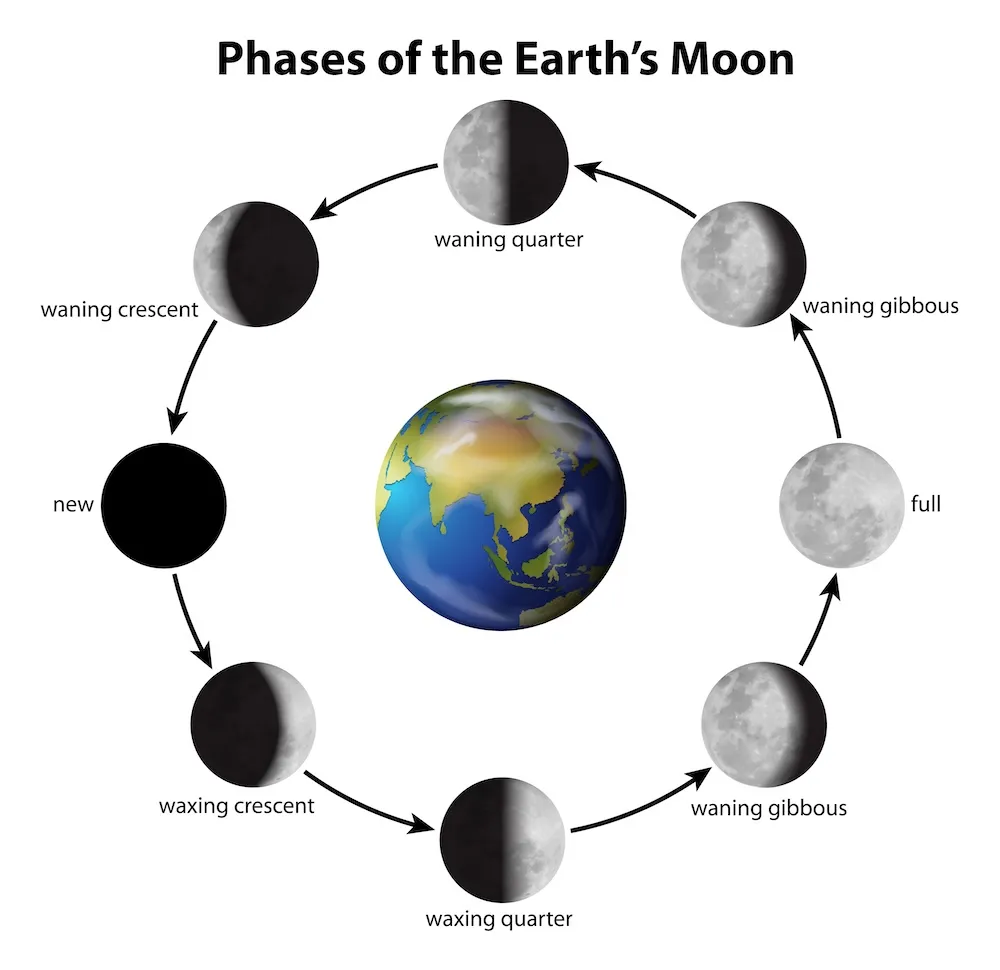
The Moon shows eight distinct phases as it orbits Earth. These phases are new moon, waxing crescent, waning quarter, waxing gibbous, full moon, waning gibbous, waxing quarter, and waning crescent. Each phase displays a different fraction of the Moon's illuminated side. Scientists observe that the entire cycle repeats every 29.5 days.
The phases occur because the Moon orbits Earth while the Sun lights one half of the Moon. From Earth, we see different amounts of the lit side. During a new moon, the lit side faces away from Earth. We cannot see the Moon in the night sky. As the Moon continues its orbit, more of the lit side becomes visible. This creates the waxing crescent phase. The word waxing means growing larger. During first quarter, we see exactly half of the lit side. The waxing gibbous phase shows more than half but not all of the lit side.
A full moon occurs when the entire lit side faces Earth. The Moon appears as a complete bright circle in the sky. After the full moon, the visible lit portion begins to shrink. This creates the waning phases. Waning means growing smaller. The waning gibbous shows more than half of the lit side. Third quarter displays exactly half. The waning crescent shows just a small sliver before the cycle returns to new moon.
Evidence shows that the lunar cycle has been remarkably consistent throughout human history. Ancient civilizations tracked moon phases to create calendars. The Babylonians used lunar observations over 4,000 years ago. They recorded the same 29.5-day pattern we observe today. Modern scientists use precise measurements to confirm this cycle length.
Understanding moon phases matters for many reasons. The phases affect ocean tides through gravitational pull. They help scientists study orbital mechanics in our solar system. Astronomers also use moon phases to plan telescope observations. A bright full moon can make it difficult to see faint stars. Many people around the world still use lunar calendars for cultural and religious events.
Interesting Fact: The same side of the Moon always faces Earth because the Moon rotates once during each orbit. This means we never see the far side of the Moon from Earth without spacecraft.
How many phases does the Moon show as it orbits Earth?
Six phasesEight phasesTen phasesTwelve phases
How long does it take for the complete lunar cycle to repeat?
27.3 days29.5 days30.5 days31 days
What does the word 'waxing' mean when describing moon phases?
Growing smallerStaying the sameGrowing largerDisappearing completely
What does the word 'waning' mean in the context of moon phases?
Growing brighterGrowing smallerRotating fasterMoving closer to Earth
Why do we see different moon phases from Earth?
The Moon changes its shapeClouds block different parts of the MoonWe see different amounts of the Moon's lit side as it orbitsThe Sun moves around the Moon
During which phase is the Moon not visible from Earth?
Full moonFirst quarterNew moonWaxing crescent
How did ancient civilizations use moon phases?
To predict earthquakesTo create calendarsTo measure temperatureTo navigate on land
Why does a bright full moon make it difficult for astronomers to observe faint stars?
The Moon blocks the starsThe Moon's brightness makes dim stars harder to seeStars move behind the MoonThe Moon creates clouds
The same side of the Moon always faces Earth.
TrueFalse
The Sun lights different halves of the Moon during different phases.
TrueFalse
Who it's for
Perfect for the way you teach
Teachers
Build comprehension skills
Auto-graded quiz
Differentiated reading
Parents
Read together at home
Improve fluency
Quiet reading time
Homeschoolers
Reading curriculum support
Independent practice
Track Lexile growth
Topics
moon phaseslunar cyclenew moonfull moonwaxing crescentwaning gibbousEarth-Moon systemMS-ESS1-1middle school science
Reviews & Ratings
No reviews yet. Be the first to share your experience!
More reading you might love
20 more
What is Solar Radiation
This NGSS-aligned science reading passage for middle school students explores the concept of solar radiation. Solar radi...
MS-ESS1-1
How Incoming Solar Radiation Changes with Latitude
This NGSS-aligned science reading passage helps middle school students understand how solar radiation, or insolation, ch...
MS-ESS1-1
Tides and Tidal Forces
This middle school science passage explores the mechanisms of tides and tidal forces, aligning with NGSS standards MS-ES...
MS-ESS1-1MS-ESS1-2
The Night Sky
This comprehensive science reading passage for grades 6-8 aligns with NGSS standard MS-ESS1-1 and explores the systems a...
MS-ESS1-1
Ancient Astronomy
This engaging passage for grades 6-8 explores the history of astronomy through the lens of ancient observations. Student...
MS-ESS1-1
Tools of Modern Astronomy
This passage introduces middle school students to modern astronomy, aligning with NGSS standard MS-ESS1-1. It explains h...
MS-ESS1-1
How Astronomy Became a Science
This passage explores the transformative period known as the Scientific Revolution, with a special focus on the history ...
MS-ESS1-1
Earth's Rotation
This middle school science passage, aligned with NGSS standard MS-ESS1-1, focuses on Earth's rotation—how Earth spins on...
MS-ESS1-1
Earth's Revolution
This middle school science passage explores the science behind Earth's revolution around the Sun, closely aligned with N...
MS-ESS1-1
Why We Have Seasons
This comprehensive middle school science reading passage explains the mechanisms behind Earth's seasons, directly addres...
MS-ESS1-1
Earth's Seasons
This comprehensive reading passage for grades 6-8 explains why Earth has seasons, revealing the scientific mechanisms be...
MS-ESS1-1
Phases of the Moon
This comprehensive middle school science passage explains the phases of the Moon, focusing on the mechanisms behind the ...
MS-ESS1-1
Tides
This comprehensive middle school science reading passage explores the phenomenon of ocean tides, aligned to NGSS standar...
MS-ESS1-1MS-ESS1-2
Eclipses
This comprehensive passage for grades 6-8 explores the science behind eclipses, including solar and lunar eclipses, thei...
MS-ESS1-1
The Moon's Characteristics
This comprehensive science reading passage for grades 6-8 examines the Moon's physical characteristics, including its si...
MS-ESS1-1MS-ESS1-2
Lunar Eclipses
This passage introduces middle school students to the phenomenon of lunar eclipses, connecting observable events to the ...
MS-ESS1-1
The Sun's Characteristics
This engaging science passage introduces middle school students to the Sun’s key characteristics, such as its classifica...
MS-ESS1-1MS-ESS1-2
What Is a Galaxy?
This comprehensive middle school science passage answers the question: What is a galaxy? Aligned to NGSS standard MS-ESS...
MS-ESS1-1
The Milky Way: Our Home Galaxy
This comprehensive science passage introduces middle school students to the Milky Way, the barred spiral galaxy that is ...
MS-ESS1-1
Types of Galaxies
This comprehensive middle school science passage introduces students to the classification and characteristics of galaxi...