This comprehensive middle school science reading passage explores the new moon phase and its significance in the Earth-Sun-Moon system. Students learn why the Moon appears invisible during this phase, how its position between Earth and the Sun creates this phenomenon, and why new moons provide ideal conditions for stargazing. The passage aligns with NGSS standards MS-ESS1-1 and MS-ESS1.B, helping students understand patterns of lunar phases and the predictable motion of celestial objects. Audio-integrated content supports diverse learners, while differentiated versions ensure accessibility for all reading levels. Activities include comprehension questions, writing prompts, and graphic organizers that reinforce understanding of cause-and-effect relationships in astronomy. Students explore how the Moon's orbit and position relative to Earth and the Sun create observable patterns in the night sky, developing foundational knowledge about our solar system.
Written by Workybooks TeamPublished by Workybooks
Preview
Sample passage and quiz content
CONTENT PREVIEW
Expand content preview
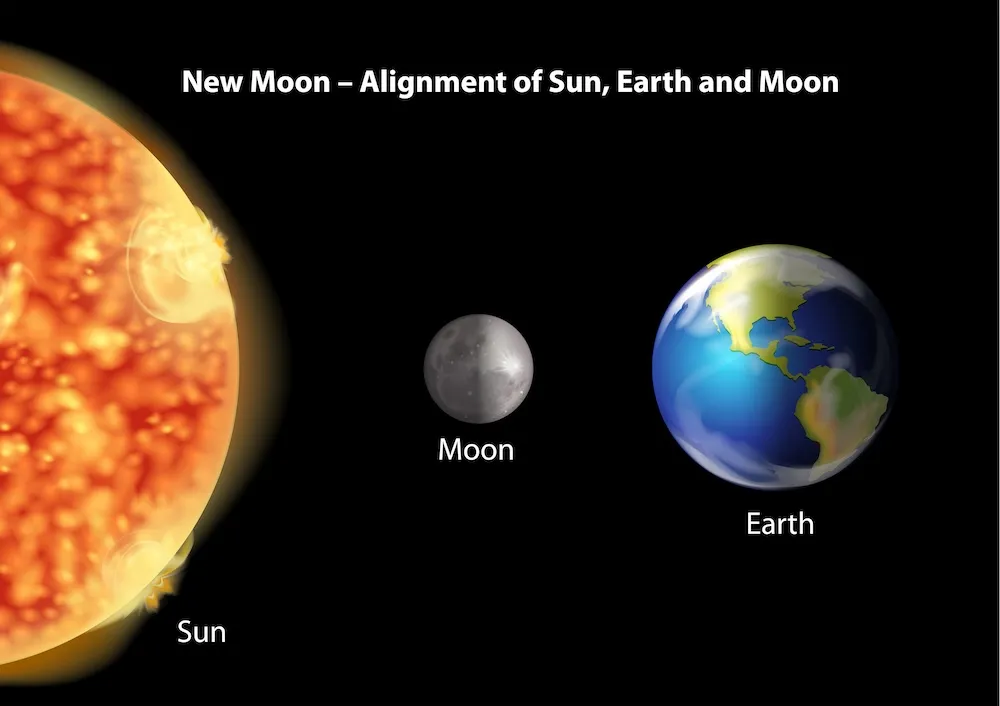
A new moon is a lunar phase that occurs when the Moon sits directly between Earth and the Sun.
A new moon is a lunar phase that occurs when the Moon sits directly between Earth and the Sun. During this alignment, the Sun lights up the side of the Moon facing away from Earth. The side facing Earth remains completely dark. This positioning makes the Moon appear invisible in our night sky. Scientists observe that new moons happen approximately every 29.5 days as part of the Moon's regular orbit around Earth.
The Moon moves in a predictable path around Earth while Earth orbits the Sun. When the Moon reaches the position between Earth and the Sun, we experience a new moon. The illuminated side faces the Sun, and the unilluminated side faces Earth. Evidence shows that new moons rise and set with the Sun. This means the Moon travels across the sky during daylight hours when we cannot see it. The dark side of the Moon blends into the bright daytime sky.
New moons create the darkest night skies because no moonlight reflects toward Earth. Astronomers consider this phase ideal for stargazing and observing distant space objects. For example, the Perseid meteor shower in August becomes most visible during new moon phases. Without moonlight washing out the sky, observers can see fainter stars and celestial objects more clearly. Professional observatories often schedule important observations during new moon periods to capture the best images.
Understanding new moons helps scientists predict tides, plan space observations, and study the Earth-Sun-Moon system. The predictable pattern of lunar phases demonstrates how gravity and motion work together in our solar system. New moons remind us that the Moon constantly orbits Earth, even when we cannot see it. This knowledge connects to larger patterns in space and helps us understand our place in the universe.
Interesting Fact: During a new moon, if the alignment is perfect, the Moon can block the Sun and create a solar eclipse. This rare event can only happen during the new moon phase.
Where is the Moon positioned during a new moon phase?
Behind Earth, away from the SunBetween Earth and the SunTo the side of Earth and the SunBeyond the Sun, away from Earth
Why does the Moon appear invisible during a new moon?
The Moon stops reflecting sunlight completelyThe Moon moves too far from Earth to seeThe illuminated side faces away from EarthClouds always block the Moon during this phase
What does the word 'illuminated' mean in the context of this passage?
Hidden or covered upLit up or brightened by lightMoving in a circular pathReflecting off a surface
Based on the passage, what does 'celestial objects' refer to?
Objects found on Earth's surfaceTools used by astronomersNatural objects in space like stars and galaxiesArtificial satellites orbiting Earth
Why do astronomers prefer to observe space during a new moon?
The Moon is closer to Earth during this phaseThe lack of moonlight creates darker skies for better viewingThe Moon blocks light from distant starsTelescopes work better when the Moon is invisible
How does the new moon phase demonstrate predictable patterns in space?
It shows that the Moon randomly appears and disappearsIt proves that the Sun controls the Moon's movementIt occurs regularly every 29.5 days as the Moon orbits EarthIt happens only when Earth is closest to the Sun
If an astronomer wanted to photograph faint stars, when would be the best time?
During a full moon when the sky is brightestDuring a new moon when the sky is darkestDuring sunrise when stars are most visibleDuring any phase because moonlight does not affect visibility
What can you infer about the relationship between new moons and solar eclipses?
Solar eclipses can happen during any moon phaseSolar eclipses require the Moon to be behind EarthSolar eclipses can only occur when the Moon is between Earth and the SunSolar eclipses happen more often than new moons
True or False: New moons rise and set with the Sun.
TrueFalse
True or False: During a new moon, the side of the Moon facing Earth is illuminated by the Sun.
TrueFalse
Who it's for
Perfect for the way you teach
Teachers
Build comprehension skills
Auto-graded quiz
Differentiated reading
Parents
Read together at home
Improve fluency
Quiet reading time
Homeschoolers
Reading curriculum support
Independent practice
Track Lexile growth
Topics
new moonlunar phasesMoon phasesEarth-Sun-Moon systemastronomystargazingMS-ESS1-1middle school science
Reviews & Ratings
No reviews yet. Be the first to share your experience!
More reading you might love
20 more
What is Solar Radiation
This NGSS-aligned science reading passage for middle school students explores the concept of solar radiation. Solar radi...
MS-ESS1-1
How Incoming Solar Radiation Changes with Latitude
This NGSS-aligned science reading passage helps middle school students understand how solar radiation, or insolation, ch...
MS-ESS1-1
Tides and Tidal Forces
This middle school science passage explores the mechanisms of tides and tidal forces, aligning with NGSS standards MS-ES...
MS-ESS1-1MS-ESS1-2
The Night Sky
This comprehensive science reading passage for grades 6-8 aligns with NGSS standard MS-ESS1-1 and explores the systems a...
MS-ESS1-1
Ancient Astronomy
This engaging passage for grades 6-8 explores the history of astronomy through the lens of ancient observations. Student...
MS-ESS1-1
Tools of Modern Astronomy
This passage introduces middle school students to modern astronomy, aligning with NGSS standard MS-ESS1-1. It explains h...
MS-ESS1-1
How Astronomy Became a Science
This passage explores the transformative period known as the Scientific Revolution, with a special focus on the history ...
MS-ESS1-1
Earth's Rotation
This middle school science passage, aligned with NGSS standard MS-ESS1-1, focuses on Earth's rotation—how Earth spins on...
MS-ESS1-1
Earth's Revolution
This middle school science passage explores the science behind Earth's revolution around the Sun, closely aligned with N...
MS-ESS1-1
Why We Have Seasons
This comprehensive middle school science reading passage explains the mechanisms behind Earth's seasons, directly addres...
MS-ESS1-1
Earth's Seasons
This comprehensive reading passage for grades 6-8 explains why Earth has seasons, revealing the scientific mechanisms be...
MS-ESS1-1
Phases of the Moon
This comprehensive middle school science passage explains the phases of the Moon, focusing on the mechanisms behind the ...
MS-ESS1-1
Tides
This comprehensive middle school science reading passage explores the phenomenon of ocean tides, aligned to NGSS standar...
MS-ESS1-1MS-ESS1-2
Eclipses
This comprehensive passage for grades 6-8 explores the science behind eclipses, including solar and lunar eclipses, thei...
MS-ESS1-1
The Moon's Characteristics
This comprehensive science reading passage for grades 6-8 examines the Moon's physical characteristics, including its si...
MS-ESS1-1MS-ESS1-2
Lunar Eclipses
This passage introduces middle school students to the phenomenon of lunar eclipses, connecting observable events to the ...
MS-ESS1-1
The Sun's Characteristics
This engaging science passage introduces middle school students to the Sun’s key characteristics, such as its classifica...
MS-ESS1-1MS-ESS1-2
What Is a Galaxy?
This comprehensive middle school science passage answers the question: What is a galaxy? Aligned to NGSS standard MS-ESS...
MS-ESS1-1
The Milky Way: Our Home Galaxy
This comprehensive science passage introduces middle school students to the Milky Way, the barred spiral galaxy that is ...
MS-ESS1-1
Types of Galaxies
This comprehensive middle school science passage introduces students to the classification and characteristics of galaxi...