What Is Bowen's Reaction Series
Interactive passage with audio narration, comprehension questions, and printable PDF.
By completing this purchase you agree to our Terms of Use and Privacy Policy. Your subscription renews automatically until you cancel. You can cancel anytime from your account settings. All sales are final and non-refundable. Digital content is available for download in your account immediately upon purchase.
What's included
What Is Bowen's Reaction Series preview and details
About this printable What Is Bowen's Reaction Series science reading passage, NGSS-aligned (Grades 6-8)
Sample passage and quiz from What Is Bowen's Reaction Series
Reading passage and comprehension quiz preview
What Is Bowen's Reaction Series
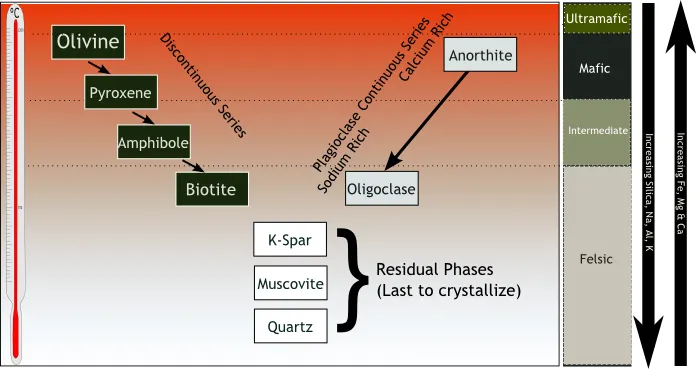
"Bowen's Reaction Series" by Colivine / Wikimedia Commons
Bowen's Reaction Series is a scientific model that explains the order in which minerals crystallize from cooling magma. Named after Canadian geologist Norman L. Bowen, this series shows that minerals form in a predictable sequence as molten rock cools. Understanding this process helps scientists explain why different types of igneous rocks have different mineral compositions.
The series works because different minerals crystallize at different temperatures. When magma begins to cool from extremely high temperatures, minerals with high melting points form first. Olivine, a dark green mineral rich in iron and magnesium, crystallizes first at temperatures around 1,200°C. As the magma continues to cool, other minerals form in sequence. Pyroxene forms next, followed by amphibole, then biotite mica. Finally, at the lowest temperatures around 700°C, quartz crystallizes last.
Bowen's Reaction Series actually has two branches that work simultaneously. The discontinuous branch includes the dark-colored minerals mentioned above, which change completely in structure as temperature drops. The continuous branch involves plagioclase feldspar, which changes gradually from calcium-rich to sodium-rich varieties as cooling occurs. Both branches eventually converge at lower temperatures where potassium feldspar, muscovite mica, and quartz form.
This crystallization sequence explains why different igneous rocks exist. If magma cools slowly deep underground, early-forming minerals can settle to the bottom through a process called fractional crystallization. The remaining liquid magma then has a different composition than the original melt. This creates rocks with different mineral content from the same starting magma. For example, basalt forms from magma rich in early-crystallizing minerals like olivine and pyroxene, while granite forms from magma enriched in late-crystallizing minerals like quartz and feldspar.
The series also helps geologists understand volcanic activity and Earth's interior. Rocks formed from early-crystallizing minerals are denser and darker, typically found in oceanic crust. Rocks formed from late-crystallizing minerals are lighter in color and density, commonly found in continental crust. By examining the minerals in an igneous rock, scientists can determine the temperature and conditions under which it formed.
Bowen's Reaction Series demonstrates an important principle in earth science: the same starting material can produce different end products depending on conditions. This concept applies to many geological processes and helps explain the diversity of rocks found on Earth's surface. The series remains a fundamental tool for understanding how Earth's crust forms and changes over time.
Interesting Fact: Norman L. Bowen developed his reaction series in 1915 by conducting experiments with molten rock in laboratory furnaces, carefully observing which minerals formed at specific temperatures.
Comprehension quiz (10 questions)
1. What is Bowen's Reaction Series?
2. Which mineral crystallizes first at the highest temperature?
3. At approximately what temperature does quartz crystallize?
4. What does the term 'fractional crystallization' mean in the passage?
5. How many branches does Bowen's Reaction Series have?
6. Why do different igneous rocks have different mineral compositions?
7. Which type of rock forms from early-crystallizing minerals like olivine and pyroxene?
8. What happens to plagioclase feldspar in the continuous branch as temperature decreases?
9. Norman L. Bowen developed his reaction series in 1915.
10. Rocks formed from late-crystallizing minerals are typically found in oceanic crust.
Perfect for the way you teach
- Build comprehension skills
- Auto-graded quiz
- Differentiated reading
- Read together at home
- Improve fluency
- Quiet reading time
- Reading curriculum support
- Independent practice
- Track Lexile growth