This learning resource is available in interactive and printable formats. The interactive worksheet can be played online and assigned to students. The Printable PDF version can be downloaded and printed for completion by hand.
This comprehensive reading passage introduces middle school students to geology, the scientific study of Earth's solid materials and the processes that shape our planet. Students will learn about rocks, minerals, and how geologists investigate Earth's structure and landforms. The passage covers key concepts including the three main rock types, mineral properties, and geological processes like weathering and erosion that continuously modify Earth's surface. Aligned with NGSS standard MS-ESS2-1, this resource helps students understand Earth's systems and the dynamic nature of our planet. The passage includes audio integration for enhanced accessibility, a simplified version for struggling readers, Spanish translations, vocabulary glossary, comprehension questions, writing activities, and graphic organizers. Perfect for grades 6-8 science curriculum, this material supports diverse learners while maintaining rigorous content standards and promoting scientific literacy in Earth science.
CONTENT PREVIEW
Expand content preview
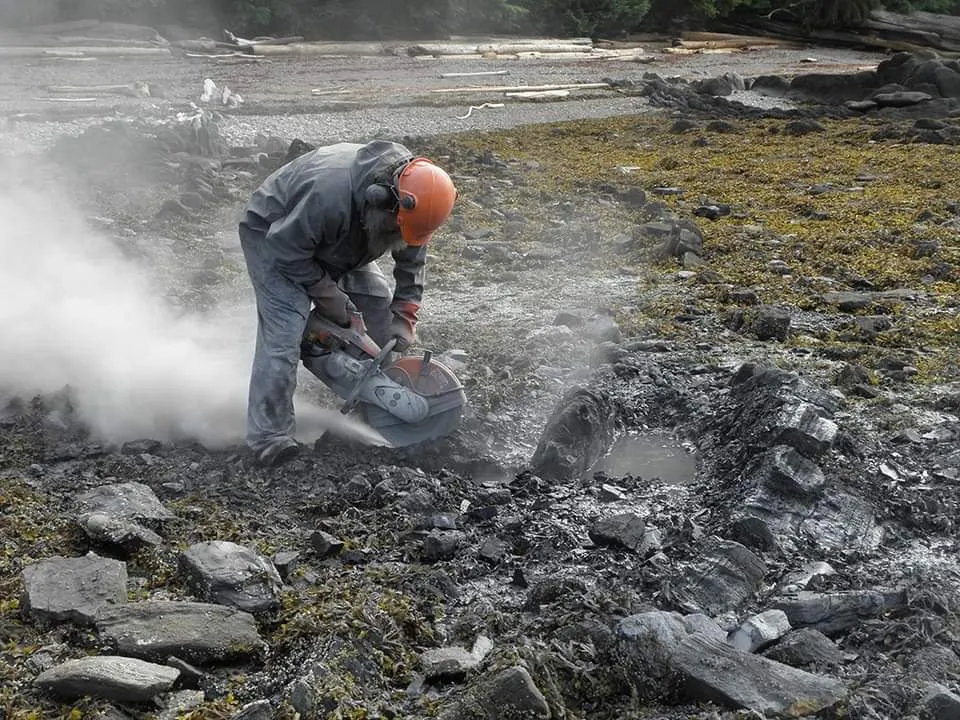
"Geologist Jim Baichtal" by National Forest Service / Wikimedia Commons
Geology is the scientific study of Earth's solid materials and the processes that shape our planet. Geologists investigate rocks, minerals, and landforms to understand how Earth has changed over billions of years and continues to change today. This field of science helps us learn about Earth's structure, composition, and the forces that create mountains, valleys, and other features we see on the surface.
At the heart of geology are rocks and minerals. Minerals are naturally occurring solid substances with a specific chemical composition and crystal structure. For example, quartz is a common mineral made of silicon and oxygen atoms arranged in a repeating pattern. Rocks are solid mixtures of one or more minerals. The granite countertop in a kitchen contains several minerals including quartz, feldspar, and mica. Geologists classify rocks into three main types based on how they form: igneous rocks form from cooled magma or lava, sedimentary rocks form from compressed sediment layers, and metamorphic rocks form when existing rocks change due to heat and pressure deep underground.
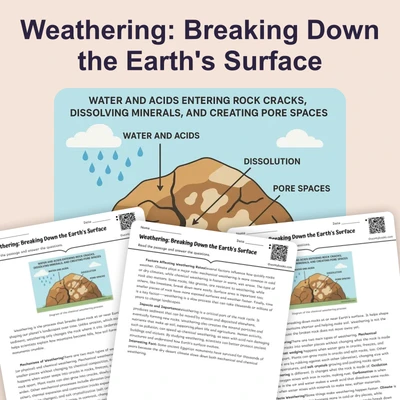
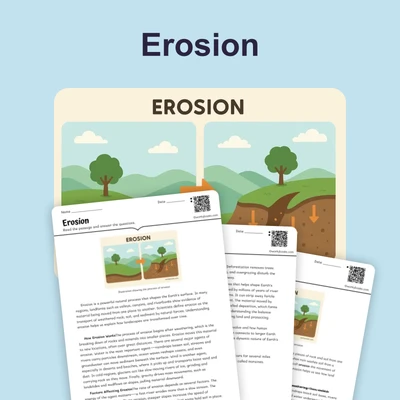
Geologists study the processes that create and modify Earth's landforms. Weathering breaks down rocks into smaller pieces through physical forces like freezing water or chemical reactions. Erosion moves these weathered materials from one place to another through wind, water, or ice. These processes work together over long time periods to carve valleys, form soil, and reshape coastlines. Plate tectonics, the movement of Earth's crustal plates, creates mountains, earthquakes, and volcanoes. Understanding these processes helps geologists predict natural hazards and locate valuable resources.
The work of geologists extends far beyond studying rocks in laboratories. They examine layers of rock called strata in cliffs and canyons to read Earth's history like pages in a book. Each layer tells a story about past environments, climates, and life forms. Geologists also help society by locating deposits of metals, fossil fuels, and groundwater. They assess risks from earthquakes and landslides, helping communities build safely. Environmental geologists study how human activities affect Earth's systems and work to protect natural resources for future generations.
Modern geology combines fieldwork with advanced technology. Geologists collect rock samples from mountains, ocean floors, and even other planets. They use tools like seismographs to detect earthquake waves traveling through Earth's interior, revealing information about layers we cannot see. Satellite imagery helps geologists map landforms and track changes over time. Computer models simulate geological processes that take millions of years to complete in nature. These tools allow scientists to test hypotheses about how Earth works and make predictions about future changes.
Geology connects to many other scientific fields. Chemistry helps explain how minerals form and rocks weather. Physics describes the forces that move tectonic plates and trigger earthquakes. Biology relies on geology to understand fossil records and how life evolved on Earth. Even astronomy connects to geology when scientists study rocks from meteorites or analyze data from Mars rovers. This interdisciplinary nature makes geology essential for understanding our planet as a complete system where all parts interact and influence each other.
Interesting Fact: The oldest known rocks on Earth are about 4 billion years old, found in northwestern Canada, but individual mineral grains called zircons from Western Australia date back 4.4 billion years—nearly as old as Earth itself!
What is geology?
The study of Earth's solid materials and processes that shape the planetThe study of weather patterns and climateThe study of living organisms and ecosystemsThe study of stars and planets in space
Which statement about minerals is true?
Minerals are mixtures of different rocksMinerals have a specific chemical composition and crystal structureMinerals can only be found in laboratoriesMinerals are always soft and easily broken
What does the term 'weathering' mean in geology?
The movement of rocks by wind and waterThe formation of new rocks from magmaThe breaking down of rocks into smaller piecesThe layering of sediments over time
How do sedimentary rocks form?
From cooled magma or lavaFrom compressed layers of sedimentFrom heat and pressure changing existing rocksFrom volcanic eruptions
Based on the passage, what can geologists learn by examining rock strata in cliffs and canyons?
The exact age of EarthInformation about past environments, climates, and life formsThe location of all earthquakesThe chemical composition of the atmosphere
Which tool do geologists use to detect earthquake waves traveling through Earth's interior?
MicroscopesTelescopesSeismographsThermometers
Why is geology considered an interdisciplinary science?
It only focuses on rocks and mineralsIt connects to chemistry, physics, biology, and astronomyIt requires expensive equipmentIt can only be studied in laboratories
What is the main difference between weathering and erosion?
Weathering breaks down rocks; erosion moves the broken materialsWeathering moves rocks; erosion breaks them downWeathering only happens in deserts; erosion happens everywhereThere is no difference between weathering and erosion
True or False: Metamorphic rocks form when existing rocks change due to heat and pressure.
TrueFalse
True or False: Geologists only work in laboratories and never collect samples from the field.
TrueFalse
Perfect For:
👩🏫 Teachers
• Reading comprehension practice
• Auto-graded assessments
• Literacy skill development
👨👩👧👦 Parents
• Reading practice at home
• Comprehension improvement
• Educational reading time
🏠 Homeschoolers
• Reading curriculum support
• Independent reading practice
• Progress monitoring
Reading Features:
📖
Reading Passage
Engaging fiction or nonfiction text
❓
Comprehension Quiz
Auto-graded questions
📊
Instant Feedback
Immediate results and scoring
📄
Printable Version
Download for offline reading
🔊
Read Aloud
Voice-over with word highlighting
Reviews & Ratings
No reviews yet. Be the first to share your experience!
Related Content
Frost Wedging: How Ice Splits Rock
This passage explains frost wedging as a mechanical weathering process. Aligned with NGSS MS-ESS2-1 (Earth’s systems) a...
MS-ESS2-1MS-ESS2-2RST.6-8.3
Limestone Caves: Nature’s Underground Wonders
This passage explains limestone cave formation through carbonation, aligned with NGSS MS-ESS2-1 (Earth’s systems) and L...
MS-ESS2-1LS2.CRST.6-8.7
Chemical Weathering: The Breakdown of Rocks Through Chemical Reactions
This passage explains chemical weathering processes, aligned with NGSS MS-ESS2-1 (Earth’s systems) and ESS2-2 (surface ...
MS-ESS2-1MS-ESS2-2RST.6-8.4
Talus Slopes: Formation and Features
This earth science passage explains talus slope formation through mechanical weathering processes, aligning with NGSS MS...
MS-ESS2-1MS-ESS2-2RST.6-8.4
Biological Weathering: Types and Examples
This passage details biological weathering processes, connecting to NGSS MS-ESS2-1 (Earth's systems) and LS2.B (ecosyste...
MS-ESS2-1MS-PS1-2RST.6-8.3
The Coldest City in the World: Yakutsk
This NGSS-aligned science passage introduces middle school readers to Yakutsk, the coldest city on Earth. Students will ...
MS-ESS2-1
Igneous Rocks
This comprehensive passage introduces middle school students to igneous rocks, focusing on how these rocks form from mol...
MS-ESS2-1MS-ESS3-1
Sedimentary Rocks
This comprehensive middle school science passage introduces students to sedimentary rocks, detailing their step-by-step ...
MS-ESS2-1MS-ESS2-3MS-ESS3-1
Metamorphic Rocks
This engaging middle school science passage introduces students to the fascinating world of metamorphic rocks. Aligned w...
MS-ESS2-1MS-ESS3-1
Scientific Inquiry in Earth Science
This passage explores scientific inquiry in Earth science for grades 6-8, aligned with NGSS standards MS-ESS1-4, MS-ESS2...
MS-ESS1-4MS-ESS2-1MS-ESS3-5SEP
Contour Lines and Elevation
This passage, designed for grades 6-8 and aligned with NGSS standards MS-ESS2-2 and MS-ESS2-1, introduces students to th...
MS-ESS2-2MS-ESS2-1SEP.4SEP.8
Weathering
This comprehensive science reading passage for grades 6-8 focuses on the concept of weathering, aligning with NGSS stand...
MS-ESS2-1
Erosion
This comprehensive middle school science passage explains erosion—the process that transports weathered rock and soil fr...
MS-ESS2-1
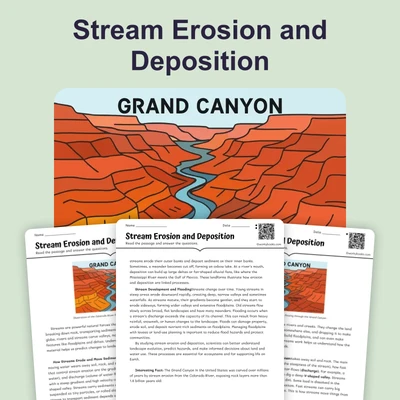
Stream Erosion and Deposition
This middle school science passage, aligned to NGSS MS-ESS2-1, introduces students to the dynamic processes of stream er...
MS-ESS2-1
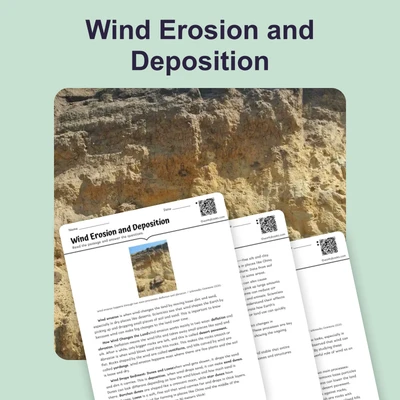
Wind Erosion and Deposition
This comprehensive science reading passage for grades 6-8 explores the processes of wind erosion and deposition, alignin...
MS-ESS2-1
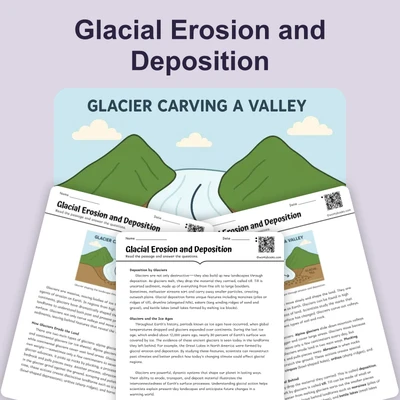
Glacial Erosion and Deposition
This middle school science passage explores glacial erosion and deposition, focusing on the mechanisms by which glaciers...
MS-ESS2-1
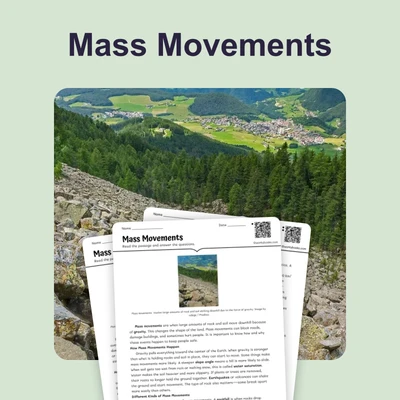
Mass Movements
This NGSS-aligned passage introduces middle school students to the science of mass movements—gravity-driven motions of r...
MS-ESS2-1MS-ESS3-2
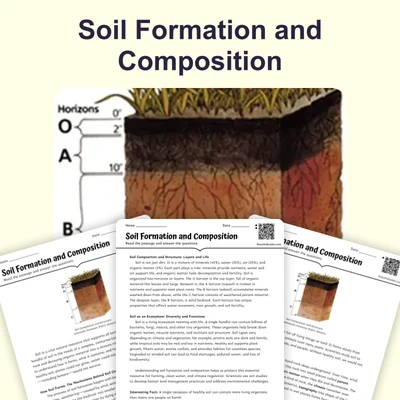
Soil Formation and Composition
This comprehensive middle school science passage explores soil formation and composition, perfectly aligned to NGSS stan...
MS-ESS2-1
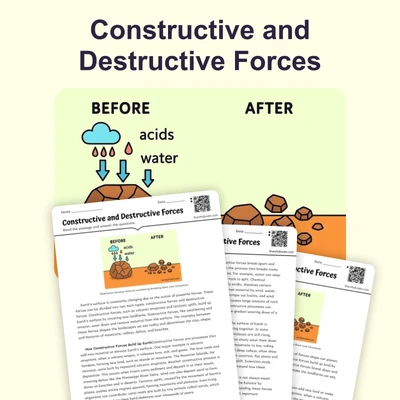
Constructive and Destructive Forces
This middle school science passage explores how Earth's surface is constantly shaped by the interplay of constructive an...
MS-ESS2-1
Mountains and Mountain Building
This NGSS-aligned passage for grades 6-8 covers the fascinating processes that create Earth's highest landforms—mountain...