What Is the Solar Wind
Interactive passage with audio narration, comprehension questions, and printable PDF.
By completing this purchase you agree to our Terms of Use and Privacy Policy. Your subscription renews automatically until you cancel. You can cancel anytime from your account settings. All sales are final and non-refundable. Digital content is available for download in your account immediately upon purchase.
What's included
What Is the Solar Wind preview and details
About this printable What Is the Solar Wind science reading passage, NGSS-aligned (Grades 5-8)
Sample passage and quiz from What Is the Solar Wind
Reading passage and comprehension quiz preview
What Is the Solar Wind
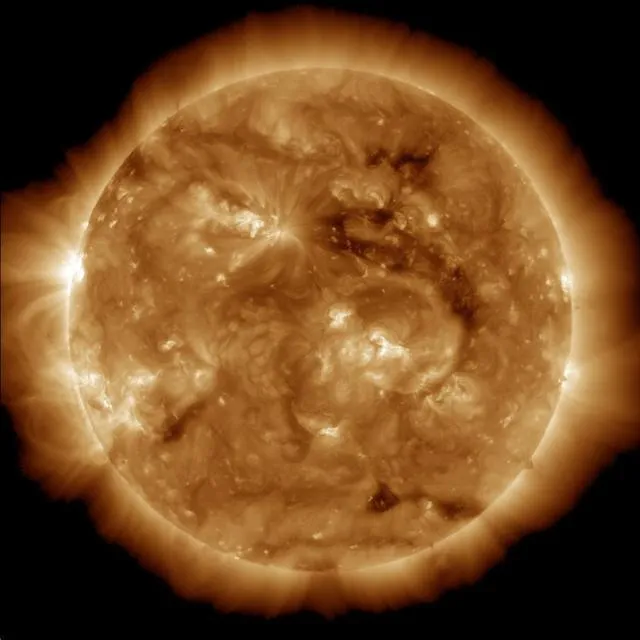
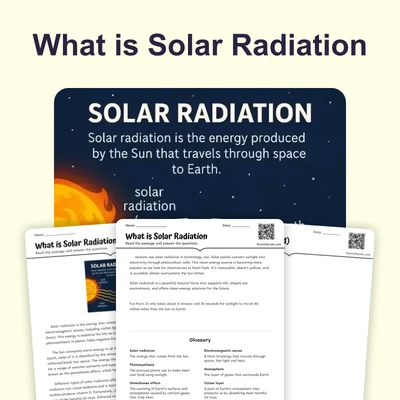
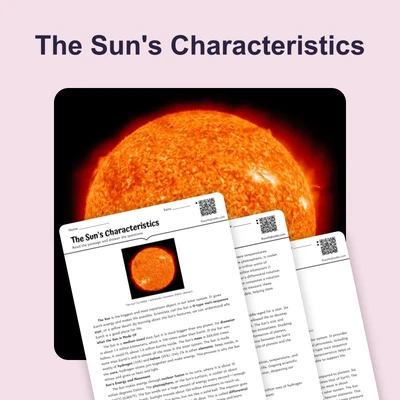
The dark region seen on the face of the sun at the end of March 2013 is a coronal hole just above and to the right of the middle of the picture, which is a source of fast solar wind leaving the sun in this image from NASA Solar Dynamic Observatory."Pulses from the Sun" / NASA (Public domain).
The Sun does more than provide light and warmth to Earth. It constantly releases a stream of tiny charged particles into space. Scientists call this invisible flow the solar wind. This stream of particles travels outward from the Sun in all directions. It moves at speeds between 250 and 500 miles per second. The solar wind reaches every planet in our solar system.
The solar wind consists mainly of electrons and protons. These charged particles come from the Sun's outer atmosphere, called the corona. The corona is extremely hot, reaching temperatures over one million degrees Celsius. At such high temperatures, particles move so fast they can escape the Sun's gravity. Once free, they speed through space as the solar wind. Evidence shows that the solar wind is not steady. It can vary in speed and density depending on solar activity.
When the solar wind reaches Earth, our planet's magnetic field acts like a protective shield. This invisible field surrounds Earth and extends far into space. Scientists call this protective region the magnetosphere. The magnetosphere deflects most solar wind particles around our planet. Without this protection, the solar wind could strip away Earth's atmosphere over time. This would make life as we know it impossible.
However, some solar wind particles do enter Earth's atmosphere near the North and South Poles. When these charged particles collide with gases in our atmosphere, they create glowing lights called auroras. In the Northern Hemisphere, scientists observe these displays as the aurora borealis. In the Southern Hemisphere, they appear as the aurora australis. The colors depend on which atmospheric gases the particles strike. Oxygen produces green and red light, while nitrogen creates blue and purple hues.
The solar wind also affects other objects in space. When comets approach the Sun, the solar wind pushes on the gas and dust they release. This creates the comet's distinctive tail, which always points away from the Sun. Scientists study the solar wind to better understand space weather. Strong bursts of solar wind can interfere with satellites, power grids, and communication systems on Earth. Understanding the solar wind helps us protect our technology and predict these events.
Interesting Fact: The solar wind travels so fast that it reaches Earth in just three to four days, covering the 93-million-mile distance between the Sun and our planet.
Comprehension quiz (10 questions)
1. What is the solar wind?
2. How fast does the solar wind travel?
3. What does Earth's magnetosphere do?
4. In the passage, the word 'corona' refers to:
5. What does 'deflects' mean in the context of this passage?
6. Why do auroras appear near Earth's North and South Poles?
7. Based on the passage, what can we infer about planets without magnetic fields?
8. If a comet is traveling through space, in which direction would its tail point?
9. The solar wind is completely steady and never changes speed or density.
10. Scientists study the solar wind only to understand auroras.
Perfect for the way you teach
- Build comprehension skills
- Auto-graded quiz
- Differentiated reading
- Read together at home
- Improve fluency
- Quiet reading time
- Reading curriculum support
- Independent practice
- Track Lexile growth