Why Do Planets Appear to Move
Interactive passage with audio narration, comprehension questions, and printable PDF.
By completing this purchase you agree to our Terms of Use and Privacy Policy. Your subscription renews automatically until you cancel. You can cancel anytime from your account settings. All sales are final and non-refundable. Digital content is available for download in your account immediately upon purchase.
What's included
Why Do Planets Appear to Move preview and details
About this printable Why Do Planets Appear to Move science reading passage, NGSS-aligned (Grades 5-8)
Sample passage and quiz from Why Do Planets Appear to Move
Reading passage and comprehension quiz preview
Why Do Planets Appear to Move
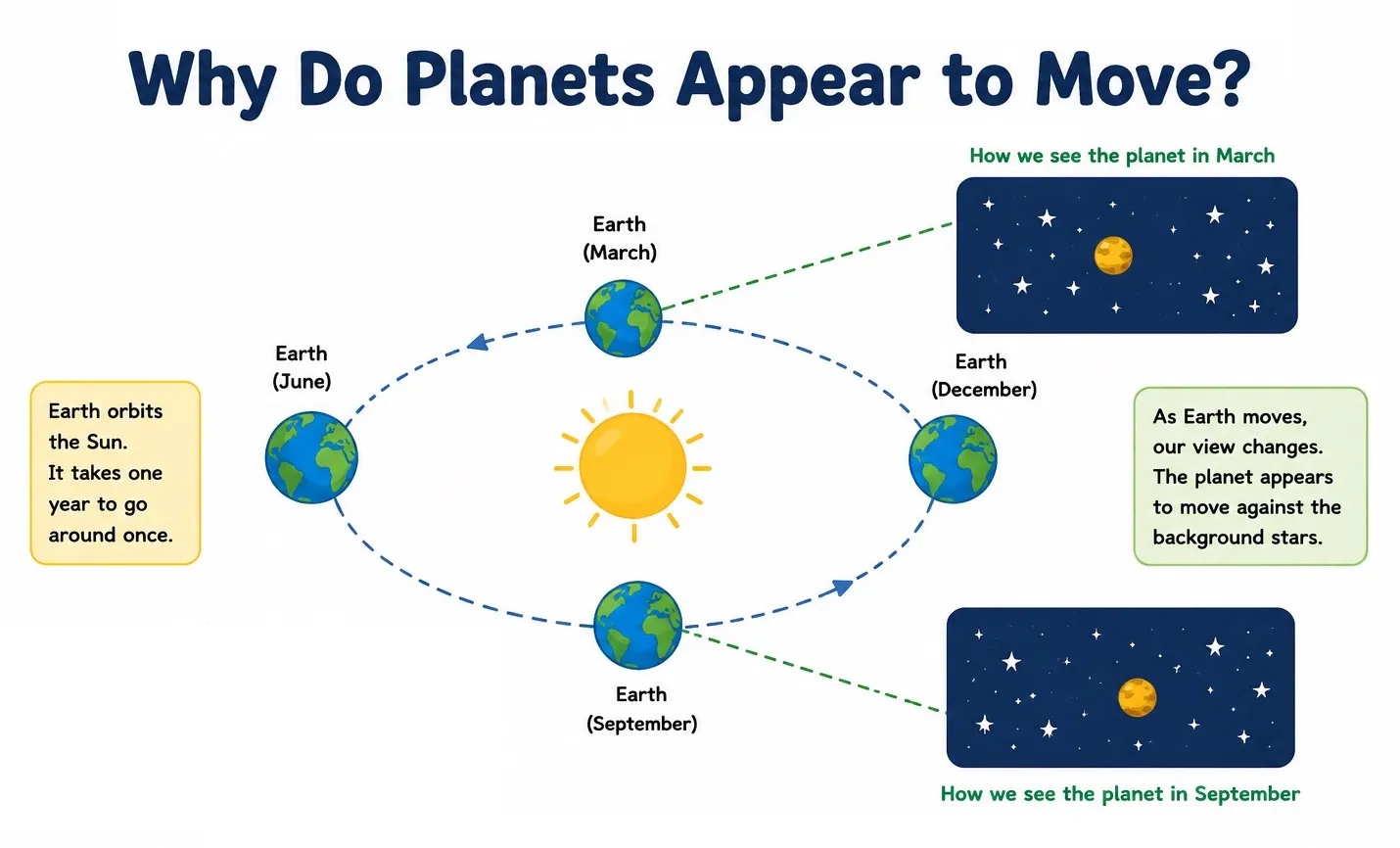
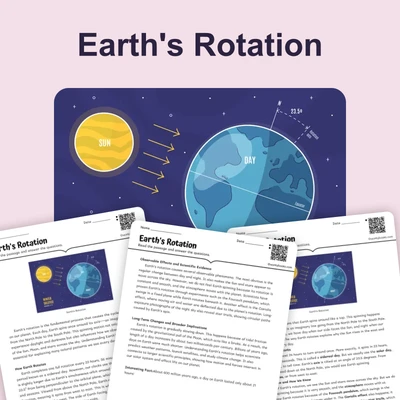
When you look at the night sky, planets appear to move slowly against the background of distant stars. This movement happens because planets, including Earth, orbit the Sun at different speeds. Scientists observe that planets closer to the Sun travel faster than those farther away. Earth completes its orbit in one year, while Mars takes nearly two years.
The apparent motion of planets is not always straightforward. Sometimes a planet seems to stop and move backward across the sky. Scientists call this backward movement retrograde motion. Evidence shows that retrograde motion is an illusion caused by Earth's movement. The planet does not actually reverse direction in its orbit. Instead, Earth catches up to and passes slower outer planets like Mars or Jupiter.
Think of two cars traveling on a highway in the same direction. The faster car approaches the slower car from behind. As the faster car passes, the slower car appears to move backward from the perspective of passengers in the faster vehicle. This comparison helps explain planetary retrograde motion. Earth acts like the faster car, while outer planets act like slower vehicles. When Earth overtakes an outer planet, that planet appears to move backward against the stars.
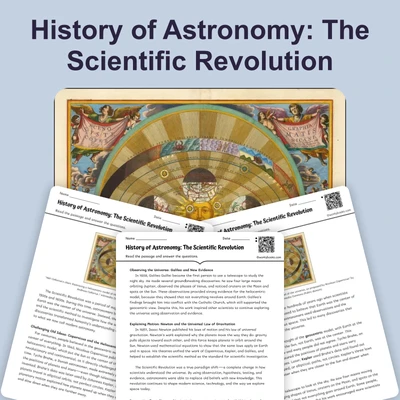
In 1609, astronomer Galileo Galilei used a telescope to observe Jupiter and its moons. His observations provided evidence that objects can orbit bodies other than Earth. This discovery supported the idea that planets orbit the Sun. Modern astronomers use this understanding to predict when retrograde motion will occur. They can calculate the positions of planets years in advance.
Understanding planetary motion matters because it reveals how our solar system works. The relative motion of Earth and other planets creates patterns we can observe and predict. Ancient astronomers struggled to explain retrograde motion because they believed Earth was the center of everything. Today, scientists explain these patterns using evidence about orbital speed and position. This knowledge helps us navigate spacecraft and understand our place in space.
Interesting Fact: Mars appears to move backward in retrograde motion for about two months every 26 months. During this time, Mars can appear brighter because Earth and Mars are closer together in their orbits.
Comprehension quiz (10 questions)
1. Why do planets appear to move against the background of stars?
2. What is retrograde motion?
3. What does the word 'orbit' mean in this passage?
4. According to the passage, what does 'apparent motion' describe?
5. Why does Earth overtake outer planets like Mars?
6. If you were on a faster car passing a slower car on the highway, what would the slower car appear to do?
7. What evidence did Galileo's observations of Jupiter provide?
8. How can modern astronomers predict planetary positions?
9. True or False: During retrograde motion, a planet actually reverses direction in its orbit.
10. True or False: Planets closer to the Sun travel faster than planets farther from the Sun.
Perfect for the way you teach
- Build comprehension skills
- Auto-graded quiz
- Differentiated reading
- Read together at home
- Improve fluency
- Quiet reading time
- Reading curriculum support
- Independent practice
- Track Lexile growth